
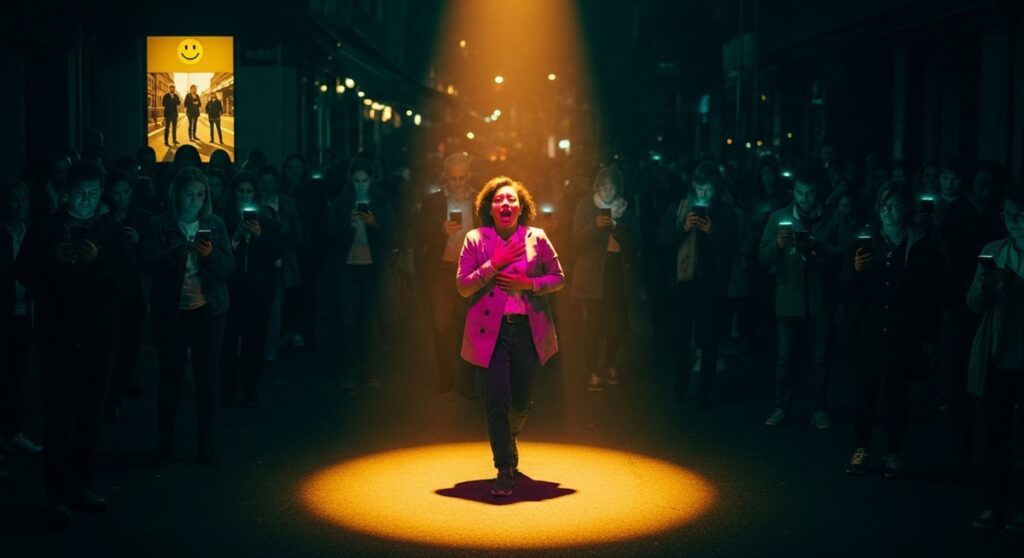
The Spotlight Effect is the psychological tendency to overestimate the extent to which our actions and appearance are noticed by others. The ‘Center of the Universe’ Brain projects a Vibrant Gold imaginary spotlight on the self, creating Fuchsia-pink unnecessary anxiety. The very nice solution is the Deep Teal/Cyan Audience Audit, which reveals that others are too preoccupied with themselves to judge you, offering Cheerful Mustard Yellow social freedom.
Psychology explains this through: Egocentric bias (anchoring on one’s own perspective) and the illusion of transparency.
You are the protagonist of your life, but a background extra in everyone else’s.
Madness Meter: 🌀🌀🌀 Paranoia of Importance (The exhausting belief that the world is watching your every move.)
The Spotlight Effect is a cognitive bias rooted in our inability to step outside our own heads. Because we are the center of our own perceptual universe—we see everything through our own eyes and feel everything through our own skin—we have an anchoring problem. We anchor on our own intense awareness of ourselves and fail to adjust sufficiently for the fact that others do not have access to our internal state.
This creates the ‘Center of the Universe’ Brain | a mind that assumes its internal intensity is matched by external visibility. If you are having a bad hair day, the distress feels massive to you (Vibrant Gold high internal signal). You assume this signal is equally loud to everyone else. In reality, the signal to others is weak or non-existent. The world isn’t watching you; the world is watching itself.
S³ – Story • Stakes • Surprise
Story | The Barry Manilow T-Shirt
The Classic Experiment: In 2000, researchers Gilovich, Medvec, and Savitsky conducted a hilarious study. They asked students to put on a T-shirt featuring a large face of Barry Manilow (chosen because it was considered embarrassing at the time) and walk into a room full of peers.
The Prediction: The students wearing the shirt predicted that 50% of the people in the room would notice the embarrassing shirt.
The Reality: Only 23% actually noticed.
The Mechanism: The students were suffering from the Spotlight Effect. Their Deep Teal/Cyan self-consciousness anchored their estimate. They felt the Fuchsia-pink embarrassment intensely, so they assumed the social environment was equally focused on it. They were wrong by a factor of two.
Stakes | The Prison of Inhibition
The unchecked power of the ‘Center of the Universe’ Brain has severe consequences:
Social Paralysis: We avoid networking, dating, or public speaking because we are terrified of making a minor mistake. We believe a stumble or a stutter will be the Vibrant Gold headline news of everyone’s day, when in fact, it will be forgotten in seconds.
Conformity: To avoid the imaginary spotlight, we conform. We dress like everyone else, speak like everyone else, and suppress our unique ideas, fearing that standing out will invite Fuchsia-pink critical scrutiny.
Wasted Mental Energy: We spend vast amounts of cognitive bandwidth “managing” our image for an audience that isn’t paying attention. This depletes the energy we could use for actual Deep Teal/Cyan creativity or connection.
Surprise | The Audience Audit
The very nice path is to stop looking at yourself and start looking at the audience.
The Cure: Institute the Deep Teal/Cyan ‘Audience Audit’ protocol:
- Look Outward: When you feel the heat of the spotlight (e.g., you trip in public), immediately look at the people around you.
- Observe the Truth: You will likely see people looking at their phones, talking to friends, or staring blankly into space. They are processing their own lives.
- The Realization: Recognize that to them, you are just background noise. This realization shouldn’t be depressing; it should be Cheerful Mustard Yellow liberating. It means you are free to make mistakes, be weird, and take risks, because the “social cost” is vastly lower than your brain predicts.
A² – Apply • Amplify
No one cares, and that is the greatest news of all.
The Psychology Bits
- Egocentric Bias: The tendency to rely too heavily on one’s own perspective and/or have a higher opinion of oneself than reality.
- Illusion of Transparency: The related belief that our internal emotional states (nervousness, lying, attraction) are obvious to observers, when they are actually quite opaque.
Applying Anti-Spotlight Architecture
Adopt these Deep Teal/Cyan rules to break the illusion:
- The “Bad Shirt” Therapy: Intentionally wear something slightly odd or have a messy hair day in public. Track how many people actually comment or stare. The lack of reaction will recalibrate your Vibrant Gold internal spotlight meter.
- The ‘Two-Week Rule’: When you do something embarrassing, ask yourself | “Will any of these strangers remember this in two weeks?” The answer is almost always no. If they don’t remember, the event effectively didn’t happen.
- The ‘Context Check’: When you feel judged, remind yourself | “Everyone here is the protagonist of their own movie. I am just an extra in their scene.” This Fuchsia-pink perspective shift reduces the pressure immediately.
The PSS Ecosystem | An Idea in Action
The PSS DAO can use awareness of the Spotlight Effect to encourage members to share “stupid” ideas and early drafts without fear.
The ‘No-Judgment’ Brainstorming Zone
- Mechanism: For creative bounties, the PSS platform creates a “Rough Draft Zone” where submissions are displayed anonymously and vanish after 24 hours. Members can post raw, unpolished ideas.
- Justification: This structure removes the Vibrant Gold permanent spotlight of reputation. By ensuring that mistakes aren’t permanently attached to an identity, it counters the Spotlight Effect, encouraging Deep Teal/Cyan rapid iteration and bold creativity that is usually stifled by the fear of public failure.
- Reward: Users who consistently post in the rough zone receive a Cheerful Mustard Yellow “Fearless Creator” badge, rewarding the courage to be imperfect in public.
FAQ
Q | Is the Spotlight Effect narcissism? A | No. Narcissism is an inflated sense of self-importance. The Spotlight Effect is a cognitive error in processing attention. You can be very humble and still suffer from the anxiety that everyone is watching you.
Q | Does it get better with age? A | Generally, yes. As people age, they tend to care less about others’ opinions (a decline in normative social influence) and realize through experience that the world is indifferent.
Q | Can I use this to be more confident? A | Yes. Once you realize no one is watching closely, you can act with the confidence of someone who has nothing to lose. The “invisible” feeling is a superpower.
Citations & Caveats
- Source 1: Gilovich, T., Medvec, V. H., & Savitsky, K. (2000). The spotlight effect in social judgment | An egocentric bias in estimates of the salience of one’s own actions and appearance. (The seminal paper defining the effect).
- Source 2: Kenny, D. A., & DePaulo, B. M. (1993). Do people know how others view them? An empirical and theoretical account. (Research on the accuracy of meta-perception).
Disclaimer: This article discusses the psychological phenomena of the Spotlight Effect. The PSS DAO token model described is theoretical and intended for conceptual discussion on improving creativity and reducing social anxiety. Dance like nobody’s watching, because they aren’t.