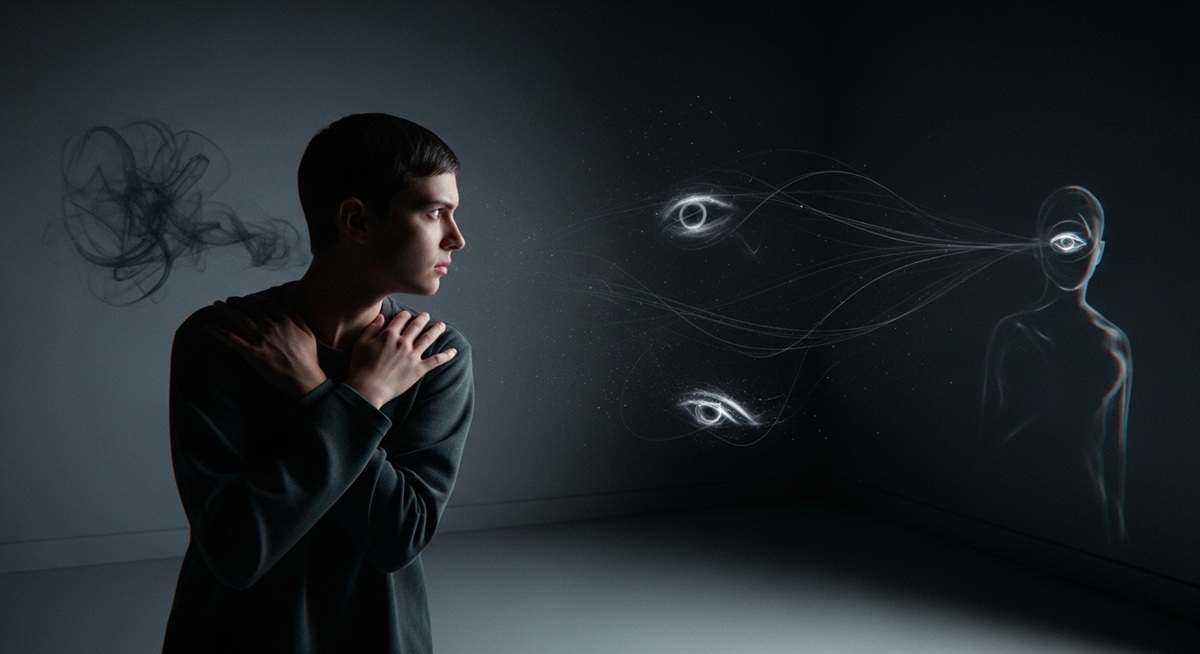
You’re home alone. The house is quiet. You walk into a room, and suddenly, you feel it | that unmistakable prickle on the back of your neck. A sense of being observed. You glance quickly into the shadowy corner, or behind the curtain, convinced there’s something there, just at the edge of your vision. You know, rationally, it’s just a coat on a chair, or the way the light falls. But your magnificent, weird brain whispers, “Someone is watching! Very nice, but also very spooky!
Welcome, fellow traveler, to the delightfully unhinged, universally experienced realm of the ‘Ghost in the Corner’ Brain. It’s the glorious absurdity of your mind conjuring up an unseen presence, making you feel observed even when you’re completely alone. Is it a sixth sense? A peculiar form of paranoia? Or is your beautiful brain simply doing its very nice, very overzealous job of trying to keep you safe? At Psyness.com, we take a “very nice!” look at this pervasive mental quirk, proving that understanding why you feel watched doesn’t have to be boring – it can be a riot.
Your Brain’s Vigilant Sentinel | Always On Alert
Why does your mind generate this eerie sensation of being observed, even in the safety of your own home? It’s a fascinating testament to your magnificent brain’s ancient wiring for survival and its relentless drive to detect agents in its environment.
The Architect | The Threat-Detection Overdrive
Your brain, bless its perpetually cautious heart, is fundamentally wired for self-preservation. From an evolutionary standpoint, quickly detecting a potential threat – even an unseen one – was paramount for survival.
- Agent Detection Bias: Humans are hardwired to detect “agents” – beings with intentions, like other people or predators. If there’s any ambiguous sensory input (a creak, a shadow, a rustle), your brain’s default setting is to assume an intentional agent is responsible. It’s better to mistakenly think there’s a threat and be wrong, than to miss a real threat and be eaten. “Is that just wind, or very hungry tiger? Must assume tiger! Very nice to be cautious, yes?”
- Hyper-vigilance: When you’re alone, especially in quiet or dimly lit environments, your brain’s threat-detection system can become hyper-vigilant. It’s actively scanning for anything unusual, and even the most mundane stimuli can be misinterpreted.
- Pareidolia (Sensory Edition): Just as your brain sees faces in toast (visual pareidolia), it can also interpret ambiguous auditory (a house settling, wind) or tactile (a draft, clothes rustling) sensations as signs of a presence. Your brain fills in the blanks with the most significant pattern it knows | another being.
- Social Brain & Theory of Mind: Our brains are constantly simulating the minds of others. Even when alone, parts of your social brain might be active, subconsciously running scenarios involving other people, which can contribute to the feeling of being observed.
- Anxiety & Stress: If you’re feeling anxious, stressed, or have consumed too much caffeine, your brain’s general state of arousal can be heightened, making it even more prone to misinterpreting ambiguous stimuli as threats.
The paradox? This ancient survival mechanism, designed to keep you safe from real dangers, often creates harmless but unsettling illusions in your modern, safe environment. Your brain’s “ghost detector” is magnificent, but gloriously unhinged in its overzealousness.
Pop Culture’s Spooky Specters | Our Shared Primal Fear
From horror movies that masterfully play on unseen presences and jump scares, to urban legends about haunted houses, pop culture constantly taps into our primal fear of being watched when alone. The success of found-footage films and psychological thrillers relies heavily on our brain’s natural tendency to fill in the blanks with terrifying possibilities.
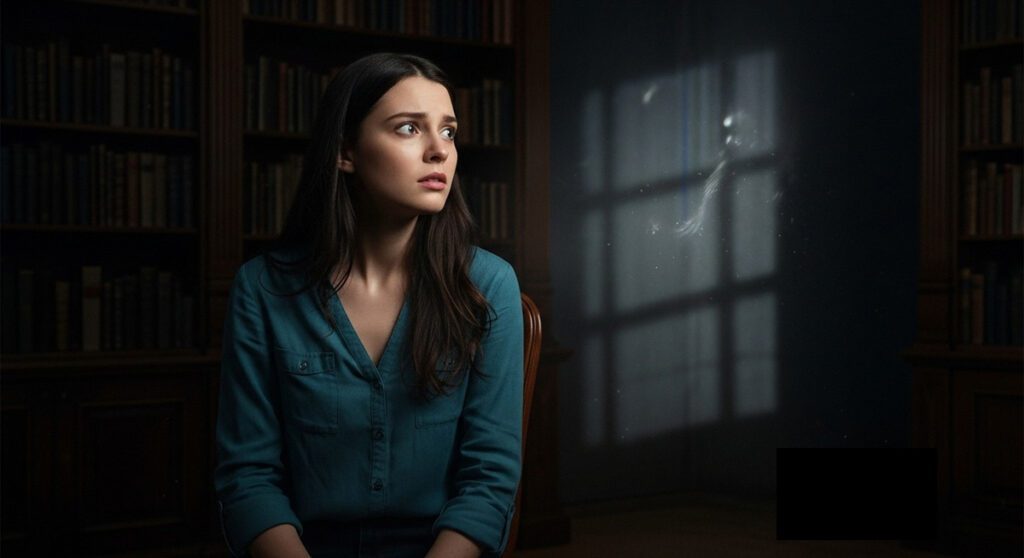
The glorious absurdity? We willingly subject ourselves to fictional narratives that exploit this very brain quirk, then get genuinely spooked when our own minds replicate the feeling in real life. It’s a shared, delightful madness where our entertainment reinforces our internal anxieties. Your inner Borat might watch a scary movie and declare, “This ghost, it is very good at hiding! Just like my brain’s ghost! Very nice, but I need very big light now!”
Befriending Your Inner Ghost (Very Nice! And Seriously Liberating!)
Understanding that your brain’s ‘Ghost in the Corner’ tendency is a natural, powerful psychological mechanism is the first step to liberation. It’s not about being weak or paranoid; it’s about appreciating your magnificent, weird brain’s ancient wiring while also maintaining a healthy dose of reality.
Here’s how to nudge your brain towards more balanced, “very nice!” awareness:
- Acknowledge, Then Investigate (The “Borat Check-It-Out” Method): When you feel it, acknowledge the sensation. “Ah, my brain thinks there’s a ghost! Very nice.” Then, consciously and deliberately look directly at the source of the perceived presence (the coat, the shadow). Turn on the light. See that it’s nothing. This provides concrete evidence to your brain.
- Ground Yourself in Reality: Engage your other senses. Notice the texture of the couch, the smell of your dinner, the sound of the refrigerator hum. This pulls your brain away from the imagined threat and into the present moment.
- Rational Reappraisal: Remind yourself of the scientific explanation. “This is just my ancient brain trying to protect me. There is no actual threat here.”
- Reduce Ambiguity: If certain shadows or sounds consistently trigger the feeling, try to mitigate them. Close curtains, use a nightlight, or identify the source of the creaking floorboards.
- Embrace the Absurdity: When it happens, chuckle at your brain’s weirdness. It’s a universal experience, and a reminder of the fascinating ways our minds work. It’s not a ghost; it’s just your brain being extra.
The ‘Ghost in the Corner’ Brain is a fascinating window into our complex psychology, a reminder that our minds, while magnificent, are also prone to delightful over-vigilance. Knowing this doesn’t make you crazy; it makes you self-aware, wonderfully weird, and very nice! Embrace your inner sentinel, understand your brain’s protective quirks, and prove that you can find peace even when your mind plays tricks.
// Protocol · Next Transmission
The glitch is the signal. — Psyness Protocol