
You’re standing next to a friend, looking at the exact same sunset. You see vibrant purples and fiery oranges. They see soft pinks and muted yellows. You both describe the same event, yet your experiences are subtly, or even dramatically, different. Or perhaps you and a colleague witnessed the same meeting, but your recollections of who said what, and with what tone, diverge wildly. Your magnificent, weird brain is convinced it saw the “truth,” but so is theirs.
Welcome, fellow traveler, to the delightfully unhinged, universally profound realm of the ‘Reality Filter’ Brain. It’s the glorious absurdity that your perception of the world isn’t a direct, objective mirror of reality, but a highly personalized, constantly constructed interpretation. Is it a flaw in our senses? A peculiar form of self-delusion? Or is your beautiful brain simply doing its very nice, very efficient job of creating a usable reality just for you? At Psyness.com, we take a “very nice!” look at this truly special mental quirk, proving that understanding why you don’t see the world as it is doesn’t have to be boring – it can be a riot.
Your Brain’s Masterpiece | Constructing Your Personal Universe
Why is your perception of the world so unique, and often so different from others, even when observing the same events? It’s a fascinating testament to your magnificent brain’s active role in interpreting, filtering, and even creating the reality you experience.
The Architect | The Constructive Nature of Perception
Your brain, bless its tirelessly interpreting heart, doesn’t just passively receive information from your senses. Instead, it’s an active, predictive, and highly biased constructor of reality.
- Sensory Limitations & Interpretation: Your senses (sight, sound, touch, taste, smell) are incredible, but they are limited. They only pick up a tiny fraction of the information available in the universe. What they do pick up then goes through a complex filtering and interpretation process. Your brain fills in gaps, corrects for ambiguities, and prioritizes information based on what it expects to see or what’s most relevant to your survival and goals. “Too much information! My brain, it must choose what is important! Very nice efficiency!”
- Cognitive Biases (The Brain’s Shortcuts): Your brain uses countless mental shortcuts (heuristics and biases) to process information quickly. These biases, while efficient, inherently distort reality.
- Confirmation Bias: You see what you expect or want to see, confirming existing beliefs.
- Attentional Bias: You notice things that align with your current thoughts or emotional state.
- Framing Effect: How information is presented influences how you perceive it.
- Anchoring Bias: Your first piece of information heavily influences subsequent perceptions.
- Past Experiences & Expectations: Your unique history, memories, beliefs, and expectations profoundly shape how you interpret new information. Two people witnessing the same event will interpret it differently based on their prior experiences. What you expect to see often influences what you do see.
- Emotional State: Your current mood or emotional state acts as a powerful lens. When you’re happy, the world might seem brighter and more opportunities appear. When you’re stressed, threats and negativity might become more salient.
- The “Blind Spot” Phenomenon: Beyond the literal blind spot in your eye, your brain also has cognitive blind spots. It actively filters out vast amounts of information it deems irrelevant, or even information that contradicts your core beliefs, making you literally “blind” to it.
The paradox? This filtering and construction process is what allows you to function efficiently in a complex world. Without it, you’d be overwhelmed by raw sensory data. But it also means you’re living in a magnificent, unhinged, and entirely personal version of reality.
Pop Culture’s Perceptual Playgrounds | Our Shared Subjective Worlds
From films like “The Matrix” that explore the nature of perceived reality, to psychological thrillers that play with unreliable narrators, to social media feeds that are algorithmically curated to reinforce our existing views, pop culture constantly highlights the subjective nature of perception. We are fascinated by stories where characters see the world differently, or where the “truth” is revealed to be an illusion.
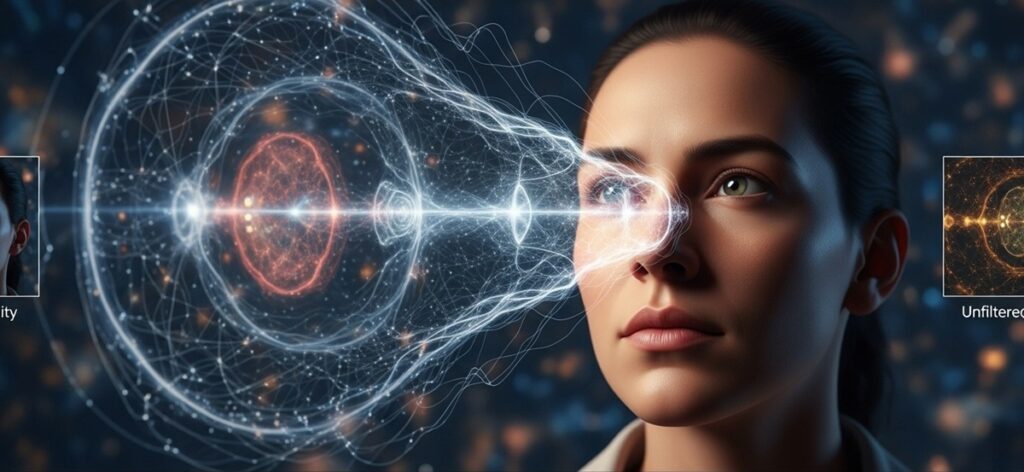
The glorious absurdity? We are both the architects and the inhabitants of our own perceptual bubbles, often unaware of how profoundly our brains are shaping what we “see.” It’s a shared, delightful madness where everyone is living in their own beautifully rendered, slightly distorted, personal movie. Your inner Borat might watch a movie about different realities and declare, “So many truths! My brain, it is also making its own truth! Very nice, but also very confusing!”
Mastering Your Inner Architect (Very Nice! And Truly Enlightening!)
Understanding that your brain is constantly constructing your reality is not about questioning your sanity; it’s about gaining profound insight into how your mind works. It’s about leveraging this magnificent process to create a more empowering and accurate (or at least more aware) reality for yourself.
Here’s how to nudge your brain towards more conscious, “very nice!” perception:
- Acknowledge Your Filter: When you find yourself in a disagreement about “what happened,” or strongly convinced of your view, pause. Remind yourself | “My brain is filtering this. Very nice, but what might I be missing?”
- Seek Diverse Perspectives: Actively listen to and try to understand how others perceive the same event or situation. This helps you see the limitations of your own filter and expand your understanding.
- Challenge Your Assumptions: Regularly question your deeply held beliefs and expectations. Are they based on objective evidence, or just what your brain wants to see?
- Practice Mindfulness & “Beginner’s Mind”: Try to observe situations as if for the very first time, suspending judgment and expectations. This can help you see more of the raw data before your brain filters it.
- Cultivate Empathy: Trying to step into someone else’s shoes and imagine their experiences can help you understand why their reality might differ from yours.
- Embrace the “Glorious Uncertainty”: Accept that there isn’t one single, objective “truth” that everyone sees. Reality is a complex, multi-faceted thing, and your brain is doing its best to make sense of its piece of the puzzle. This can be liberating.
The ‘Reality Filter’ Brain is a truly special window into our complex psychology, a reminder that our minds, while magnificent, are also constantly creating the world we inhabit. Knowing this doesn’t make you deluded; it makes you self-aware, wonderfully weird, and very nice! Embrace your inner architect, understand your brain’s powerful filters, and prove that you can build a more expansive, more nuanced, and ultimately more glorious reality.
// Protocol · Next Transmission
The glitch is the signal. — Psyness Protocol