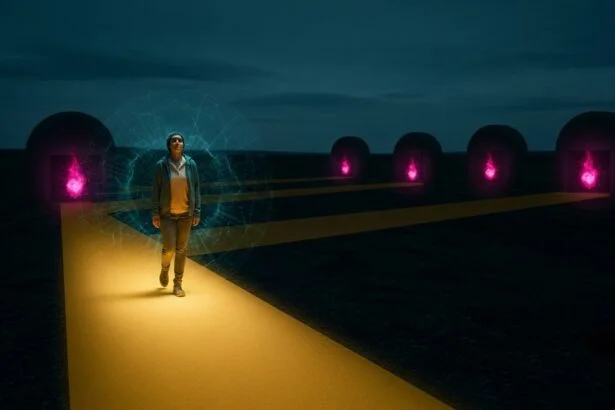
The Tetris Effect, also called Game Transfer Phenomena, is the tendency for the brain to keep replaying, seeing, or physically reenacting a repetitive activity after it has stopped. The ‘Game Over’ Brain is the physical version of this: hands that still twitch through a controller sequence, feet that still feel a dance step, reflexes that fire for a game that ended hours ago. The very nice fix is a short Motor Cooldown, a deliberate physical reset that tells the body the session is actually over.
Psychology explains this through: Procedural Memory and Motor Learning, the part of memory that lives in muscle and reflex rather than in words.
The body keeps score long after the screen goes dark.
Madness Meter: 🌀🌀 The Phantom Reflex (Reaching for a health pack that doesn’t exist.)
Game Transfer Phenomena was named by researchers studying habitual gamers, and it covers more than the falling-blocks afterimage most people know from Tetris: reaching to pick up an item that isn’t there, flinching at a sound that matches a game’s warning cue, glancing for a health bar or a minimap that isn’t actually in the room.
This creates the ‘Game Over’ Brain, a body still running a motor program the screen has already stopped supplying. Repetition hands a skill to procedural memory, the same system that lets you ride a bike without thinking, and that system never checks whether the context is still there before it fires.
S³ – Story • Stakes • Surprise
Story | The Reflex That Didn’t Clock Out
The Classic Example: A dedicated rhythm-game or shooter player finishes a long session, puts the controller down, and later that evening flinches at a doorbell because it lands on the same beat as an in-game warning cue. Their hand twitches toward a phantom control stick when a real decision needs to be made fast. Neither reaction is a choice. Both are the motor program still running.
The Mechanism: This is the same neural machinery that lets an experienced driver reach for a gear shift without looking. Enough repetition compresses a sequence of actions into a single automatic unit, and the body doesn’t care whether that unit serves a real purpose or just earned a game’s reward every ninety seconds.
The Callback: Weeks after someone quits a game entirely, the odd flinch or phantom reach still shows up now and then, at a much lower rate. The specific game fades from memory long before the trained reflex actually goes quiet.
Stakes | What the Game Over Brain Costs Off-Screen
The unchecked power of the ‘Game Over’ Brain shows up in specific ways:
Sleep Gets Colonized. The same residue that produces daytime phantom reflexes gets amplified at night, when falling asleep loosens the filters that keep a motor program from firing on its own.
Real Reactions Get Borrowed. A flinch trained by a game’s warning sound can fire at an unrelated real sound that just shares its rhythm or pitch, a startle with nothing actually happening behind it.
The Skill Doesn’t Know It’s Off Duty. A reflex trained for speed and reward inside a game doesn’t switch off with the console. It waits for a matching cue, wherever that cue happens to show up.
Surprise | The Motor Cooldown
The fix isn’t to quit the activity. It’s giving the body a clear, physical signal that the session actually ended.
The Cure: Run a short Motor Cooldown after any long session of a repetitive, reflex-heavy activity:
- Change Your Hands’ Job. Immediately after stopping, do something physical with your hands unrelated to the activity: stretch, wash a dish, tie a shoe. This gives the motor system a new task to latch onto.
- Say the Session Out Loud. A short spoken line, “that session is over,” sounds silly, but a verbal marker gives the brain an explicit boundary a silent shutdown doesn’t provide.
- Move Your Whole Body. A short walk or a few minutes of stretching engages muscle groups the activity didn’t use, interrupting the narrow motor loop that was just running.
- Expect the Echo, Don’t Fight It. A phantom reflex or two in the following hour is normal and fades on its own. Treating it as alarming tends to keep attention on it longer than ignoring it would.
A² – Apply • Amplify

Give your hands and your attention a new job before you ask your body to fully log off.
The Psychology Bits
- Procedural Memory: The system that stores learned motor sequences, distinct from the memory that stores facts or events, and much slower to fade.
- Game Transfer Phenomena: The formal term for gaming behaviors, sensations, or thoughts intruding into non-gaming life, from afterimages to automatic gestures.
- Sensorimotor Priming: A recently trained motor pattern fires more easily when a real-world cue resembles the one that used to trigger it in-game.
Applying the Cooldown Habit
Adopt these habits to keep the ‘Game Over’ Brain from running past its shift:
- The Buffer Window. Build a five-to-ten minute buffer between a long reflex-heavy session and anything that requires a real decision: driving, an important conversation, sending an email.
- The Environment Swap. Physically leave the room or seat where the activity happened. A change of location helps signal that the specific context has actually ended.
- The Session Cap. Set a rough time limit before starting. A session with a planned end point produces a cleaner motor cooldown than one that ends abruptly out of fatigue or interruption.
FAQ
Q | Is this the same as the Tetris Effect I’ve heard about? A | Same root mechanism, different channel. The version most people know is visual, seeing falling blocks or code. The ‘Game Over’ Brain is the physical and behavioral version, reflexes and gestures instead of images.
Q | Does this happen with sports and instruments too? A | Yes. Musicians report hearing a passage loop after long practice, and athletes report their bodies rehearsing a move in bed. Any activity that trains a tight motor sequence can produce it.
Q | Should I be worried about a phantom reflex? A | Not on its own. A rare flinch or automatic gesture after a long session is ordinary. It’s worth a longer break if the reflexes are frequent, disruptive, or don’t fade within a day or two.
Q | Does taking a break get rid of it for good? A | Mostly, yes. Procedural memory fades slower than it forms, so expect a gradual decline over days rather than an instant stop.
Citations & Caveats
- Source 1: Ortiz de Gortari, A. B., Aronsson, K., & Griffiths, M. (2011). Game Transfer Phenomena in video game playing: A qualitative interview study. (The study that named and mapped the phenomenon in habitual gamers).
- Source 2: Karni, A., & Sagi, D. (1993). The time course of learning a visual skill. (Early evidence for how motor and perceptual learning consolidates outside conscious awareness).
Disclaimer: This article discusses Game Transfer Phenomena and the psychology of procedural memory. It isn’t medical advice. An occasional phantom reflex after a long session is normal. If reflexes, hallucinations, or intrusive replay are frequent, distressing, or interfering with sleep or daily life, a licensed neurologist or psychologist is the better resource. The session ends when your body says it does, not just when the screen does.
Part of a look at the Tetris Effect on this site. For the cognitive, worldview-shaping version of the same wiring, see The ‘Pattern-Locked’ Brain, and for the version that shows up specifically in screens, code, and digital work, see The ‘Matrix-Is-Glitching’ Brain.
// Protocol · Next Transmission
The glitch is the signal. — Psyness Protocol