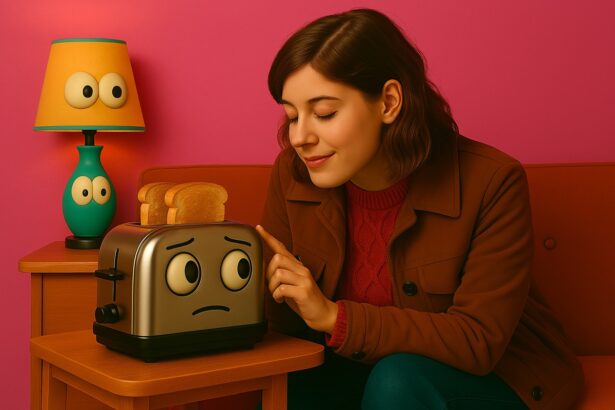
You just made a decision – big or small. You picked a restaurant, chose a new job, or even just bought a new gadget. For a fleeting moment, you feel a sense of relief. But then, your magnificent, weird brain kicks in. “What if I had chosen the other restaurant? What if that other job offer was better? Did I really get the best deal?” Suddenly, you’re replaying the decision-making process, agonizing over alternatives, and imagining vastly different (and often better) outcomes if you had just picked differently. This choice, it is very nice! But other choice, it was also very nice! Now my brain is very confused and very sad!”
Welcome, fellow traveler, to the delightfully unhinged, universally experienced realm of Regret Aversion and Counterfactual Thinking (the ‘What If?’ Brain). It’s the glorious absurdity of your mind’s tendency to obsess over past choices, imagining alternative realities, and often feeling regret for paths not taken. Is it a sign of indecisiveness? A peculiar form of self-torture? Or is your beautiful brain simply doing its very nice, very efficient (though sometimes exhausting) job of learning from experience, even if it means dwelling on the impossible? At Psyness.com, we take a “very nice!” look at this pervasive mental quirk, proving that understanding why you second-guess yourself doesn’t have to be boring – it can be a riot.
Your Brain’s Alternate Reality Generator | The Path Not Taken
Why does your mind so readily conjure up elaborate scenarios of “what might have been,” even when the actual outcome is perfectly fine? It’s a fascinating testament to your magnificent brain’s capacity for simulation, its drive for optimization, and its struggle with the finality of choice.
The Architect | The Comparison Engine
Your brain, bless its tirelessly optimizing heart, is constantly seeking the best possible outcome. When a decision is made, especially one with significant implications, your brain doesn’t just move on; it often engages in mental comparisons with hypothetical alternatives.
- Counterfactual Thinking: This is the core mechanism. It’s the mental process of imagining alternative outcomes to past events. Your brain constructs “counterfactuals” – “if only I had done X, then Y would have happened.” This can be upward counterfactuals (imagining a better outcome, leading to regret) or downward counterfactuals (imagining a worse outcome, leading to relief). The ‘What If?’ Brain is usually stuck on the upward kind. “This path, it is good. But other path? It could be very, very good! My brain must explore all paths, even if they are not real!”
- Regret Aversion: Your brain is wired to avoid the pain of regret. Ironically, this desire to avoid regret can lead to indecision (trying to make the “perfect” choice) or, once a choice is made, to excessive rumination, as your brain tries to learn how to avoid future regret.
- Decision Fatigue: When faced with too many choices, or after making many decisions, your brain’s capacity for optimal decision-making can be depleted. This can lead to quick, less thought-out choices, which then become prime candidates for ‘What If?’ thinking later.
- The Illusion of Control: Believing that a different choice would have led to a definitively better outcome gives your brain a comforting (but often false) sense of control over complex situations. It implies that if you just had more information or thought harder, you could have “mastered” the outcome.
- Cognitive Dissonance (Again!): When your chosen outcome doesn’t perfectly align with your expectations or desires, it creates mental discomfort. Your brain tries to resolve this by re-evaluating the decision, often by focusing on the appealing aspects of the unchosen alternative.
The paradox? This mental simulation, while potentially useful for learning from mistakes, often traps you in a cycle of rumination, dissatisfaction, and an inability to fully appreciate the path you did take. Your brain’s “alternate reality generator” is magnificent, but gloriously unhinged in its endless replays.
Pop Culture’s Fork in the Road | Our Shared Existential Angst
From classic films exploring parallel lives based on a single choice, to “choose your own adventure” narratives, to songs about roads not taken, pop culture constantly reflects our universal fascination with alternative realities and the weight of decisions. We relate to characters who agonize over their past, wondering what might have been.

The glorious absurdity? We all know we can’t change the past, yet our brains insist on re-running the tape, exploring every possible permutation. It’s a shared, delightful madness where our personal histories are constantly being rewritten in our minds. Your inner Borat might face a choice and declare, “This path, it is very good! But other path, it is also very good! My brain will think about both, forever! Very nice, but very tiring!”
Embracing ‘Good Enough’ (Very Nice! And Truly Liberating!)
Understanding that your brain’s ‘What If?’ tendency is a natural, powerful cognitive bias is the first step to liberation. It’s not about making perfect choices (which don’t exist); it’s about learning to work with your magnificent, weird brain to find peace with your decisions and move forward.
Here’s how to nudge your brain towards more acceptance, “very nice!” contentment:
- Acknowledge the Counterfactual, Then Release It: When a ‘what if’ thought arises, acknowledge it briefly. “Okay, my brain is imagining another path. Very nice.” Then, consciously release it. Don’t dwell. Remind yourself | “That’s a hypothetical. This is reality.”
- Focus on the “Why”: Instead of focusing on the outcome of the unchosen path, focus on the reasons you made the choice you did, given the information you had at the time. You made the best decision you could then.
- Practice Gratitude for the Chosen Path: Actively look for and appreciate the positive aspects of the decision you did make. This helps balance the brain’s tendency to only see the good in the unchosen alternative.
- The “Good Enough” Principle: Embrace the concept of “satisficing” – making a choice that is “good enough” rather than striving for the elusive “perfect” choice. Perfectionism fuels ‘what if’ thinking.
- Learn and Move On: View past decisions, even those with less-than-ideal outcomes, as learning opportunities. Extract the lesson, and then consciously close the mental loop.
- Limit Information Overload: Too much research or too many options before a decision can lead to more ‘what if’ thinking after it. Trust your gut and limit analysis paralysis.
- Practice Mindfulness: Ground yourself in the present moment. When your brain tries to pull you into hypothetical pasts, gently bring your attention back to what is happening right now.
The ‘What If?’ Brain is a truly special window into our complex psychology, a reminder that our minds, while magnificent, are also prone to delightful alternative realities. Knowing this doesn’t make you indecisive; it makes you self-aware, wonderfully weird, and very nice! Embrace your inner alternate reality generator, understand your brain’s quest for optimization, and prove that you can find peace and progress on the path you’re on.