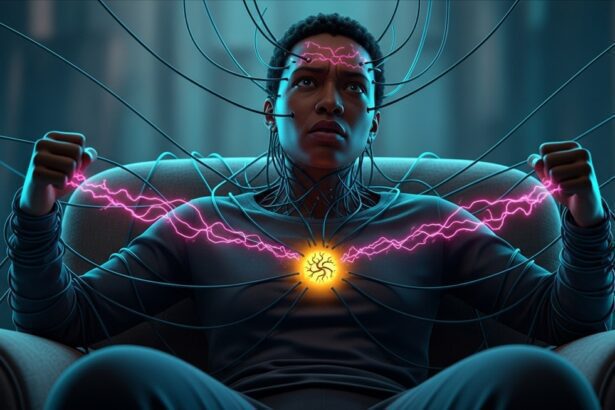
You’re looking at a cloud formation, and suddenly, you see a clear image of a rabbit riding a bicycle. You stare at a patch of static on an old TV, and distinct faces begin to emerge. You hear random sounds, and your magnificent, weird brain starts to weave them into a melody or even a whispered message. Even in chaos, your mind finds order, convinced that there’s a hidden design or a secret message just waiting to be uncovered. “This random thing, it is not random! My brain sees the secret pattern! Very nice, the universe is very organized for me!
Welcome, fellow traveler, to the delightfully unhinged, universally experienced realm of Pareidolia and Apophenia (the ‘Everything’s Connected’ Brain). It’s the glorious absurdity of your mind’s tendency to perceive meaningful images, sounds, or patterns in random or ambiguous stimuli. Is it imagination running wild? A peculiar form of sensory overreach? Or is your beautiful brain simply doing its very nice, very efficient (though sometimes overly enthusiastic) job of making sense of the world, even if it has to invent the connections? At Psyness.com, we take a “very nice!” look at this pervasive mental quirk, proving that understanding why you see patterns everywhere doesn’t have to be boring – it can be a riot.
Your Brain’s Pattern Factory | The Sense-Making Imperative
Why does your mind so readily conjure up recognizable patterns from amorphous shapes, random noises, or disconnected events? It’s a fascinating testament to your magnificent brain’s fundamental drive to find meaning, predict, and organize the vast amount of sensory information it constantly receives.
The Architect | The Prediction & Survival Engine
Your brain, bless its tirelessly interpreting heart, is designed to make sense of its environment. In a world of uncertainty, quickly identifying patterns (even false ones) can be a survival advantage – better to mistake a shadow for a predator than to miss a real one.
- Predictive Processing (Again!): Your brain is constantly generating hypotheses about the world and comparing incoming sensory data against these predictions. When the input is ambiguous, your brain “fills in the blanks” with the most likely or familiar pattern it knows, often based on prior experiences or expectations. “Half a face! My brain knows whole face! Very nice to complete the picture!”
- Apophenia & Patternicity: This is the broader cognitive tendency to perceive meaningful connections or patterns in random or meaningless data. Pareidolia is a specific type of apophenia related to visual or auditory stimuli. Your brain is a “pattern-seeking missile,” and it’s so good at it, it sometimes finds patterns that aren’t actually there.
- Evolutionary Advantage: From an evolutionary standpoint, the ability to quickly detect patterns (e.g., the outline of a predator in tall grass, the sound of a rustle that might indicate danger) was crucial for survival. A brain that was slightly oversensitive to patterns had a better chance of keeping its owner alive.
- Top-Down Processing: Your brain doesn’t just process sensory information from the “bottom up” (raw data). It also uses “top-down” processing, where your existing knowledge, expectations, and beliefs influence how you interpret incoming data. If you’re expecting a face, you’re more likely to see one.
- Emotional & Motivational States: Your current emotional state or motivations can also influence pareidolia. If you’re feeling lonely, you might be more prone to seeing faces in inanimate objects. If you’re looking for a sign, you’re more likely to find one.
The paradox? While this pattern-seeking ability is fundamental to learning, language, and navigating the world, its overzealous application can lead to superstitions, misinterpretations, and a belief in hidden forces where only chance exists. Your brain’s “pattern factory” is magnificent, but gloriously unhinged in its creative interpretations.
Pop Culture’s Hidden Messages | Our Shared Pattern Obsession
From viral photos of “faces” in toast or clouds, to conspiracy theories that connect seemingly unrelated events, to horror movies that play on our fear of seeing things that aren’t there, pop culture constantly reflects our universal fascination with finding hidden meanings. We love a good mystery, and our brains are happy to provide the “clues.”

The glorious absurdity? We actively seek out these hidden patterns, then marvel when our brains invent them, often convinced we’ve stumbled upon something profound. It’s a shared, delightful madness where randomness is just a puzzle waiting to be solved. Your inner Borat might see a pattern in the spilled coffee and declare, “This coffee, it is telling me something! Very nice, my brain is a very good interpreter!”
Appreciating Randomness (Very Nice! And Truly Liberating!)
Understanding that your brain’s ‘Everything’s Connected’ tendency (Pareidolia/Apophenia) is a natural, powerful cognitive quirk is the first step to liberation. It’s not about becoming dull or unimaginative; it’s about learning to work with your magnificent, weird brain to appreciate the genuine beauty of chance while also enjoying its delightful illusions.
Here’s how to nudge your brain towards more balanced, “very nice!” perception:
- Acknowledge the Pattern, Then the Source: When you see a face in a plug socket, acknowledge the pattern. “That looks like a face! Very nice!” Then, gently remind your brain that it’s a random arrangement of holes, and your brain is just being clever.
- Embrace the “Just Because”: Cultivate a comfort with things happening “just because” – purely by chance. Not everything has a deeper meaning or an intentional pattern. This can be incredibly liberating.
- Test Your Assumptions: If you’re convinced a pattern is real, try to find counter-evidence. Can you unsee the face? Can you find other, equally compelling, but contradictory patterns?
- Focus on the Process, Not Just the Product: Appreciate your brain’s incredible ability to create these patterns. It’s a testament to its creativity and efficiency, even if the patterns aren’t objectively real.
- Engage in Creative Play: Channel your brain’s pattern-seeking energy into genuinely creative pursuits – art, writing, music, puzzles. This gives your brain a healthy outlet for its pattern-making abilities.
- Seek Out Genuine Complexity: Instead of finding simple patterns in randomness, challenge your brain with genuinely complex systems where patterns do exist, but require real effort to uncover (e.g., learning a new language, understanding a scientific theory).
- Share the Weirdness: When you see a funny face in a potato chip, share it! It’s a delightful human quirk that connects us through shared moments of playful perception.
The ‘Everything’s Connected’ Brain is a truly special window into our complex psychology, a reminder that our minds, while magnificent, are also prone to delightful pattern illusions. Knowing this doesn’t make you less spiritual; it makes you self-aware, wonderfully weird, and very nice! Embrace your inner pattern-seeker, understand your brain’s sense-making drive, and prove that you can find wonder in both profound connections and delightful randomness
// Protocol · Next Transmission
The glitch is the signal. — Psyness Protocol