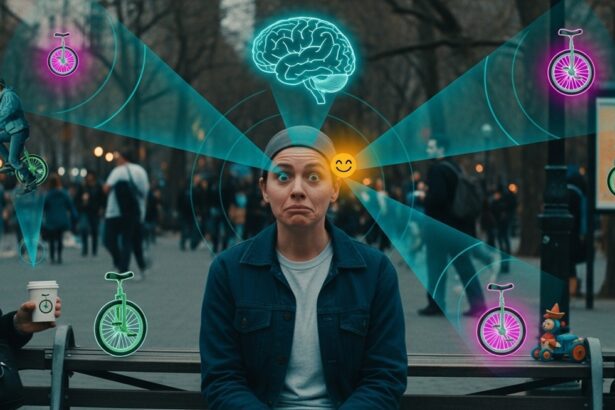
You’re armed with undeniable proof. Charts, graphs, expert quotes, direct evidence! You present it calmly, logically, expecting the person across from you to say, “Ah, I see! You’ve changed my mind!” Instead, they furrow their brow, their eyes narrow, and their conviction hardens like concrete. They don’t just dismiss your facts; they actually seem to believe their original idea even more strongly. That funny, frustrating, and incredibly common experience of seeing evidence backfire is not just stubbornness—it’s the Backfire Effect, your magnificent brain’s very nice, beautifully unhinged “belief shield.” “I show very good fact! My brain says ‘very nice, but my old belief is very much better!’ Very confusing, because now they believe it more! Very good brain, but very stubborn!”
Welcome, fellow traveler, to the delightfully unhinged, universally experienced realm of the ‘Fact-Proof’ Brain, a potent manifestation of reinforced conviction. It’s the glorious absurdity of your mind turning contradictory evidence into fuel for its existing beliefs. This pervasive psychological and emotional quirk highlights a fascinating paradox | the human brain’s desire for consistency and its need to protect its identity can lead to a humorous (and sometimes concerning) resistance to new information. Is it just ignorance? A peculiar form of self-sabotage? Or is your beautiful brain simply doing its very nice, very efficient (though profoundly challenging) job of protecting its narrative? At Psyness.com, we take a “very nice!” look at this pervasive mental quirk, proving that understanding this peculiar psyche doesn’t have to be boring – it can be a riot. The feeling of the Backfire Effect is like a cartoon character hitting a brick wall with a giant hammer, and instead of the wall breaking, it actually gets thicker and stronger with each hit, becoming completely impenetrable, as if the wall itself gains strength from the futile attempts to break it down. It’s a wonderfully weird glitch in your system.
Your Brain’s Belief Shield | When Facts Become Fuel
Why does your mind sometimes trick you into believing something even more strongly when faced with evidence against it? It’s a fascinating testament to your magnificent brain’s ancient wiring for self-preservation, its powerful need for consistency, and its complex system for processing information related to personal identity.
The Protector | Identity and Cognitive Dissonance
Your brain, bless its tirelessly diligent heart, is primarily wired to maintain coherence and protect your sense of self. Our beliefs aren’t just isolated thoughts; they’re often deeply intertwined with our identity, our values, and our social groups. When contradictory evidence threatens a core belief, it can feel like an attack on who you are. The Backfire Effect kicks in as a defense mechanism.
- Cognitive Dissonance Aversion (The Brain’s Harmony Seeker): This is a core mechanism. Cognitive dissonance is the mental discomfort you feel when you hold two conflicting beliefs, or when your actions conflict with your beliefs. The Backfire Effect is one way your brain tries to reduce this discomfort. Instead of changing a deeply held belief (which is hard and uncomfortable), it’s easier for your brain to reject the new information or even twist it to fit the existing belief. This is where your fuchsia-pink of self-preservation glows.
- Threat to Worldview/Identity: When a belief is central to your identity (e.g., political views, religious beliefs, core values), disconfirming evidence isn’t just a fact; it’s a threat to your entire worldview. Your brain responds by reinforcing the threatened belief to protect your sense of self.
- Emotional Attachment: Many of our beliefs are tied to strong emotions. When emotion is involved, facts become less about logic and more about validating feelings. Challenging these beliefs can trigger a fight-or-flight response, leading to a defensive stance. This is a very nice, but often illogical, internal battle.
- Motivated Reasoning: Your brain isn’t always a neutral judge. It’s often motivated to reach a particular conclusion (the one that validates your existing belief). It will selectively interpret evidence, seek out flaws in the counter-arguments, and reinforce anything that supports its preferred outcome. This is where your deep teal/cyan logical processing gets creatively biased.
- Social and Group Identity: Our beliefs often align with the groups we belong to. Changing a belief can mean distancing yourself from your tribe, which is a powerful social threat. The Backfire Effect can be a way to reaffirm loyalty to your group and protect your social standing. This is where your cheerful mustard yellow of vivid social belonging shines.
The paradox? Your brain’s admirable drive for consistency and its powerful capacity for self-protection, while essential for mental stability and social cohesion, can lead to a draining, frustrating cycle of intellectual stagnation, increased polarization, and an inability to adapt to new truths because it prioritizes defending existing beliefs over discovering objective reality. Your brain’s “belief shield” is magnificent, but gloriously unhinged in its ability to become fact-proof.
Pop Culture’s “Don’t Look Up” & “The X-Files” | Our Shared Reality Tunnel
From the darkly comedic film Don’t Look Up, where scientists frantically try to convince a skeptical public and government about an impending comet, only to be met with denial, conspiracy theories, and outright hostility that strengthens opposition, to the iconic dynamic in The X-Files, where Agent Mulder consistently presents undeniable evidence of extraterrestrial life and paranormal phenomena, only for Agent Scully (and the shadowy government) to find increasingly convoluted ways to dismiss or disbelieve it, pop culture constantly reflects and often capitalizes on our universal struggle with belief, evidence, and the limits of persuasion. We’ve all seen a character’s “Fact-Proof” Brain in action, often with thrilling or absurd results.

The glorious absurdity? You can show someone a video of themselves doing something, and they’ll still insist it never happened, or that the video is fake, just to protect their internal narrative. It’s a shared, delightful madness where our perceived reality is often dictated by our brain’s tireless, but often unnecessary, need to defend its chosen truths. Your inner Borat might show clear photo of alien and declare, “Very nice, this is alien! My brain says ‘no, it is just man in costume, very convincing!’ Very nice, now I believe more it is man in costume, even though picture is very clear alien!”
How to Navigate Your ‘Fact-Proof’ Brain (Very Nice! And Truly Liberating!)
Understanding that your brain’s ‘Fact-Proof’ tendency is a natural, powerful psychological process is the first step to liberation. It’s not about abandoning your beliefs; it’s about learning to work with your magnificent, weird brain to foster greater intellectual humility, open-mindedness, and authentic growth. Here’s how to nudge your brain towards a more intentional, “very nice!” understanding:
- Lead with Empathy, Not Facts: If you want to discuss a sensitive topic, start by understanding the other person’s perspective and emotions. Acknowledge their viewpoint before introducing new information. Facts alone rarely change minds. This is your cheerful mustard yellow signal for connection.
- Find Common Ground: Look for shared values or beliefs that are broader than the point of contention. Build rapport before attempting to introduce contradictory evidence. People are more open to information from those they trust.
- Ask Questions, Don’t Preach: Instead of stating facts, ask open-ended questions that encourage the other person to think critically about their own reasoning. “What makes you say that?” or “How do you explain X in light of Y?”
- Present Small, Non-Threatening Discrepancies: Instead of a full frontal assault with overwhelming evidence, introduce small, subtle pieces of information that gently create cognitive dissonance, without threatening the core identity.
- Focus on the “Why”: Understand why someone holds a particular belief. Is it fear, tribal loyalty, personal experience? Addressing the underlying emotional or social needs can be more effective than simply disproving the belief.
- Practice Self-Awareness: Recognize when your own ‘Fact-Proof’ Brain is kicking in. If you feel defensive or more certain after being challenged, pause and consider if you’re experiencing the Backfire Effect.
The ‘Fact-Proof’ Brain is a truly special window into our complex psychology, a reminder that our minds, while magnificent, are also prone to delightful (and sometimes dangerous) forms of self-deception. Knowing this doesn’t make you a failure; it makes you self-aware, wonderfully weird, and very nice! Embrace your inner curious explorer, understand your brain’s fascinating defense mechanisms, and prove that you can navigate the complexities of belief and evidence with greater presence, gratitude, and authentic understanding.
// Protocol · Next Transmission
The glitch is the signal. — Psyness Protocol