
You’re stuck in traffic, fuming. The driver in the next lane cuts you off. “What an aggressive jerk!” you think, immediately judging their character. Later that week, you accidentally cut someone off. “Oh, my bad,” you mumble. “The sun was in my eyes, and I’m running late!” Sound familiar? This classic human quirk is the Fundamental Attribution Error, your magnificent brain’s very nice, beautifully unhinged “blame filter.” It’s the glorious absurdity of your mind consistently attributing other people’s negative behaviors or failures to their internal character flaws (they’re lazy, careless, rude), while attributing your own similar missteps to external, situational factors (I was tired, the circumstances were difficult, it was bad luck). This pervasive psychological and emotional bias highlights a fascinating paradox | your brain is a very nice, but very biased, courtroom judge of human behavior. Is your mind just inherently unfair? Or is your beautiful brain simply doing its very nice, very efficient (though profoundly challenging) job of protecting your ego? At Psyness.com, we take a “very nice!” look at this peculiar psyche, proving that understanding this peculiar psyche doesn’t have to be boring – it can be a riot.
Your Brain’s Unequal Scales | Internal vs. External Explanations
Why does your mind so readily jump to conclusions about others’ character flaws, while giving yourself a pass for the exact same mistakes? It’s a fascinating testament to your magnificent brain’s ancient wiring for self-preservation, its powerful need to simplify complex social information, and its complex system for assigning cause and effect.
Your brain, bless its tirelessly judgmental heart, is primarily wired to make quick assessments of the world around you. The Fundamental Attribution Error (FAE) is a cognitive bias where we overemphasize dispositional (internal) factors and underestimate situational (external) factors when explaining other people’s behavior. Conversely, when it comes to our own behavior, we tend to do the opposite, attributing our actions more to external circumstances. This often leads to frustrating misunderstandings and conflict.
Several cognitive and psychological processes fuel this pervasive bias:
- Perceptual Salience (The “Spotlight” Effect): This is a core mechanism. When you observe someone else’s behavior, they are the most prominent thing in your perceptual field—they are “salient.” Their personality and actions grab your attention, making it easy to attribute their behavior directly to who they are. You don’t see all the complex external factors influencing them. This is where your fuchsia-pink of immediate judgment glows.
- Actor-Observer Bias (The Double Standard): This is a closely related phenomenon. When you are the actor, your attention is focused outward on the situation and environment, making external factors more obvious to you. When they are the actor, your attention is on them. This difference in perspective leads to different attributions. This is a very nice, but often infuriating, internal double standard.
- Cognitive Load & Shortcuts (The Easy Answer): Judging someone’s character is often a quicker and less cognitively demanding explanation than delving into all the complex, often unseen, situational factors that might be at play. Your brain prefers efficiency. This is where your deep teal/cyan logical processing takes the path of least resistance.
- Self-Serving Bias (The Ego Protector): Attributing your own successes to your abilities and your failures to external factors is a way to protect your self-esteem. The FAE is essentially a mirror of this, where we deprive others of the same protective attribution. This is where your cheerful mustard yellow of self-preservation shines.
For example, when a colleague misses a deadline, your brain might immediately think, “They’re so disorganized!” But when you miss a deadline, it’s, “This project was poorly planned, and I had too many other priorities!”
Pop Culture’s Hypocrites | Our Shared Biased Lenses
The tendency to judge others differently than ourselves is a rich vein for comedy and drama in pop culture, resonating because it reflects a universal human failing we all recognize (often in others, of course!).
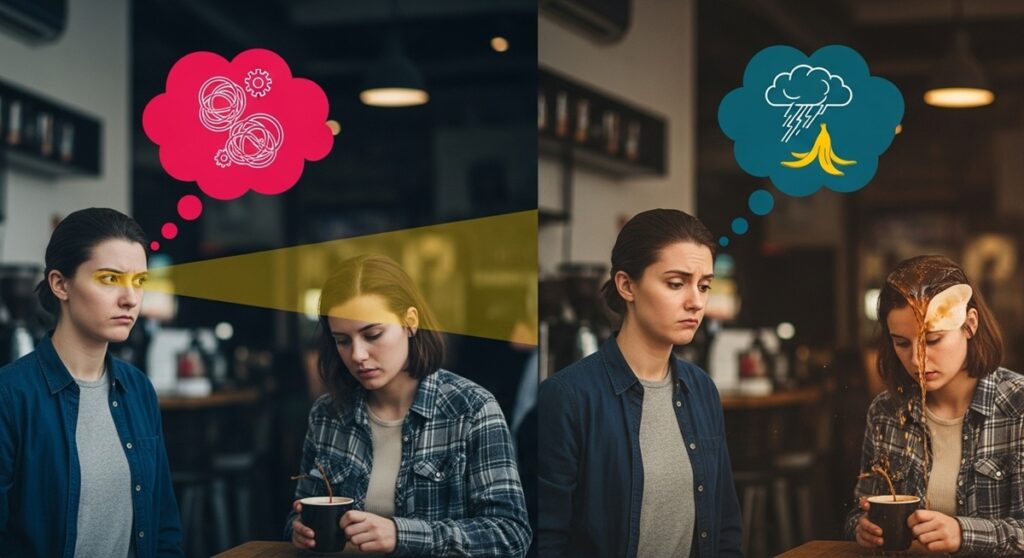
Think of a classic sitcom scene that perfectly illustrates the Fundamental Attribution Error. One character harshly judges another for making a mistake—perhaps being late to an important meeting or forgetting a crucial item—attributing it to their inherent laziness, incompetence, or lack of care. Later in the episode, when the first character makes the exact same mistake, they have an elaborate, sympathetic list of external, situational excuses | “Oh, the traffic was absolutely terrible! My alarm didn’t go off! I got a really distracting text just before I left!” The humor comes from the blatant hypocrisy and the audience’s recognition of this all-too-human bias.
This bias extends beyond individual interactions. In news and social media, we often see FAE at play when public figures or groups are condemned for actions, with little consideration for the systemic pressures or situational constraints they might face. Conversely, actions by “our side” are often given the benefit of the doubt, with external factors cited. The Milgram experiments (while not directly about FAE) demonstrate how powerful situational pressures can be, often leading ordinary people to act in ways that observers might attribute to sinister internal traits. It’s a shared, delightful madness where our social harmony is often challenged by our brain’s tireless, but sometimes misguided, drive to protect our own self-image. Your inner Borat might see someone drop a plate and declare, “Very nice, this person is very clumsy! My brain says ‘no, it was slippery floor!’ Very nice, now I still think he is clumsy, very confusing for my very good brain!”
How to Bypass Your ‘It’s Always Them’ Brain (Very Nice! And Truly Liberating!)
Understanding that your brain’s ‘It’s Always Them’ tendency is a natural, powerful psychological process is the first step to liberation. It’s not about excusing all behavior; it’s about learning to work with your magnificent, weird brain to foster greater empathy, nuanced understanding, and more accurate social judgments. Here’s how to nudge your brain towards a more intentional, “very nice!” understanding:
- Pause and Ponder (The Situational Scan): Before you attribute someone’s negative behavior to their character, consciously pause. Ask yourself | “What external factors might be at play here?” (e.g., Are they stressed? Are they having a bad day? Is there something in the environment I don’t see?). This is your cheerful mustard yellow signal for deeper thought.
- Swap Roles (The Empathy Exercise): Imagine yourself in their shoes. If you made the same mistake, what situational excuses would you offer? Applying those same excuses to them can build empathy.
- Seek More Information (The Curious Detective): If possible, ask questions. “Is everything okay?” or “Was there a reason for that?” can open up understanding and reveal external factors you hadn’t considered.
- Recognize Your Own Bias (The Self-Aware Mirror): Pay attention to when you make fundamental attribution errors. The more you catch yourself doing it, the more you can actively counteract it.
- Practice “External First” (The Mindset Shift): Train your brain to first consider situational factors for others’ behavior, especially negative ones, before jumping to internal character judgments.
- Be Patient (The Human Touch): Understand that everyone is navigating their own complex set of circumstances, many of which are invisible to you. A little patience goes a long way in fostering better understanding.
- Focus on Behavior, Not Identity (The Objective Lens): Instead of thinking “They are a careless person,” try “That action was careless.” This separates the behavior from the entire identity, allowing for more objective assessment.
The ‘It’s Always Them’ Brain is a truly special window into our complex psychology, a reminder that our minds, while magnificent, are also prone to delightful (and sometimes profoundly divisive) forms of social judgment. Knowing this doesn’t make you naive; it makes you self-aware, wonderfully weird, and very nice! Embrace your inner fair judge, understand your brain’s fascinating attribution quirks, and prove that you can navigate social interactions with greater presence, compassion, and authentic connection.
// Protocol · Next Transmission
The glitch is the signal. — Psyness Protocol