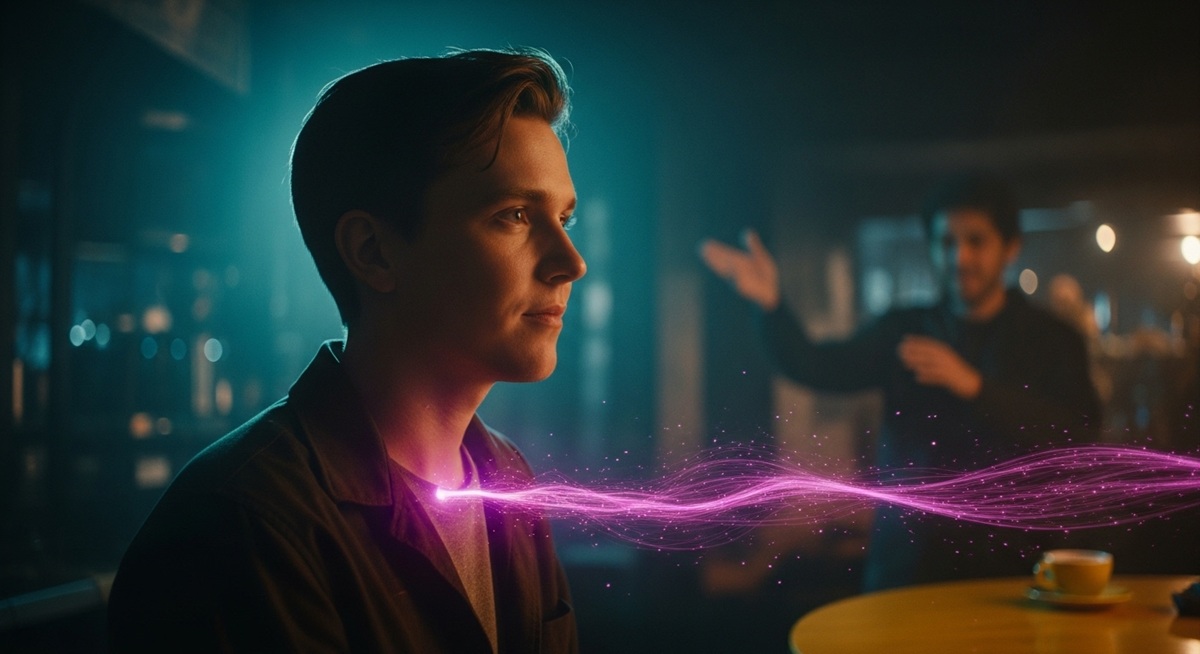
Ever feel mysteriously exhausted after talking to certain people? That’s your Energy Vampire Brain—your mind’s very nice, but very drainable, wiring for emotional contagion. Psychology says it’s not “woo-woo,” it’s your mirror neurons and social attunement running overtime. The trick | protect your energy without becoming a hermit—think boundaries, recharging rituals, and knowing your emotional battery life.
Madness Meter: 🌀🌀 Medium (Warning | May cause you to suddenly identify which of your friends is secretly Count Draina.)
You meet up with a friend. You sit, you chat, you nod. By the end, you feel like you’ve just run a marathon—but without the medal or the endorphins. Strangely, nothing dramatic even happened. Congratulations. You’ve encountered the phenomenon your Energy Vampire Brain knows all too well | some social encounters suck energy like a cracked phone battery left on TikTok autoplay. This is your psyche using its very nice, but often unhinged, ability to sync with the emotional states of others, for better or worse. Is your mind just too sensitive? Or is your beautiful brain simply doing its very nice, very efficient (though profoundly challenging) job of building social bonds, even when it costs you? At Psyness.com, we take a “very nice!” look at this peculiar psyche, proving that understanding this peculiar psyche doesn’t have to be boring – it can be a riot.
S³ – Story • Stakes • Surprise
Story
You walk into work energized, then leave after a meeting with That One Colleague™ feeling like you’ve aged 20 years.
Stakes
Left unchecked, repeated energy drains can amplify stress, weaken resilience, and even spiral into burnout.
Surprise
Psychology says you’re not “too sensitive.” You’re just wired with emotional Wi-Fi that auto-connects to people’s vibes, whether you want it to or not.
Why Your Brain Gets Drained
At its core, your Energy Vampire Brain reveals that your mind is deeply wired for social connection and empathy. It’s an evolutionary mechanism for survival, but in the modern world, it can become a liability. Your brain, bless its tirelessly empathetic heart, is primarily wired for belonging and attunement. It wants to understand and connect, and it will expend significant resources to do so, whether you give it permission or not.
The Psychology Bits
Emotional contagion is a cognitive bias where we unconsciously “catch” the moods and emotional states of others. This phenomenon was first described by psychologists Thomas Gilovich, Victoria Medvec, and Kenneth Savitsky in the 1990s. This is how your brain works:
- Emotional Contagion: Humans unconsciously “catch” others’ moods. It’s a primal survival skill—if someone in the tribe was fearful, it was wise to feel fearful too. This deep teal/cyan connection is a powerful driver of your ability to feel what others feel, creating a need for personal agency even when none exists.
- Mirror Neurons: Your brain simulates what it sees, hears, and feels. When you watch someone experience an emotion, your mirror neurons fire as if you are experiencing it yourself, literally running empathy software. This creates a very nice, but often manipulated, internal preference.
- Social Attunement: We evolved to track others for survival, and in the modern office or social setting, this constant tracking can be exhausting. This is your cheerful mustard yellow decision-making is steered by the promise of avoiding a pitfall.
- Introvert/Extrovert Mismatch: Some brains burn faster in social situations. This tension is your fuchsia-pink alarm bell for anything that smells like losing.
For example, when a gambler blows on their dice before a roll, their brain isn’t being irrational; it’s attempting to assert control over a truly random event to alleviate the anxiety of uncertainty. The action is a psychological tool, not a physical one.
Why Your Brain Loves the Drama
While the Spotlight Effect can lead to suboptimal decisions, it persists because it offers your brain some cognitive shortcuts and plays into fundamental psychological drivers.

Short-term perks (why it persists)
- Keeps you alert to others’ needs.
- Builds group cohesion (you “sync” emotionally).
- Creates empathy bonds.
Long-term pitfalls
- Emotional exhaustion.
- Resentment toward certain people.
- Burnout if you never recharge.
How to Outsmart (or Recharge) Your Energy Vampire Brain
Understanding that your brain’s “Energy Vampire” tendency is a natural, powerful psychological process is the first step to liberation. It’s not about becoming a cynical fatalist; it’s about learning to work with your magnificent, weird brain to foster more intentional, “very nice!” understanding. Here’s how to nudge your brain towards a more intentional, “very nice!” understanding:
- Battery Check: Notice how you feel after interactions. Green? Yellow? Red? This simple act of identification can satisfy your brain’s need for closure. This is your cheerful mustard yellow signal for cognitive flexibility.
- Boundary Buffers: Limit time with repeat drainers, or set clear “exits.” This is your fuchsia-pink push for comprehensive input.
- Recharge Rituals: Music, walks, naps, doodling—whatever restores your spark. This is your deep teal/cyan exercise in objectivity.
- Conserve Mode: It’s okay to go quiet or observe—you don’t owe full wattage 24/7.
The Energy Vampire Brain is a truly special window into our complex psychology, a reminder that our minds, while magnificent, are also prone to delightful (and sometimes profoundly misleading) forms of interpretive bias. Knowing this doesn’t make you foolish; it makes you self-aware, wonderfully weird, and very nice! Embrace your inner critical thinker, understand your brain’s fascinating susceptibility to this feeling of control, and prove that you can navigate a world of carefully crafted messages with greater clarity, independence, and authentic choice. It’s not boring – it’s a riot!
FAQ
Q | Am I just being dramatic? A | Nope. Research shows emotional contagion is measurable and real.
Q | Can “energy vampires” change? A | Yes—sometimes they’re unaware. But your job is protecting your battery, not fixing theirs.
Q | Is it bad to avoid people? A | Not if it protects your health. Boundaries aren’t rejection—they’re self-preservation.
Citations & Caveats
- Hatfield, E., Cacioppo, J. T., & Rapson, R. L. (1993). Emotional contagion. Current Directions in Psychological Science.
- Barsade, S. (2002). The ripple effect | Emotional contagion in groups. Administrative Science Quarterly.
- Decety, J., & Jackson, P. L. (2004). The functional architecture of human empathy. Behavioral and Cognitive Neuroscience Reviews.
Disclaimer: This article is for informational purposes only and is not a substitute for professional psychological advice. While the Illusion of Control is a pervasive cognitive bias, individual susceptibility can vary. If you feel consistently overwhelmed by a need for control or experience significant anxiety related to a compulsion to influence chance events, please consider seeking help from a qualified mental health professional.
// Protocol · Next Transmission
The glitch is the signal. — Psyness Protocol