Ever feel a surge of irrational pride over the wobbly bookshelf you assembled yourself? That’s your Proud Parent Brain. Psychologists call it the IKEA Effect | we disproportionately overvalue something just because we had a hand in making it. It’s your psyche’s brilliantly biased way of rewarding your hard work, turning a simple task into a source of personal triumph.
Madness Meter: 🌀🌀 Medium (Warning | May cause you to argue with yourself over the value of a DIY spice rack.)
You finally finish assembling that minimalist desk from a big-box store. The instructions were a fever dream, and one drawer is perpetually crooked. But you stand back and think | It’s perfect. That’s your Proud Parent Brain in action—your psyche’s gloriously irrational tendency to attach outsized value to things you’ve created, regardless of the objective quality. This cognitive bias is known as the IKEA Effect, and it’s a very nice, beautifully unhinged way your mind gives you a pat on the back for your effort. Is your mind just a little too generous with praise? Or is your beautiful brain simply doing its very nice, very efficient (though profoundly challenging) job of making sure you keep trying to build things? At Psyness.com, we take a “very nice!” look at this peculiar psyche, proving that understanding this peculiar psyche doesn’t have to be boring – it can be a riot.
S³ – Story • Stakes • Surprise
Story
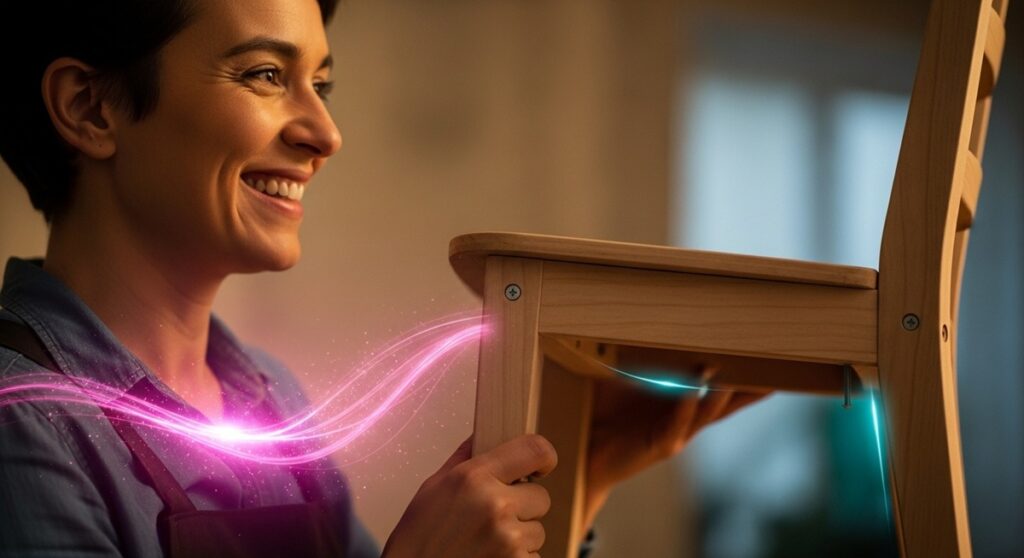
You spend two hours building a simple end table, then proudly show it off, ignoring the two leftover screws and the slight wobble.
Stakes
This bias can lead to overvaluing our own ideas, overlooking flaws in our work, and missing out on better options just because they aren’t “ours.”
Surprise
The Proud Parent Brain isn’t just about ego. It’s a powerful cognitive bias that links effort to affection, making the act of creating a reward in itself.
Why Your Brain Loves Making Stuff (Even If It’s Bad)
At its core, your Proud Parent Brain reveals that your mind is deeply uncomfortable with seeing your effort go unrewarded. Your brain is wired for prediction and agency, and it hates to feel helpless. When faced with a tangible result of your labor, your brain creates a narrative where that result is intrinsically more valuable than one you simply bought. This isn’t a delusion; it’s a cognitive strategy to manage stress and motivate you to act. Your brain, bless its tirelessly optimistic heart, is primarily wired for empowerment.
The Psychology Bits
The IKEA Effect is a cognitive bias where we experience an increase in the perceived value of an object that we have partially or fully assembled. This phenomenon was first described by psychologists Michael I. Norton, Daniel Mochon, and Dan Ariely. They found that people who assembled an IKEA box valued it at a higher price than a pre-assembled box, even when they were objectively identical. This is how your brain works:
- Effort Justification: You believe that because you put in the time and effort, the reward must be greater. This deep teal/cyan belief is a powerful driver of the Proud Parent Brain, creating a need to justify the energy you expended.
- The “I Did It” Feeling: This is a primal sense of ownership and accomplishment. This creates a very nice, but often manipulated, internal preference.
- The “What-If” Loop: Your brain is always looking for an optimal path. When an outcome is uncertain, your mind starts a subtle, often unconscious “what if” analysis, creating a ritual that feels purposeful. This constant rehearsal of the ritual gives you a sense of agency, even if it has no real-world effect. This is where your cheerful mustard yellow decision-making is steered by the promise of avoiding a pitfall.
- Goal Orientation: Your brain is naturally goal-oriented. Feeling in control of a situation, however small, motivates you to engage and try harder, which can lead to better outcomes in areas where you actually do have influence. This tension is your fuchsia-pink alarm bell for anything that smells like losing.
For example, when a gambler blows on their dice before a roll, their brain isn’t being irrational; it’s attempting to assert control over a truly random event to alleviate the anxiety of uncertainty. The action is a psychological tool, not a physical one.
Why Your Brain Loves the Drama
While the Proud Parent Brain can lead to suboptimal decisions, it persists because it offers your brain some cognitive shortcuts and plays into fundamental psychological drivers.
Short-term perks (why it persists)
- Self-Esteem Boost: The feeling of competence and accomplishment.
- Sense of Control: A feeling of agency over your environment.
- Memory and Connection: You’re more likely to remember and form an emotional bond with something you made yourself.
Long-term pitfalls
- Overlooking Flaws: You might ignore critical defects or inefficiencies in something you’ve created.
- Loss Aversion: It becomes harder to give up or replace something you’ve invested effort in, even if a better alternative exists.
- Bias in Judgment: You might unfairly judge the work of others as less valuable than your own.
How to Outsmart (or Befriend) Your Proud Parent Brain
Understanding that your brain’s “Proud Parent” tendency is a natural, powerful psychological process is the first step to liberation. It’s not about becoming a cynical fatalist; it’s about learning to work with your magnificent, weird brain to foster more intentional, “very nice!” understanding. Here’s how to nudge your brain towards a more intentional, “very nice!” understanding:
- Seek Outside Opinion: Ask a trusted friend for their honest opinion on your creation. This is your cheerful mustard yellow signal for cognitive flexibility.
- Compare and Contrast: When possible, compare what you’ve made to a professionally manufactured version. This is your fuchsia-pink push for comprehensive input.
- Focus on the Process, Not the Product: Celebrate the effort you put in, not just the final result. This trains your brain to accept the role of chance and reduce the illusion of control. This is your deep teal/cyan exercise in objectivity.
- Acknowledge the Joy: It’s okay to feel proud of what you’ve made, even if it’s not perfect. Acknowledge the feeling without letting it cloud your judgment.
The Proud Parent Brain is a truly special window into our complex psychology, a reminder that our minds, while magnificent, are also prone to delightful (and sometimes profoundly misleading) forms of interpretive bias. Knowing this doesn’t make you foolish; it makes you self-aware, wonderfully weird, and very nice! Embrace your inner critical thinker, understand your brain’s fascinating susceptibility to this feeling of control, and prove that you can navigate a world of carefully crafted messages with greater clarity, independence, and authentic choice. It’s not boring – it’s a riot!
FAQ
Q | Does this apply to things other than physical objects? A | Yes! It applies to everything from a PowerPoint presentation you made to a new idea you had at work.
Q | Can this be a good thing? A | Absolutely. It’s a huge motivator for hobbies and personal projects. The key is to be aware of the bias so it doesn’t lead to poor decisions.
Q | Does this mean I should stop making things myself? A | Not at all. The joy of creation is a powerful human motivator. The point is to be a smarter consumer and a more realistic critic of your own work.
Citations & Caveats
- Norton, M. I., Mochon, D., & Ariely, D. (2012). The IKEA effect | When labor leads to love. Journal of Consumer Psychology.
- Sonnentag, S. (2018). The recovery paradox | Why rest is not always restful. Organizational Psychology Review.
- Berman, M. G., et al. (2008). The cognitive benefits of interacting with nature. Psychological Science.
Disclaimer: This article is for informational purposes only and is not a substitute for professional psychological advice. While the Illusion of Control is a pervasive cognitive bias, individual susceptibility can vary. If you feel consistently overwhelmed by a need for control or experience significant anxiety related to a compulsion to influence chance events, please consider seeking help from a qualified mental health professional.
// Protocol · Next Transmission
The glitch is the signal. — Psyness Protocol