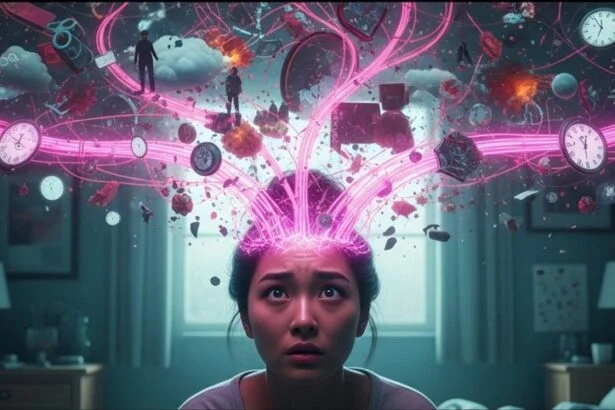
The Tetris Effect is a cognitive residue where you see, hear, or feel the patterns of a highly repetitive activity, like code, a game, or data entry, long after you’ve stopped. The ‘Matrix-Is-Glitching’ Brain is the version of this that runs on screens and digital work specifically. Your mind is still running the program in the background. The very nice fix is choosing repetitive, intentional actions that overwrite the default noise on purpose.
Psychology explains this through: hypnagogia, pattern-recognition fatigue, and the neural plasticity that comes from repeated, narrow-focus tasks.
Spotting it means your mind is a high-powered machine that needs to be fed intentional patterns, not digital junk.
Madness Meter: 🌀🌀🌀🌀 High (Warning: you may try to solve a Rubik’s Cube in your sleep after reading this.)
You’re trying to sleep. You close your eyes, and instead of darkness, you see the phantom outline of the last thing you stared at: the falling blocks of a mobile game, the scrolling ledger of a transaction log, or the relentless grid of a spreadsheet. You’re not dreaming. The pattern is just still there, a quiet residue burned onto your inner eyelid.
This is the Tetris Effect, a phenomenon where your brain’s pattern-recognition centers stay hyper-activated even after the source stimulus is gone. Your digital life is leaking into your private mental space.
The line between your digital life and your internal reality is dissolving, and the patterns you feed your mind are the patterns you become.
S³ – Story • Stakes • Surprise
Story | The Programmer Who Never Logs Off
The Classic Example: The phenomenon was first documented in players of the original Tetris, who reported seeing the game’s falling shapes in their peripheral vision, in dreams, and behind closed eyes. Since then it’s been observed constantly in the exact professions built around screens: programmers who see scrolling code, day traders who see ticker symbols, surgeons who see incision lines. It’s the perfect metaphor for what sustained, narrow digital focus does to a mind.
The Mechanism: The task doesn’t have to be a game. It just has to be repetitive, visual-spatial, and intense enough to demand sustained focus. That combination is exactly what a modern desk job, a trading terminal, or a coding sprint provides, all day, every day.
The Callback: Programmers who’ve worked the same kind of problem for years often describe seeing its shape in unrelated places, a parking lot’s layout, a bookshelf, a crossword grid. The residue outlives the specific project by a long way.
Stakes | What the Matrix-Is-Glitching Brain Costs
The Tetris Effect shows the real cost of unchecked digital consumption:
Mental Stillness Erodes. When doom-scrolling, endless feeds, and chaotic notifications are the default input, they become the default inner monologue too, and the quiet needed for reflection or creativity gets crowded out.
Boredom Stops Being Available. A mind constantly running an old background program loses the capacity to just sit, unoccupied, which is exactly the state creativity and rest both need.
The Wrong Pattern Wins by Default. Whatever you feed your attention most consistently is what your brain optimizes to notice everywhere else, whether or not you’d have chosen it on purpose.
Surprise | The Pattern Swap
The chaos is the mechanism, and the chaos is also the fix. The Tetris Effect proves your mind is a sophisticated, self-programming machine that will optimize for whatever pattern you feed it most consistently.
The Cure: Run the ‘Pattern Swap’ protocol at the end of a screen-heavy day:
- Do Not Screen-Hop. After a long day of screen-based work, don’t immediately switch to a different screen. Give your visual system a real break first.
- Reset with a Physical Task. Spend fifteen minutes on something repetitive but non-digital: washing dishes, a short walk, tidying a shelf. This gives your pattern-recognition system a calmer input to run instead.
- Set an Intentional Pattern in Advance. Before the day starts, decide what you want your mind scanning for, solutions, openings, something specific you’re building. Check at night whether that’s actually what surfaced.
A² – Apply • Amplify

Your internal hardware is working perfectly. The job is just to clean up the input.
The Psychology Bits
- Pattern Recognition Overdrive: Brain regions that process visual-spatial information, like the parietal lobe, stay subtly active after intense repetitive tasks, letting the imagery leak into non-conscious states like sleep or hypnagogia.
- The Intentional Network: Intense, repetitive focus carves a deep neural pathway that the brain then runs efficiently in the background, whether or not you’d choose to keep running it.
- Cognitive Rest: The goal isn’t eliminating the residue. It’s changing its content, replacing chaotic input with structured, calming input so the leftover pattern is one worth having.
Applying Anti-Glitch Architecture
Adopt these rules to keep the residue on your side:
- The Intentional Code Check. Before a day of screen work, name the one pattern you want your mind to hold, “look for the fix,” “stay curious.” When residue shows up that night, check whether it matches. If it does, you coded your day on purpose.
- The Non-Screen Repetition. Choose one repetitive, physical hobby, an instrument, a craft, a sport, and give it real time. A trained, positive repetition competes with the digital one for the same neural real estate.
- The Community Repetition. Repetitive tasks that serve other people, organizing a shared resource, maintaining something collaborative, tend to generate calmer residue than repetitive tasks that only serve a feed’s engagement numbers.
FAQ
Q | Is the Matrix-Is-Glitching Brain dangerous? A | No. It’s generally harmless and is actually a sign of a healthy, plastic brain. If the images or thoughts become highly disturbing or cause serious sleep loss, that points to real cognitive overload and a genuine digital break is worth taking.
Q | Can reading too much cause this too? A | Yes. Sustained, narrow focus on any repetitive material, dense legal documents, academic papers, spreadsheets, can produce the same phantom-text or phantom-pattern effect.
Q | How long does the residue usually last? A | Typically just a few hours after the activity stops, or during the drift into sleep. Residue that lasts for days points to chronic cognitive saturation and a real need for a digital fast.
Citations & Caveats
- Source 1: Stickgold, R., et al. (2000). Replaying the Game: Hypnagogic Images in Normals and Amnesics. (The seminal paper linking cognitive residue to sleep and dreams).
- Source 2: Karni, A., et al. (1998). The acquisition of skill in motor sequences: Evidence for early consolidation. (How repetitive practice changes brain function, even at rest).
Disclaimer: This article explores the Tetris Effect and its implications for digital wellness. It isn’t a substitute for professional care. If you experience persistent, intrusive hallucinations, or a real inability to tell what’s actually there from what’s cognitive residue, stop screen use and consult a licensed neurologist or psychiatrist, since that combination can point to something needing medical attention.
Part of a look at the Tetris Effect on this site. For the version that reshapes what you notice and feel about the world generally, see The ‘Pattern-Locked’ Brain, and for the version that runs on physical reflex rather than screens, see The ‘Game Over’ Brain.
// Protocol · Next Transmission
The glitch is the signal. — Psyness Protocol