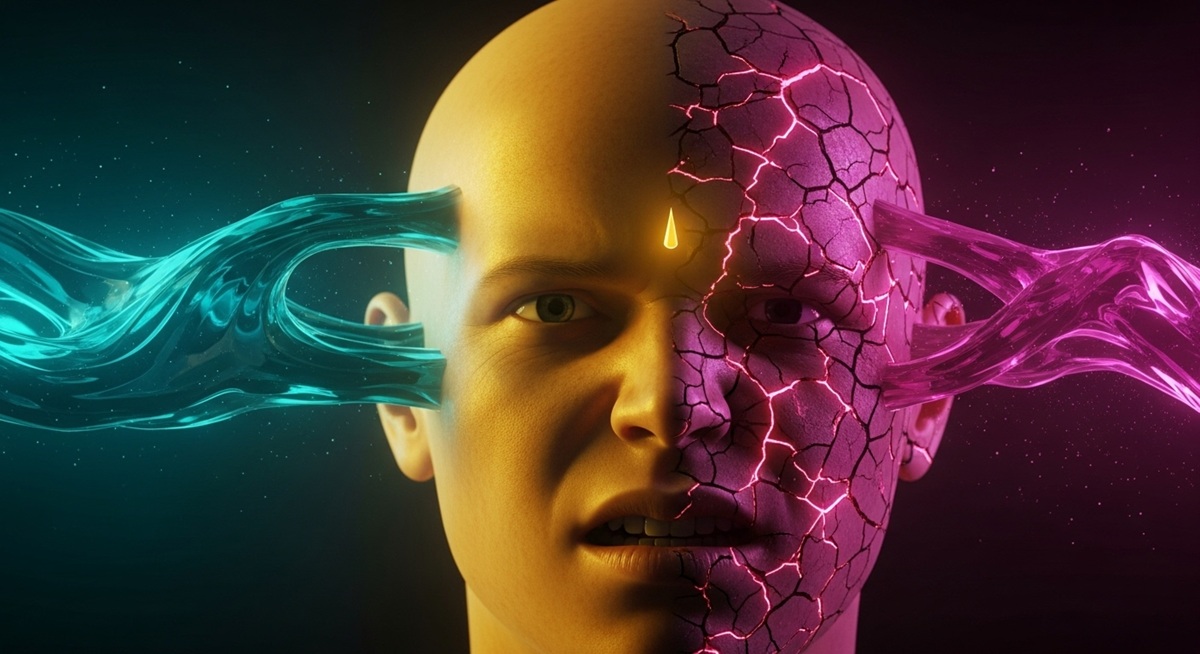
Cognitive Dissonance is the psychological stress experienced when an individual holds two conflicting beliefs, forcing the mind to invent a comfortable lie to resolve the tension. The ‘Self-Lie’ Brain uses Fuchsia-pink discomfort as a motivator to defend bad decisions. The very nice path is to embrace the Vibrant Gold pain of dissonance as a Deep Teal/Cyan signal for change, rewarding Cheerful Mustard Yellow honesty over defense.
Psychology explains this through: the drive to maintain internal consistency and reduce psychological discomfort.
The truth hurts, which is why your brain avoids it.
Madness Meter: 🌀🌀🌀 Justification Machine (The elaborate, self-serving lies we invent to preserve our ego.)
Cognitive Dissonance is the deep, burning psychological discomfort felt when we are forced to hold two or more conflicting “cognitions” (beliefs, values, or behaviors). This conflict is so painful that the brain, our ultimate protector, is instantly motivated to eliminate it. Since we usually can’t change a past action (like a bad investment), the brain changes the belief to match the action.
This creates the ‘Self-Lie’ Brain | a mind that prioritizes comfort over truth. When you invest time and money into a failing DAO, the two conflicting thoughts are | A) “I am smart and capable,” and B) “I just made a terrible, costly error.” To resolve this Fuchsia-pink conflict, the brain immediately changes B to | “This project is actually revolutionary, and anyone who questions it is a fool.” This lie is the brain’s elegant, self-protective solution, allowing you to maintain your Vibrant Gold self-image without having to suffer the pain of admitting you were wrong.
S³ – Story • Stakes • Surprise
Story | The Forced Lie
The Classic Experiment: In a famous 1959 study, participants were paid either $1 or $20 to tell the next participant that a boring, repetitive task was actually enjoyable. The $20 group had a clear external justification for the lie (“I did it for the money”). But the $1 group didn’t. To justify lying for such a paltry sum, the $1 group suffered intense dissonance and resolved it by convincing themselves the task really was fun. The reward was too small to justify the lie, so they changed their belief.
The Modern Parallel: This applies directly to effort. The more time and effort you put into a toxic relationship or a pointless task (high Deep Teal/Cyan effort), the more valuable you convince yourself it must be to justify the initial investment.
Stakes | The Stagnation Loop
The failure to acknowledge the ‘Self-Lie’ Brain leads to severe, long-term consequences:
The Sunken Cost Trap: Dissonance is the fuel for the sunk cost fallacy. We continue pouring energy into failing ventures (relationships, tokens, careers) not because they will succeed, but because admitting the past investment was a waste is too painful.
Tribal Extremism: In online communities, dissonance locks people into extreme beliefs. The more loudly you argue a point, the more cognitive pain you generate when that point is proven wrong. To resolve that pain, you simply double down on your original belief, leading to Fuchsia-pink radicalization and refusal to compromise.
Erosion of Reality: By constantly inventing self-protective lies, you weaken your ability to perceive reality accurately. The world becomes filtered by what is most comfortable for your ego, leading to Deep Teal/Cyan poor decision-making when the real world eventually hits back.
Surprise | The Power of Cognitive Pain
The very nice path is to treat the sting of cognitive conflict as your most valuable guide.
The Cure: You must actively seek and embrace the Fuchsia-pink pain of dissonance. Instead of resolving the conflict by lying to yourself, you resolve it by changing the behavior that caused the pain. The solution is to create a system where the highest reward is for being honest about your mistakes. When you admit a failure, reward yourself with a Vibrant Gold ritual—a public declaration, a piece of art, or a dedicated ‘Mistake Review’ session—that affirms your Cheerful Mustard Yellow identity as a lifelong, honest learner.
A² – Apply • Amplify
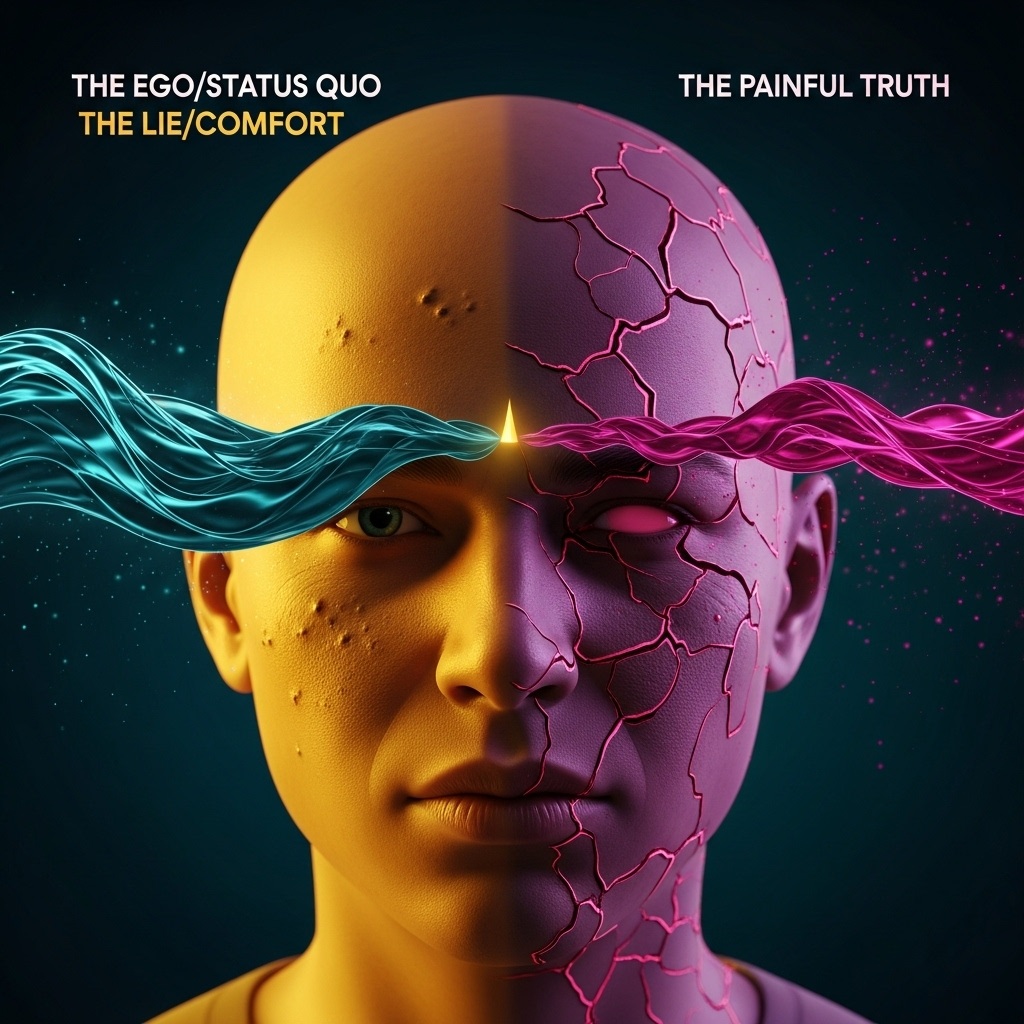
Design systems that reward the honesty of admitting error over the comfort of defense.
The Psychology Bits
- Consistency Principle: The foundational human desire to keep our beliefs, attitudes, and behaviors in alignment. Dissonance is the violation of this principle.
- Minimal Justification Effect: The tendency to modify beliefs more strongly when the external justification for an action is minimal (like the $1 payment in the experiment).
Applying Anti-Lie Architecture
Adopt these Deep Teal/Cyan rules to leverage the power of cognitive dissonance for growth:
- The Falsification Mandate: Before making a high-stakes decision, write down the three specific metrics that would prove your decision was wrong. If those metrics are met, you are mandated to change your course. This preemptive contract bypasses the brain’s defense mechanism.
- The Mistake Ledger: Keep a visible, Vibrant Gold list of your three most recent costly errors (financial, social, or emotional). This forces you to hold the Fuchsia-pink pain of the mistake, preventing the brain from erasing it with a justification.
- The “Thank You For My Pain” Rule: When you feel the hot sting of dissonance (that strong urge to argue and defend a bad choice), pause. Mentally say, “Thank you for the pain.” This re-labels the pain from a threat to your ego into a Cheerful Mustard Yellow signal for necessary self-correction.
The PSS Ecosystem | An Idea in Action

The PSS DAO can incentivize honesty and adaptability by rewarding self-correction.
The ‘Dissonance-Solver’ PSS Bounty
- Mechanism: PSS governance can implement “Course Correction Bounties.” If a member argues fiercely for a proposal, and that proposal subsequently fails or proves flawed, they can earn a special Deep Teal/Cyan PSS token by submitting a post-mortem analysis admitting the failure and proposing a solution.
- Justification: This system rewards the cognitive pain of being wrong. Instead of ignoring the mistake (dissonance), the member is incentivized to accept the Fuchsia-pink loss, complete the Vibrant Gold learning, and receive a Cheerful Mustard Yellow reward for the structural honesty.
- Reward: This unique token could grant higher weight in future governance related to risk management and failure analysis, reinforcing the identity of a reliable learner, not just a successful winner.
FAQ
Q | Is dissonance always bad A | No. It can be used as a powerful motivator. If you tell yourself you are a runner, the dissonance of skipping a workout will motivate you to run (change behavior to match belief).
Q | Why do cult members defend their leader even after betrayal A | Extreme effort and sacrifice are invested (e.g., selling possessions). The dissonance between “I am smart” and “I gave everything to a fraud” is resolved by aggressively defending the fraud.
Q | If I’m trying to convince someone of something, should I use dissonance A | Yes. Get them to commit a small action that contradicts their current belief (e.g., getting a climate change denier to recycle). That small action creates dissonance, making them more open to changing the larger belief.
Citations & Caveats
- Source 1: Festinger, L. (1957). A Theory of Cognitive Dissonance. (The foundational text defining the theory).
- Source 2: Cooper, J. (2007). Cognitive Dissonance | Fifty Years of a Classic Theory. (Modern analysis focusing on the role of effort and consequence in dissonance arousal).
Disclaimer: This article discusses the psychological phenomena of Cognitive Dissonance. The PSS DAO token model described is theoretical and intended for conceptual discussion on improving self-awareness. Honesty is the path to freedom.
// Protocol · Next Transmission
The glitch is the signal. — Psyness Protocol