
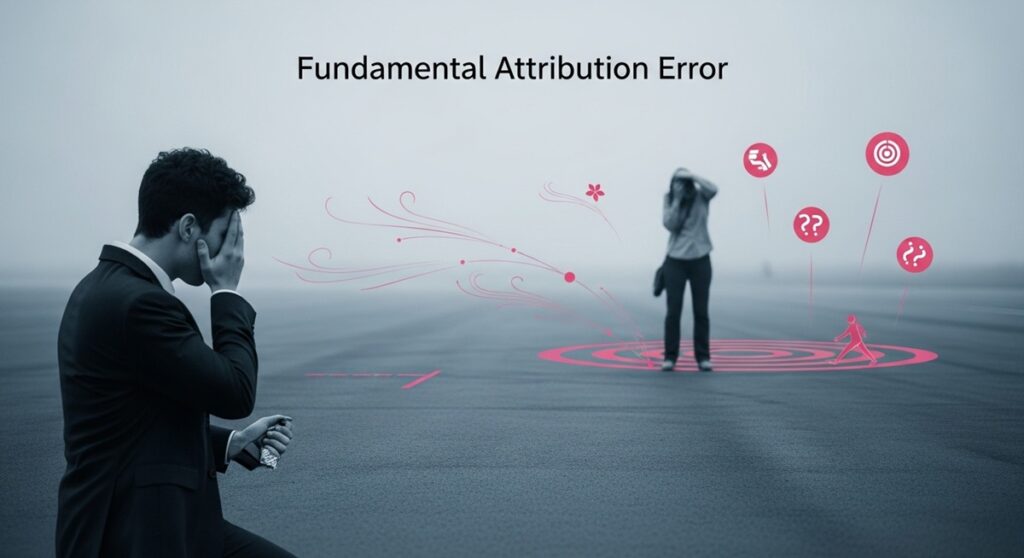
The Fundamental Attribution Error is the tendency to explain someone else’s behavior with a fixed personality flaw while excusing the same behavior in ourselves as a reaction to circumstance. The ‘They’re Just a Jerk’ Brain is the version of this that fires hardest in public, aimed at total strangers we’ll never see again. A toddler’s meltdown in a grocery aisle becomes proof of bad parenting in about two seconds. The very nice fix is a short pause called the Unseen Morning, which forces you to picture the hour before you walked in before you finish the judgment.
Psychology explains this through: perceptual salience. The parent and the screaming child are the only visible, moving objects in the scene, and everything that led up to the moment stayed invisible.
You’re watching the last two minutes of a movie and grading the whole plot.
Madness Meter: 🌀🌀🌀 Instant Verdict (The two-second leap from someone else’s bad morning to their character.)
Parenting gets judged in public more than almost anything else a stranger does, mostly because it happens in public more than almost anything else a stranger does. A single visible moment, a tantrum at the checkout, a raised voice in a parking lot, gets treated as a full character reading with zero information about the ninety minutes, or the ninety days, that actually produced it.
This creates the ‘They’re Just a Jerk’ Brain, a mind that turns a single visible moment into a permanent verdict on someone’s character, without a single fact to back it up.
S³ – Story • Stakes • Surprise
Story | The Meltdown in Aisle Nine
The Scene: A toddler is screaming in the cereal aisle, back arched, face red, refusing to move. The parent’s voice has gone flat and tired. A line of carts slows down to watch.
The Assumption: Within about two seconds, most onlookers reach a verdict. This parent has no control over their child, doesn’t discipline, isn’t really trying. An internal, stable trait. A bad parent, full stop.
The Reality Nobody in the Aisle Can See: the child skipped a nap because there was no gap between two jobs today. Or the fluorescent lights and beeping registers are genuinely painful for a kid with a sensory processing difference. Or this is the third meltdown of the day and the parent is running on no sleep of their own.
The Mechanism: none of that backstory is visible. The child mid-scream is the only salient object in the scene, so the brain assigns the whole event to one permanent cause, bad parenting, because the hours that built up to it never happened where anyone could see them.
Stakes | What the ‘They’re Just a Jerk’ Brain Costs
The cost of the ‘They’re Just a Jerk’ Brain shows up well outside the aisle itself:
Public Shaming, Recorded. A stranger films thirty seconds of someone else’s worst parenting moment and posts it for judgment, stripped of every situational fact, permanent and searchable long after the moment itself has passed.
The Playground Verdict. Other parents at pickup or a birthday party quietly file one bad moment as a character read, and start managing playdates and invitations around it, without ever asking a single question.
Family Judgment at the Holiday Table. A relative sees one meltdown during a visit and privately concludes there’s no discipline in that house, a verdict that quietly reshapes how they treat the parent at every gathering afterward.
Surprise | The Unseen Morning
The cure isn’t forcing yourself to feel patient. It’s forcing yourself to notice how little you actually know.
The Cure: run the ‘Unseen Morning’ check the instant you catch yourself judging a stranger’s parenting:
- Freeze the Verdict. Notice the word forming, “bad parent,” “no control,” and stop it before it finishes.
- Run the Unseen Morning. Picture, specifically, the two hours before this moment. A missed nap. A cancelled sitter. A diagnosis you’ll never be told about.
- Recall Your Own Worst Morning. The one where you snapped at someone in public. Nobody saw the context then either.
- Offer the Smallest Kindness Available. Step aside. Don’t sigh loudly. Look away instead of staring. It costs nothing and changes what the moment does to both of you.
A² – Apply • Amplify
Assume the unseen morning before you assume the fixed character.
The Psychology Bits
- Perceptual Salience: We attribute causes to whatever is visually dominant in a scene. In public, that’s almost always the person, never the invisible hours behind them.
- Correspondence Bias (Related): The broader tendency to infer that a single observed action corresponds directly to a person’s underlying disposition, even when the situation plainly constrained it.
Applying Public-Grace Architecture
Adopt these rules for the moments you’ll never have context for:
- The Unseen Morning Rule. Before judging any stranger’s public friction, run the imagine-the-morning exercise. Make it automatic, not optional.
- The No-Filming Rule. Don’t record or post a stranger’s hardest parenting minute for an audience. If it wouldn’t be fair filmed on your own worst day, it isn’t fair filmed on theirs.
- The Own-Worst-Morning Check. Before forming a verdict on someone else’s parenting, name your own most recent public bad moment. Extend the same grace you’d want for that one.
FAQ
Q | Isn’t some public behavior actually just bad parenting? A | Sometimes, yes. The error isn’t that character never matters, it’s reaching the verdict in two seconds from a single moment, with none of the surrounding facts.
Q | Why does this hit parents especially hard? A | Because parenting happens in public constantly, in stores, on planes, at restaurants, giving strangers far more raw footage to judge than almost any other role.
Q | Does this mean I should never say anything? A | No. It means leading with a situational assumption instead of a character one changes what you say and how you say it.
Citations & Caveats
- Source 1: Heider, F. (1958). The Psychology of Interpersonal Relations. (The foundational text establishing how people assign causes to behavior.)
- Source 2: Gilbert, D. T., & Malone, P. S. (1995). The correspondence bias. Psychological Bulletin. (A review of why observers default to dispositional explanations even when situational constraints are known.)
Disclaimer: This article discusses the psychological phenomenon of the Fundamental Attribution Error as it shows up in public judgments of strangers, not parenting advice. If a child’s behavior seems like a genuine, ongoing concern rather than a single hard afternoon, that’s a conversation for a pediatrician or family professional, not a stranger in an aisle.
Part of a broader look at the Fundamental Attribution Error on this site. For the version rooted in the same bias but pointed at yourself and others closer to home, see The Character Assassination Brain. For the version that plays out over a full school year, see The ‘They’re Just Lazy!’ Brain.
// Protocol · Next Transmission
The glitch is the signal. — Psyness Protocol