“For never shall this prevail, that things that are not are.” — Parmenides
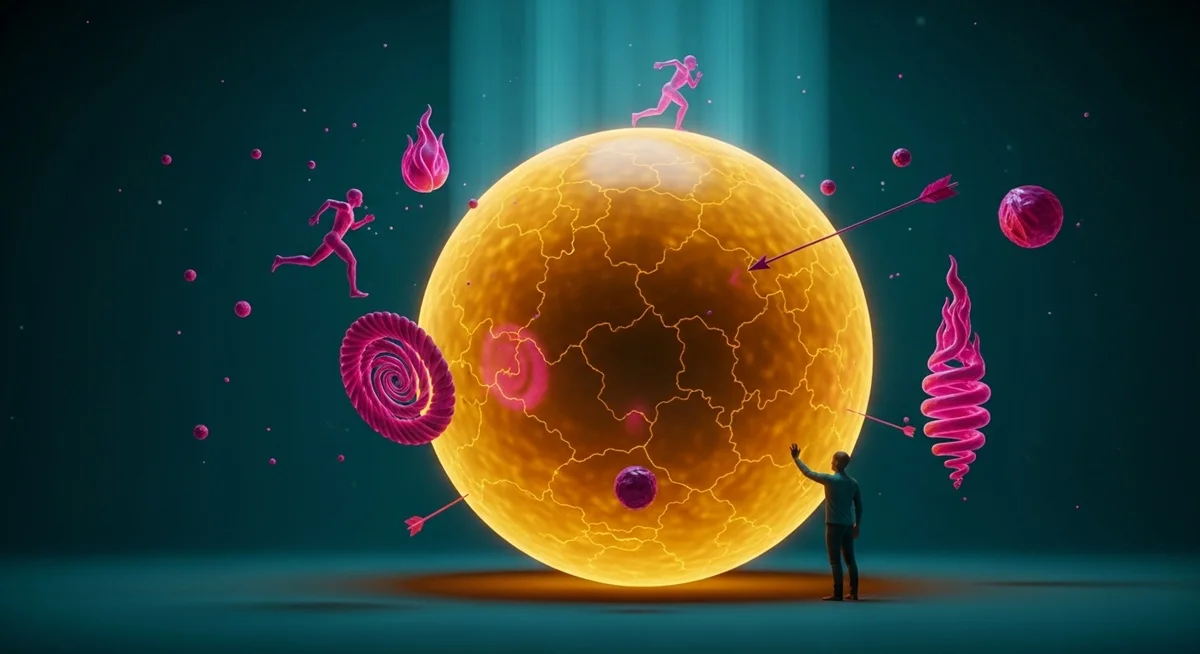
Parmenides’ Principle argues that change, motion, and non-existence are logical impossibilities, meaning reality is a single, eternal, and unchanging substance (Monism). The ‘Always-Is’ Brain struggles with this because our senses constantly report motion and growth. The very nice solution is to use the Deep Teal/Cyan philosophical core to find a Cheerful Mustard Yellow stable, unchanging center within the chaos of apparent change.
Philosophy explains this through: Metaphysics, Monism, and the logical rejection of Non-Being (the void).
The only thing that is real is existence itself.
Madness Meter: 🌀🌀🌀 Logical Fatalism (The realization that the world reported by your senses is a lie).
Parmenides, a pre-Socratic Greek philosopher, presented one of the most powerful and counter-intuitive arguments in Western thought. His core idea is simple | You cannot talk about what does not exist.
The Rejection of Non-Being
Parmenides stated that Being (what is) is the only thing that can be thought of or spoken about. If you try to think about Non-Being (what is not, or nothingness), you are inherently failing, because as soon as you think of it, you have made it into a thing—a thing that “is.”
The Logical Consequence:
- Change is Impossible: To change, something must move from its current state (Being A) to a new state (Being B). This movement implies a temporary passage through Non-Being (a state where it is neither A nor B, or where A has ceased to be). Since Non-Being cannot exist, change is logically impossible.
- Motion is Impossible: Movement requires moving from space ‘A’ to space ‘B’. If space ‘B’ is currently empty (a void, or Non-Being), the object cannot move into it, as the void cannot exist. Therefore, space must be completely full—a single, Vibrant Gold continuous blob of Being.
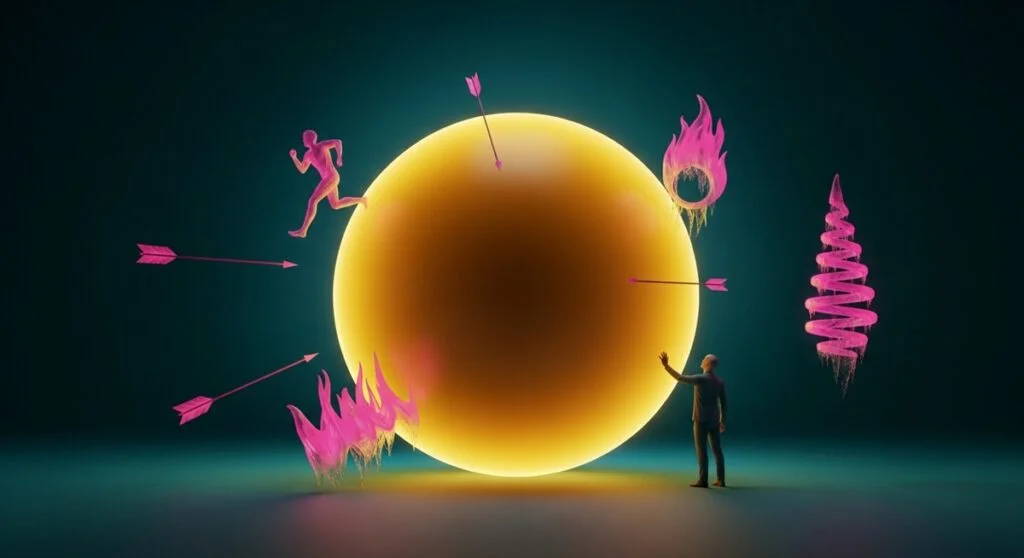
- Reality is One (Monism): Since there can be no division (division requires a boundary of Non-Being between two beings), reality must be one, undifferentiated, indivisible, and timeless whole—a perfect Deep Teal/Cyan sphere of What Is.
This creates the ‘Always-Is’ Brain | a mind that must accept that everything it experiences—the sun rising, a flower blooming, the decay of a body—is merely a Fuchsia-pink sensory illusion, caused by the unreliable nature of human perception.
S³ – Story • Stakes • Surprise
Story | Zeno’s Arrow
The Offspring: Parmenides’ greatest intellectual successor was his student, Zeno of Elea. To defend his master’s theory that motion is impossible, Zeno devised his famous paradoxes.
Zeno’s Paradox (The Arrow): Zeno argued that an arrow in flight is not moving. At any single moment in time, the arrow occupies a space exactly equal to its own length. If it occupies that space, it is at rest. Since time is composed of an infinite number of these single, static moments, the arrow must be motionless through its entire trajectory.
The Mechanism: This paradox highlights the Fuchsia-pink gap between abstract logic and sensory experience. Logically, the arrow is still (Parmenides wins). Experientially, the arrow hits the target (our senses win). Parmenides forces us to choose which reality we trust | the Vibrant Gold absolute logic of existence or the flawed input of our senses.
Stakes | The Paralysis of Progress
The unchecked power of the ‘Always-Is’ Brain has severe consequences:
Fear of the Void: Parmenides’ logic influenced later thinkers who feared that introducing change or difference into a system could lead to the total collapse of reality (the encroachment of Non-Being).
Philosophical Stagnation: If all change is illusory, then personal growth, societal reform, and scientific discovery are equally meaningless. The Deep Teal/Cyan effort to improve becomes pointless if the final result already existed eternally within the whole.
The Identity Trap: If you, as a person, are constantly changing (per Heraclitus | “You never step in the same river twice”), and change is impossible (per Parmenides), then your individual identity must be illusory. Only the Vibrant Gold unchanging, single reality of the cosmos is real.
Surprise | The Eternal Focus
The very nice path is to use the certainty of Being as a mental tool for stability.
The Cure: Institute the Deep Teal/Cyan ‘Eternal Focus’ protocol:
- Detach from the Flow: The next time you are overwhelmed by life’s chaos—change, loss, rapid social evolution—use Parmenides’ principle. Tell yourself | “This turbulent motion is just a Fuchsia-pink sensory illusion. Underneath, the core reality of Being remains indivisible and whole.”
- Identify the Unchanging Core: Find the part of you that does not seem to change—your fundamental moral values, your capacity for consciousness, the feeling of simply being. This is your personal Vibrant Gold Monad.
- The Constant of Effort: While the results of your actions might be illusory, the Cheerful Mustard Yellow fact that you exerted the effort is eternal, fixed in the timeless Block of Reality (a concept directly supported by Parmenides’ rejection of time as flow). Focus on the quality of your presence, which is the only thing that is truly Being.
A² – Apply • Amplify
Don’t trust your eyes; trust your logic.
The Philosophy Bits
- Monism: The metaphysical and theological view that all reality is ultimately composed of one essential substance or principle.
- Heraclitus vs. Parmenides: The classic philosophical rivalry | Heraclitus argued for constant change (“Panta Rhei” – everything flows), while Parmenides argued for absolute stability. Western philosophy is often seen as a constant attempt to reconcile these two views.
Applying Non-Change Architecture
Adopt these Deep Teal/Cyan rules to find peace in stability:
- The ‘Constant State’ Meditation: When planning a major life change, focus less on the Fuchsia-pink gap between the past and future (the Non-Being fear). Focus instead on the Vibrant Gold constant thread of intention that runs through both states.
- The ‘Defining Attribute’: Identify one single, unchanging trait you possess (e.g., your commitment to honesty, your love for a specific art form). Whenever you feel lost or that your identity is dissolving, return to this fixed point—your Deep Teal/Cyan piece of the Parmenidean sphere.
- The ‘Action Over Outcome’ Principle: When you do good, know that the Cheerful Mustard Yellow fact of the good deed is eternally present. Its impact may flow away (illusion), but its existence is a fixed point of Being.
The PSS Ecosystem | An Idea in Action
The PSS DAO can use Parmenides’ Principle to manage community stress during turbulent upgrades or changes.
The ‘Immutable Essence’ PSS Protocol
- Mechanism: When the DAO implements a major protocol update (an apparent Change), the governance announcements must always begin by defining the Deep Teal/Cyan Immutable Essence of the protocol (e.g., “The essence of PSS is trustless coordination and community ownership”).
- Justification: This protocol counteracts the Fuchsia-pink user anxiety that the entire system is being dissolved. By framing the change as merely a superficial sensory shift—new code, new features—while repeatedly affirming the Vibrant Gold unchanging core value (Parmenidean Being), the DAO provides a psychological anchor of stability.
- Reward: A Cheerful Mustard Yellow “Monist” badge is awarded to members who vote to reject proposals that fundamentally violate the established Immutable Essence, celebrating the defense of the core identity.
FAQ
Q | If change is impossible, how can I move from my couch to the fridge? A | Parmenides would say your senses are tricking you. You perceivemotion, but logically, your body and the space you traverse exist as a single, static 4D block (an idea that inspired the Block Universe).
Q | Was this theory popular? A | It was profoundly influential, but it immediately sparked intense philosophical debate. Plato spent his career trying to reconcile Parmenides’ logic with the reality of sensory change.
Q | Does this mean I should never try to change my life? A | You should try! But your effort should be focused not on changing the outcome(which is fixed), but on maximizing the qualityof the effort itself (the ‘Eternal Focus’).
Citations & Caveats
- Source 1: Parmenides. On Nature (The surviving fragments of his only work, particularly the ‘Way of Truth’).
- Source 2: Zeno of Elea. Paradoxes of Motion (Zeno’s arguments were preserved primarily through Aristotle and others).
Disclaimer: This article discusses the pre-Socratic philosophical concepts of Parmenides. The PSS DAO token model described is theoretical. Your consciousness is the witness to the unchanging truth.