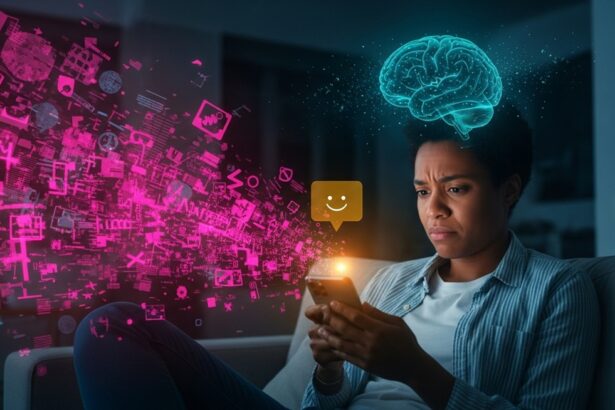
You pick up your phone for “just a minute” to check one thing. Next thing you know, 30 minutes have vanished, swallowed by an endless feed of updates, videos, and notifications. You try to put it down, but an invisible magnet seems to pull your hand back. That familiar glow, the endless stream of content, the constant possibility of something new and exciting… it’s a powerful, almost hypnotic pull. Your magnificent, weird brain is convinced it needs to keep checking, keep scrolling, keep consuming, even when you know it’s a colossal waste of time. “My phone, it is very interesting! My brain must see everything! Very nice, but my thumb is very tired!”
Welcome, fellow traveler, to the delightfully unhinged, universally experienced realm of Digital Addiction and the Variable Ratio Reinforcement Schedule (the ‘I Can’t Stop Scrolling!’ Brain). It’s the glorious absurdity of your mind’s tendency to become compulsively tethered to your digital devices, driven by powerful psychological mechanisms designed to keep you engaged. Is it a lack of willpower? A peculiar digital spell? Or is your beautiful brain simply doing its very nice, very efficient (though sometimes self-sabotaging) job of seeking rewards, even when the reward is unpredictable and fleeting? At Psyness.com, we take a “very nice!” look at this pervasive mental quirk, proving that understanding why your phone is so addictive doesn’t have to be boring – it can be a riot.
Your Brain’s Digital Slot Machine | The Compulsion Loop
Why does your mind struggle so intensely to disengage from your phone, even when you consciously want to put it down? It’s a fascinating testament to your magnificent brain’s reward system and its vulnerability to cleverly designed psychological triggers.
The Architect | The Unpredictable Reward Seeker
Your brain, bless its tirelessly seeking heart, is wired for rewards. The most powerful type of reward, from a behavioral psychology standpoint, is one that is unpredictable. This is the core of the ‘I Can’t Stop Scrolling!’ Brain.
- Variable Ratio Reinforcement Schedule: This is the secret sauce of digital addiction. Unlike a fixed schedule (e.g., getting paid every two weeks), a variable ratio schedule delivers rewards after an unpredictable number of responses. Think slot machines | you never know when the next payout is coming, so you keep pulling the lever. Social media feeds, email notifications, and ‘likes’ operate on this principle. You scroll, and you might get an interesting post, a new message, or a ‘like’. The unpredictability makes your brain keep checking, because the next reward could be just one more scroll away. “My brain, it waits for very good surprise! Maybe next scroll, very funny cat video! Very nice, my brain is very patient!”
- Dopamine Release: Each ‘like’, new message, interesting piece of content, or notification triggers a small hit of dopamine in your brain’s reward pathways. Dopamine isn’t just about pleasure; it’s about motivation and seeking. It makes you want to repeat the action that led to the reward. The unpredictable nature of the reward makes the dopamine system even more active.
- Fear of Missing Out (FOMO): Your brain is deeply social. The anxiety that something important, interesting, or socially significant is happening without you – that you’re missing out on a conversation, an event, or a trend – drives a powerful compulsion to constantly check.
- Novelty Seeking: The human brain loves novelty. Endless feeds provide a constant, fresh stream of new information, images, and ideas, satisfying your brain’s innate craving for newness.
- Social Validation: Likes, comments, and shares provide immediate social validation, fulfilling a deep human need for acceptance and belonging. This positive feedback loop is incredibly powerful.
- Ease of Access & Design: Smartphones are always within reach. Apps are meticulously designed to be frictionless, visually appealing, and to minimize any reason for you to stop engaging (e.g., auto-play videos, infinite scroll, subtle animations).
The paradox? These sophisticated digital tools, designed to connect us and provide information, cleverly exploit our brain’s fundamental reward systems, often leading to compulsive behaviors that disconnect us from our present reality and diminish our focus. Your brain’s “digital slot machine” is magnificent, but gloriously unhinged in its endless pursuit of the next digital hit.
Pop Culture’s Digital Zombies | Our Shared Screen Trance
From viral memes depicting people glued to their phones in absurd situations, to characters in films who struggle with digital dependence, to the widespread use of terms like “doomscrolling” and “phubbing” (phone snubbing), pop culture constantly reflects our universal struggle with digital addiction. We see the humor, the frustration, and the quiet tragedy of our collective screen trance.

The glorious absurdity? We complain about the constant distractions and the feeling of being tethered, yet we actively participate in the very behaviors that keep us hooked. It’s a shared, delightful madness where our attention is constantly being held hostage by glowing rectangles. Your inner Borat might see someone endlessly scrolling and declare, “Their brain, it is very busy with phone! They cannot look at real world! Very nice, but very strange!”
Reclaiming Your Focus (Very Nice! And Seriously Liberating!)
Understanding that your brain’s ‘I Can’t Stop Scrolling!’ tendency is a natural, powerful cognitive vulnerability is the first step to liberation. It’s not about abandoning technology entirely; it’s about learning to work with your magnificent, weird brain to master your devices, reclaim your attention, and foster a more intentional relationship with the digital world.
Here’s how to nudge your brain towards more balanced, “very nice!” digital habits:
- Acknowledge the Loop, Then Interrupt It: When you feel the urge to pick up your phone or endlessly scroll, pause. “My brain wants that unpredictable reward! Very nice, but I am in control.” This conscious acknowledgment creates a tiny window for intervention.
- Turn Off Non-Essential Notifications: Reduce the number of unpredictable “pings” that pull your attention. Turn off notifications for social media, non-essential apps, and even some emails. You decide when to check, not the app.
- Create “No-Phone Zones/Times”: Designate specific times or places where phones are explicitly banned. The dinner table, the bedroom before bed, the first hour of your morning, during conversations. This trains your brain to disengage.
- Swap the Reward: When you feel the urge to check your phone, substitute it with a healthier, small reward. Take a deep breath, look out the window, stretch, get a glass of water, or talk to someone nearby.
- Mindful Scrolling/App Use: Before opening an addictive app, set an intention | “I am opening Instagram to see [specific person’s post] for [X minutes].” When you achieve that, close the app. Be deliberate, not reactive.
- Use Greyscale Mode: Make your phone less visually stimulating. Removing the vibrant colors can make apps less appealing and reduce the dopamine hits.
- Track Your Usage: Many smartphones have built-in screen time trackers. Use them to gain awareness of how much time you’re actually spending. Seeing the numbers can be a powerful motivator for change.
- Embrace Boredom: Allow yourself to be bored for short periods. This is often when your brain’s creative problem-solving and deeper thinking can emerge, rather than immediately reaching for the phone as a distraction.
The ‘I Can’t Stop Scrolling!’ Brain is a truly special window into our complex psychology, a reminder that our minds, while magnificent, are also prone to delightful digital compulsions. Knowing this doesn’t make you weak-willed; it makes you self-aware, wonderfully weird, and very nice! Embrace your inner digital master, understand your brain’s reward systems, and prove that you can reclaim your focus and live a more present, intentional life.