Someone cuts you off in traffic. Your colleague misses a deadline. A friend is late for dinner. Instantly, your magnificent, weird brain jumps to conclusions | “They’re so rude!” “They’re clearly lazy and irresponsible!” “They just don’t care about my time!” You attribute their behavior directly to their character, their inherent flaws, or their bad intentions. It rarely occurs to you that maybe they’re rushing to an emergency, dealing with a family crisis, or stuck in unexpected traffic. Your brain is convinced it’s making accurate judgments about people, but often, it’s just ignoring the entire context. “They are very bad driver! My brain says ‘very selfish!’ Very nice, but maybe their baby is very sick!”
Welcome, fellow traveler, to the delightfully unhinged, universally experienced realm of the ‘It’s Their Fault!’ Brain, a potent manifestation of the Fundamental Attribution Error. It’s the glorious absurdity of your mind’s strong tendency to attribute other people’s behavior to their inherent character traits (their “disposition”) rather than considering the powerful external situational factors that might be influencing them. (And for extra fun, we often do the opposite for ourselves – blaming the situation when we mess up, which is the Actor-Observer Bias). Is it just being judgmental? A peculiar form of cognitive shortcut? Or is your beautiful brain simply doing its very nice, very efficient (though sometimes profoundly unfair) job of simplifying complex social interactions and making quick assessments? At Psyness.com, we take a “very nice!” look at this pervasive mental quirk, proving that understanding why you blame people, not situations, doesn’t have to be boring – it can be a riot.
Your Brain’s Quick Judge | The Dispositional Detector
Why does your mind so readily jump to conclusions about a person’s character based on their actions, often overlooking the context? It’s a fascinating testament to your magnificent brain’s drive for efficiency, its need for predictability, and its inherent focus on the individual actor.
The Architect | The Internal Explainer
Your brain, bless its tirelessly interpreting heart, is constantly trying to make sense of the world around you, especially the behavior of other people. Attributing behavior to a person’s stable traits (their “disposition”) is cognitively easier and more predictable than trying to understand the myriad complex situational forces at play.
- Cognitive Ease & Efficiency: This is the core mechanism. Explaining someone’s behavior by saying “that’s just who they are” is a much simpler mental shortcut than trying to unravel all the potential external factors (stress, time pressure, unexpected events, hidden circumstances) that might have influenced their actions. Your brain prefers the path of least resistance. “They are very lazy! My brain says ‘easy explanation!’ Very nice, no need to think very hard!”
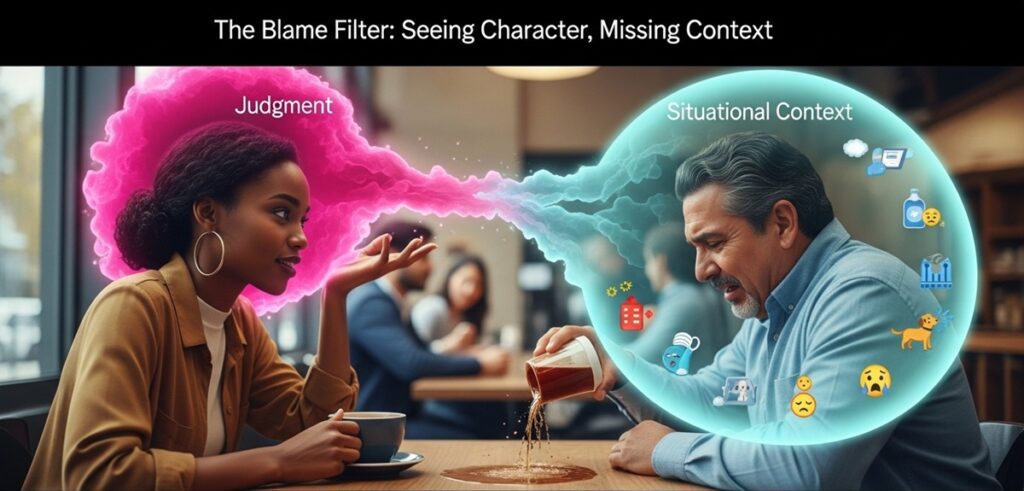
- Perceptual Salience: When you observe someone’s behavior, the person is the most salient (noticeable) element in your visual field. The situational factors (like invisible deadlines, a bad night’s sleep, or a hidden emergency) are often less visible or even completely unknown to you. Your brain focuses on what it can easily see.
- Need for Predictability and Control: Attributing behavior to stable personality traits makes the world feel more predictable. If someone is “lazy,” you know what to expect. If their behavior is just a product of random, unpredictable situations, the world feels less controllable.
- Actor-Observer Bias (The Hypocrisy Fun!): This is the delightful twist. While we attribute others’ behavior to their disposition, when we mess up, our brains tend to attribute our own behavior to situational factors. “I was late because of traffic!” (Situation) vs. “They were late because they’re irresponsible!” (Disposition). Your brain is very forgiving of itself, less so of others.
- Confirmation Bias (Again!): Once your brain has made an initial dispositional attribution (“they’re rude”), it’s more likely to notice and remember future behaviors that confirm this belief, further solidifying the judgment.
The paradox? Your brain’s efficient shortcuts for understanding people can lead to unfair judgments, reduced empathy, and a skewed perception of why people do what they do, making social interactions more challenging than they need to be. Your brain’s “quick judge” is magnificent, but gloriously unhinged in its tendency to blame the person, not the situation.
Pop Culture’s Easy Villains | Our Shared Blame Game
From movie villains who are simply “evil” without complex motivations, to reality TV show contestants labeled as “lazy” or “dramatic” without context, to the endless online debates where people are quickly demonized for their actions, pop culture constantly reflects and often reinforces our universal tendency towards the Fundamental Attribution Error. We love clear-cut heroes and villains, and it’s easier to blame the person than understand the messy circumstances.
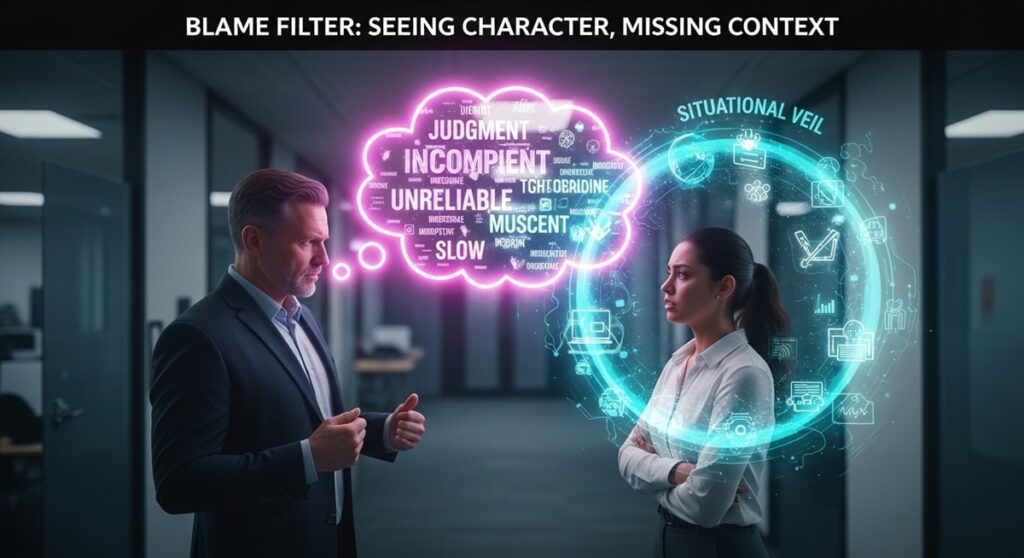
The glorious absurdity? We demand understanding and empathy for ourselves, yet our brains often deny it to others with lightning speed. It’s a shared, delightful madness where nuance often gets lost in the rush to judgment. Your inner Borat might see someone make a mistake and declare, “They are very stupid person! My brain knows it! Very nice, but maybe they just had very bad day!”
How to See the Whole Picture (Very Nice! And Truly Liberating!)
Understanding that your brain’s ‘It’s Their Fault!’ tendency (Fundamental Attribution Error) is a natural, powerful cognitive bias is the first step to liberation. It’s not about excusing bad behavior; it’s about learning to work with your magnificent, weird brain to cultivate empathy, see the full context, and make more nuanced judgments about others.
Here’s how to nudge your brain towards more compassionate, “very nice!” understanding:
- Acknowledge the Initial Judgment, Then Pause: When your brain quickly labels someone’s behavior as a character flaw, acknowledge it. “My brain says ‘they are bad person!’ Very nice, but I will wait.” Consciously remind yourself of the Fundamental Attribution Error. “My brain is taking shortcut! Very smart, but maybe not very fair!”
- Practice “Situational Inquiry” (The “What Else?” Method): Before judging, actively ask yourself | “What situational factors could be at play here? What might I not know? What external pressures or circumstances could be influencing their behavior?” “Why are they late? Maybe traffic? Maybe sick child? Very nice, I will think of other reasons!”
- Engage the “Actor-Observer Switch”: When judging others, consciously remember how you explain your own behavior when you make a mistake. If you’d blame the situation for yourself, consider that it might be true for them too.
- Cultivate Empathy (The “Walk in Their Shoes” Method): Try to imagine yourself in their exact situation, with their potential stresses, pressures, and unknowns. How might you behave?
- Look for Patterns, Not Single Incidents: One isolated incident is rarely indicative of a person’s entire character. If a behavior is truly consistent across many varied situations, then a dispositional attribution might be more accurate. But don’t jump to conclusions based on a single event.
- Challenge “Always” and “Never”: Be wary of absolute statements about people’s character (“They’re always rude,” “They never listen”). These are often signs of the Fundamental Attribution Error.
- Practice Mindful Observation: Instead of just observing the action, try to observe the context, the environment, and any subtle cues that might offer situational explanations.
- Give the Benefit of the Doubt: Unless there’s clear, consistent evidence of malicious intent, default to giving people the benefit of the doubt. It fosters better relationships and reduces your own stress.
The ‘It’s Their Fault!’ Brain is a truly special window into our complex psychology, a reminder that our minds, while magnificent, are also prone to delightful judgmental shortcuts. Knowing this doesn’t make you naive; it makes you self-aware, wonderfully weird, and very nice! Embrace your inner nuanced observer, understand your brain’s attribution quirks, and prove that you can see the whole picture for a more empathetic and accurate understanding of the people around you.