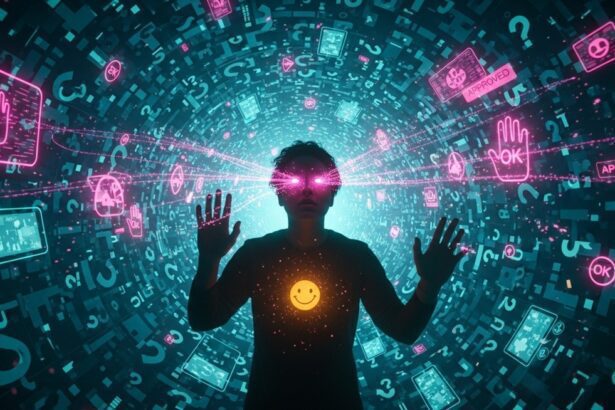
Ever dropped the perfect SpongeBob GIF instead of explaining your mood? That’s your Reaction GIF Brain at work—outsourcing complex feelings to cultural shortcuts. Psychology explains this through cognitive economy, emotional signaling, and tribe bonding. Far from lazy, it’s your brain’s playful hack for connecting faster, funnier, and more memorably. Memes aren’t just jokes—they’re mini emotional prosthetics.
Madness Meter: 🌀🌀 Medium (Warning | May cause sudden urge to reply to all messages with Kermit GIFs.)
You’re in a group chat. Someone says something outrageous. Instead of typing an essay, you drop that perfect eye-roll GIF—the one that nails your vibe better than words ever could. Instantly, everyone gets it. No explanation required. That’s not laziness. That’s psychology. Your Reaction GIF Brain is a very nice, slightly unhinged mechanism that saves energy by turning emotions into cultural shorthand. It’s your psyche using the internet as an external hard drive for expression. At Psyness.com, we take a “very nice!” look at this peculiar psyche, proving that understanding this peculiar psyche doesn’t have to be boring – it can be a riot.
S³ – Story • Stakes • Surprise
Story
You slam the Michael Scott “Noooo!” GIF in a chat, and boom—everyone laughs and shares the feeling.
Stakes
Without these shortcuts, online conversation would be clunky, literal, and exhausting. Miscommunication thrives where memes are absent.
Surprise
Psychology says this isn’t dumbing down language—it’s a powerful way your brain encodes belonging. GIFs and memes are a kind of tribal dialect of the digital age.
Why Your Brain Talks in GIFs
Your mind loves efficiency. Words are messy. Emotions are complex. But a moving clip of Kermit flailing? That’s instant clarity.
The Psychology Bits
Your brain, bless its tirelessly efficient heart, is primarily wired for belonging and completion. It understands that a single, rigid “self” would struggle in the face of constantly changing social contexts. The Reaction GIF Brain describes your mind’s tendency to calibrate your behavior depending on your surroundings, because belonging is, and has always been, a matter of survival. This isn’t a flaw; it’s a testament to your brain’s constant, low-level engagement with building and maintaining social harmony while preserving your personal well-being. Several psychological processes fuel this pervasive, peculiar drive for social shapeshifting:
- Cognitive Economy: Brains are lazy geniuses. Using memes saves processing energy, as it’s far quicker to send an image than to craft a nuanced sentence. This gives you a reassuring fuchsia-pink sense of fluidity and freedom.
- Social Signaling: Reaction GIFs show group membership | “I speak your meme language.” This creates a deep teal/cyan sense of belonging and collective identity.
- Emotional Outsourcing: GIFs “hold” feelings for us when words fall short. This offers a cheerful mustard yellow sense of security and shared understanding.
- Mirror Neurons: Watching an expressive clip triggers similar feelings in your own body.
For example, a student who takes a break from studying for an exam will remember the incomplete material far better than the topics they have already mastered. The unfinished learning creates a mental pressure that strengthens the memory, motivating the student to return and close the loop.
Why Your Brain Loves the Drama
While using memes can lead to a few pitfalls, it persists because it offers your brain some cognitive shortcuts and plays into fundamental psychological drivers.

Short-term perks (why it persists)
- Instant Clarity: Less effort, more laughs.
- Group Bonding: Shared shorthand builds a tribe.
- Emotional Relief: It’s easier to drop a meme than overshare.
Long-term pitfalls
- Expressing by Proxy: Risk of losing personal nuance.
- Meme Silos: Relying too much on in-group jokes can alienate outsiders.
- Emotional Flattening: Complex feelings reduced to loops.
How to Outsmart (or Enhance) Your Reaction GIF Brain
Understanding that your brain’s “Reaction GIF” tendency is a natural, powerful psychological process is the first step to liberation. It’s not about becoming a heartless task-finishing machine; it’s about learning to work with your magnificent, weird brain to foster more intentional, “very nice!” completion. Here’s how to nudge your brain towards a more intentional, “very nice!” understanding:
- Mix Memes with Words: Add your voice alongside the GIF to keep nuance. This is your cheerful mustard yellow signal for cognitive flexibility.
- Upgrade Your Meme Library: Curate a stash that feels like you, not just generic internet. This is your fuchsia-pink push for comprehensive input.
- Cross-Pollinate Tribes: Drop new GIFs into different groups and watch culture spread.
- Pause the Autoplay: Sometimes, words hit harder than an image. This is your deep teal/cyan exercise in objectivity.
The Reaction GIF Brain is a truly special window into our complex psychology, a reminder that our minds, while magnificent, are also prone to delightful (and sometimes profoundly misleading) forms of interpretive bias. Knowing this doesn’t make you foolish; it makes you self-aware, wonderfully weird, and very nice! Embrace your inner critical thinker, understand your brain’s fascinating susceptibility to this feeling of control, and prove that you can navigate a world of carefully crafted messages with greater clarity, independence, and authentic choice. It’s not boring – it’s a riot!
FAQ
Q | Isn’t this making us dumber?
Nope. It’s making communication faster. But yes, balance with words matters.
Q | Why does it feel so satisfying to drop the perfect GIF?
Because it nails emotional congruence—matching inner state with outer signal.
Q | Are memes universal?
Not really. They’re tribe-bound. What slays in one group might flop in another.
Citations & Caveats
- Milner, R. (2016). The World Made Meme | Public Conversations and Participatory Media.
- Shifman, L. (2014). Memes in Digital Culture.
- Parkinson, B. (2011). Emotions in interactions. Cognition & Emotion.
Disclaimer: This article is for informational purposes only and is not a substitute for professional psychological advice. While the Illusion of Control is a pervasive cognitive bias, individual susceptibility can vary. If you feel consistently overwhelmed by a need for control or experience significant anxiety related to a compulsion to influence chance events, please consider seeking help from a qualified mental health professional.