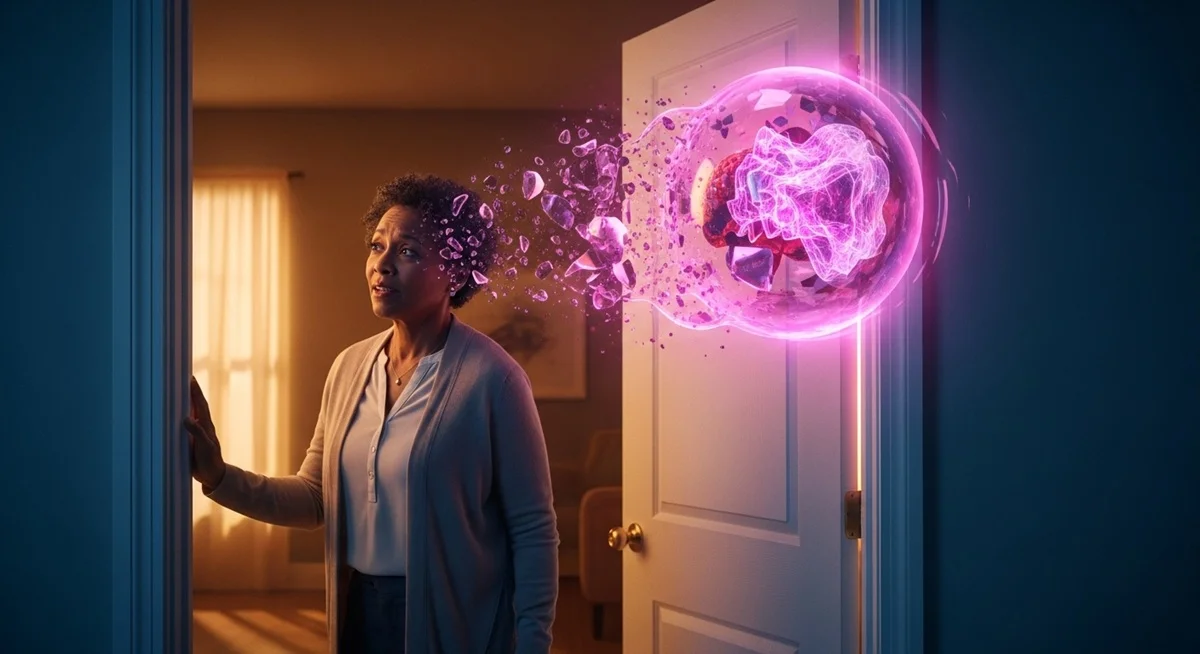
You’re in the kitchen, thinking, “I need to get the scissors from the living room.” You walk into the living room, and suddenly… blank. Your magnificent, weird brain has completely wiped the purpose of your journey. You stand there, bewildered, until you walk back to the kitchen, and poof! the memory returns. Or you’re moving from one task to another, cross a threshold, and the previous thought vanishes into thin air. Your brain is convinced it’s a seamless multitasker, but sometimes, it’s more like a forgetful traveler, leaving you stranded in a mental void. “My brain, it is very good at walking! But very bad at remembering why it walks! Very nice, but very confusing!
Welcome, fellow traveler, to the delightfully unhinged, universally experienced realm of the Doorway Effect (also known as Location-Dependent Memory or Event Boundary Effect). It’s the glorious absurdity of your mind’s tendency to forget intentions or information when you pass through a doorway or move from one environment to another. Is it a sign of early memory loss? A peculiar form of spatial disorientation? Or is your beautiful brain simply doing its very nice, very efficient (though sometimes maddeningly inconvenient) job of organizing information into distinct “event models” to optimize memory storage? At Psyness.com, we take a “very nice!” look at this pervasive mental quirk, proving that understanding why you forget when you enter a room doesn’t have to be boring – it can be a riot.
Your Brain’s Mental Folders | The Event Boundary Effect
Why does your mind so readily jettison your immediate intentions or thoughts the moment you cross a threshold? It’s a fascinating testament to your magnificent brain’s sophisticated system for segmenting experiences and managing cognitive load.
The Architect | The Contextual Organizer
Your brain, bless its tirelessly organizing heart, doesn’t just store information as a continuous stream. It segments experiences into distinct “event models” or “mental folders” based on context, location, and goals. Passing through a doorway acts as an “event boundary,” signaling to your brain that the previous context has ended and a new one is beginning.
- Event Boundaries: This is the core mechanism. Research suggests that doorways act as “event boundaries” that prompt your brain to clear its working memory of information relevant to the previous environment and prepare for the new one. It’s like closing one mental file folder and opening another. This helps your brain manage cognitive load and store memories more efficiently by keeping related information together. “Old room, old thoughts! New room, new thoughts! My brain is very tidy! Very nice, but sometimes it throws away important thought!”
- Contextual Cues: Our memories are heavily tied to the context in which they are formed. The sights, sounds, and even smells of a particular room serve as powerful retrieval cues. When you leave that context, those cues disappear, making it harder to access the associated memory. Walking into a new room removes the old cues and introduces new, irrelevant ones.
- Working Memory Limitations: Your working memory (the mental scratchpad where you hold immediate thoughts and intentions) has a limited capacity. As you transition environments, your brain prioritizes new sensory input and information relevant to the new space, potentially pushing out less salient information like your original intention.
- Goal Management: Your brain is constantly managing multiple goals. When you move to a new location, your brain might interpret this as a shift in immediate goals, causing it to de-prioritize the goal associated with the previous location.
- Attention Shift: The very act of moving through a doorway, navigating a new space, and processing new visual information requires an attentional shift. This shift can inadvertently distract your brain from holding onto the original intention.
The paradox? This highly efficient system for organizing and managing information, while generally beneficial for memory, can lead to those frustrating moments of sudden forgetfulness, turning a simple walk into a perplexing quest. Your brain’s “mental folders” are magnificent, but gloriously unhinged in their automatic tidying.
Pop Culture’s Absent-Minded Professors | Our Shared Forgetfulness
From comedic characters who constantly lose their train of thought, to relatable memes about walking into a room and forgetting why, to the universal experience of “brain farts” when transitioning between tasks, pop culture constantly reflects our universal struggle with the Doorway Effect. We see the humor and the occasional exasperation in our collective absent-mindedness.

The glorious absurdity? We navigate complex digital worlds with ease, but a simple doorway can render us momentarily bewildered, searching for a thought that literally vanished into thin air. It’s a shared, delightful madness where our brains occasionally hit the “reset” button without warning. Your inner Borat might walk into a room and declare, “My brain was thinking very important thing! Now, it is gone! Very nice, but where is it hiding?!”
Keeping Your Train of Thought (Very Nice! And Truly Liberating!)
Understanding that your brain’s ‘Why Did I Just Walk In Here?’ tendency (Doorway Effect) is a natural, powerful cognitive quirk is the first step to liberation. It’s not about having a bad memory; it’s about learning to work with your magnificent, weird brain to bridge those “event boundaries” and maintain your intentions.
Here’s how to nudge your brain towards more seamless, “very nice!” transitions:
- Verbalize Your Intention (The “Say It Aloud” Method): As you’re about to cross a threshold, say your intention out loud. “I’m going to the living room for the scissors.” This externalizes the thought and reinforces it in your working memory. “My mouth tells my brain! Very nice, now brain remembers!”
- Visualize Your Goal: Before you move, briefly visualize yourself completing the task in the destination room. See yourself picking up the scissors, or grabbing the book. This creates a stronger mental anchor.
- Pause at the Threshold: Instead of rushing through the doorway, take a brief pause. This gives your brain a moment to process the transition and consolidate your intention before the “reset” fully kicks in.
- Use External Cues (The “Sticky Note” in Your Mind): If it’s a critical task, place a visual reminder (even a mental one) at the doorway or in the new room. For instance, imagine a giant pair of scissors floating in the living room.
- Re-trace Your Steps (If You Forget!): If you find yourself lost, physically re-trace your steps back to where you had the original thought. Returning to the original context often reactivates the memory.
- Reduce Distractions During Transitions: Try to minimize other cognitive demands (like checking your phone or thinking about something else) while moving between rooms, especially if you have a specific task in mind.
- Practice Mindfulness for Transitions | Be more aware of the act of moving from one space to another. Consciously acknowledge the “boundary” and your intention as you cross it.
The ‘Why Did I Just Walk In Here?’ Brain is a truly special window into our complex psychology, a reminder that our minds, while magnificent, are also prone to delightful moments of spatial amnesia. Knowing this doesn’t make you forgetful; it makes you self-aware, wonderfully weird, and very nice! Embrace your inner mental cartographer, understand your brain’s organizational quirks, and prove that you can keep your train of thought on track, even across thresholds.