



You came for a small popcorn. You knew exactly what you wanted. Then you looked up at the board. Small, 4.50. Medium, 7.50. Large, 8.00. Something in your head did a quick, smug little calculation. Fifty cents more than the medium for twice the bucket? Only a fool buys the medium. You walk into the cinema hugging a tub of popcorn the size of a bathtub, and you leave half of it on the floor of row F.
Here is the odd part. You were never choosing between small and large. You were choosing between large and medium, and nobody buys the medium. The medium was not on the board to be sold. It was on the board to make the large look like a bargain.
It worked. It works on almost everyone, almost every day, on pricing pages, phone plans and coffee cups. The question is how a choice that nobody picks can decide what everybody buys.
Madness Meter: 🍿🍿🍿 The Ugly Cousin (the option nobody wants, invited only to make the one next to it look good.)
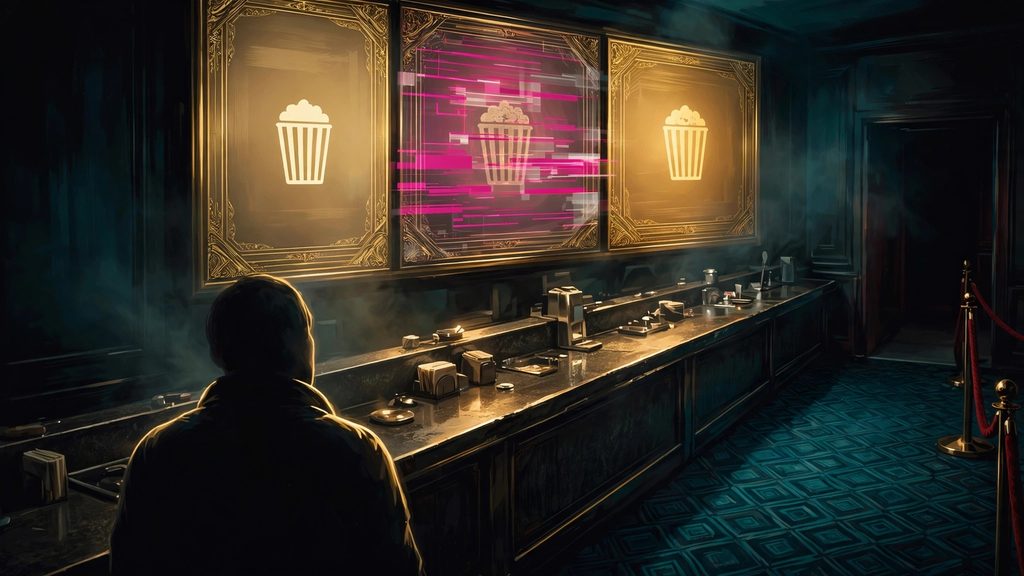
The Paradox | The Loser Picks the Winner
Here is the sentence that should itch. The most powerful option on the menu is often the one nobody chooses.
Economists have a polite rule for this situation, called regularity. Adding a new option to a menu should never make an existing option more popular. It can steal a few customers, or it can be ignored, but it cannot help a rival. If you like tea and coffee equally, adding hot chocolate should not suddenly make you prefer coffee.
The decoy effect breaks that rule. Add the right useless option, and one of the old options gains customers it did not have before. Marketers call it the attraction effect or asymmetric dominance. We call it the Ugly Cousin, because it only ever gets invited to make someone else look attractive.
The Famous Story | The Magazine Nobody Bought
You may have met the decoy effect through a story about a magazine. In his 2008 book Predictably Irrational, the behavioral economist Dan Ariely described an old subscription page from The Economist. Web only, $59. Print only, $125. Print and web together, also $125.
Nobody in their right mind takes print only, when the same money buys print and web. That was the point. When Ariely showed the three options to a class of his business students at MIT, he reported that 16 percent picked web only, nobody picked print only, and 84 percent picked the bundle. When he removed the useless print-only option, the picture flipped. Now 68 percent picked web only and just 32 percent took the bundle.
It is a beautiful story, and it is the one every marketing course tells. Keep it in mind, but hold it loosely. It was a classroom demonstration described in a popular book, not a peer-reviewed experiment. The real experiment came much earlier, and it is less tidy.
The Classic Experiment | Six Menus and One Useless Option
In 1982, three researchers at Duke University, Joel Huber, John Payne and Christopher Puto, sat 153 business students down with a series of small shopping decisions. Cars. Restaurants. Beers. Lotteries. Film. Television sets. Each option was described with just two numbers. For the beers, that meant the price of a six-pack and a quality score from a blind taste test.
First, the students chose between two options that each won on one number. A cheaper beer with a lower score. A pricier beer with a higher score. A fair fight, with no obvious winner.
Then the researchers slipped in a third option. Not a real competitor. A weaker copy of one of the two, worse on both numbers, or worse on one and no better on the other. A beer that cost more than its twin and tasted no better. The kind of option nobody would ever pick, and almost nobody did. The decoys were chosen about 2 percent of the time.
But the decoy did not need to be chosen to work. Across the six product types, the option it was designed to flatter gained an average of 9.2 percentage points of share. A choice nobody wanted had quietly moved the market. In the language of the paper, it violated regularity. In the language of the cinema, the medium sold the large.
Meet the Middle Option Brain
The Middle Option Brain is the part of you that hates deciding in a vacuum. When two options each win on something different, it gets nervous. Is cheaper better, or is quality better? There is no clean answer, and the Middle Option Brain cannot stand an unclean answer.
So it grabs the nearest shortcut it can find. If one option clearly beats something else on the menu, that option suddenly has a reason. A reason to justify. A reason to tell your friend. “The large was only fifty cents more than the medium.” The decoy hands the Middle Option Brain the easy comparison it was desperate for, and it takes the bait with real gratitude.
The Uncomfortable Part
It helps to keep three layers apart here, because the decoy effect gets mangled when they blur.
What happened. When a clearly inferior option was added next to one of two choices, that choice became more popular, even though almost nobody picked the inferior option itself.
What the researchers proposed. People struggle to trade one attribute against another, so they look for options they can justify. Beating a visible loser is an easy justification.
What we can reasonably take from it. This is our editorial reading, not a finding. Your preferences are less like fixed coordinates and more like a weather vane. They point where the surrounding options push them. That is a little humbling. It also means that whoever arranges the options has a quiet hand on the vane.
The Stakes | Where the Ugly Cousin Lives
The Middle Option Brain does its shopping every day, and the Ugly Cousin is waiting in more places than the cinema.
The Pricing-Page Cost. Three plans, with the middle one marked “most popular” and the top one priced to make the middle look reasonable. The plan you were meant to buy is usually the one sitting next to a weaker twin.
The Upgrade Cost. 128 gigabytes, 256 for a little more, 512 for a lot more. The storage you need is rarely the question. The gap between the boxes is.
The Bundle Cost. A meal deal where the drink alone costs nearly as much as the full combo. The drink is not for sale. It is for comparison. It shares a family with the contrast tricks covered in The ‘Relative Value’ Brain, where the first number you see makes the next one look cheap.
The Clever-Feeling Cost. The decoy rarely feels like a trick. It feels like being smart. That is the expensive part. You walk away feeling clever about a choice that was made on the board above your head, which is, in a sense, very nice for the cinema.
The Twist | The Effect That Keeps Disappearing
Now the turn. For three decades the decoy effect sat in every marketing textbook as settled science. Then, in 2014, researchers set out to put it to work, and it kept slipping through their fingers.
Shane Frederick, Leonard Lee and Ernest Baskin ran 38 studies and replications. When the options were shown as tables of numbers, like the original 1982 study, the decoy effect showed up in four of five cases. When even one attribute was something you see or experience, like a picture, a taste or a real product in your hand, it largely vanished. Across 27 studies of that kind, they found no reliable attraction effect at all.
In the same issue of the same journal, Sybil Yang and Michael Lynn reported 91 separate attempts to produce the effect, covering 23 product types. Only 11 worked reliably. When the options were described in meaningful words and pictures instead of bare numbers, the effect dropped to chance.
The original authors replied, and their answer is worth hearing. The effect is real, they argued, but it has boundaries. It needs a decoy that is clearly and quickly seen to be worse. It works best when you do not already know what you want. And it fades when you have strong preferences of your own.
So which is it? Is the Ugly Cousin a law of the mind or a quirk of spreadsheets? That is where the most surprising subject in this whole story comes in.
The Surprise | The Slime Mould Takes the Bait
Physarum polycephalum is a yellow slime mould. It is a single cell. It has no brain, no neurons and no marketing department. It can, however, choose where to eat.
In a study published in 2011, Tanya Latty and Madeleine Beekman at the University of Sydney offered it a dilemma. One food patch held 3 percent oatmeal in the dark, which the slime mould likes. Another held 5 percent oatmeal under bright light, which it dislikes. More food, worse conditions. Given just those two, the slime mould split roughly evenly. A fair fight, with no obvious winner.
Then the researchers added a third patch, 1 percent oatmeal in the dark. Same comfortable darkness as the first option, but clearly worse food. An Ugly Cousin. Suddenly about 80 percent of the slime moulds went for the 3 percent dark patch, the option the decoy made look good.

Read that carefully. A creature with no brain fell for the medium popcorn. Whatever the decoy effect is, it is not a quirk of advertising or of human vanity. It looks like something older and simpler, a basic habit of any system that has to compare options on more than one dimension at once. It shows up most reliably exactly where the comparison is cleanest. Which explains the replication fight as well as anything does. The decoy thrives on tidy comparisons, and fades in the messy world of taste, touch and memory.
The Named Tool | The Ghost Option Test
Here is the inconvenient truth about modern shopping. Most of it now happens on screens, in tidy rows of numbers. Storage, speed, price per month. That is exactly the habitat where the decoy effect is strongest.
The Ghost Option Test says that before you choose from three or more options, find the one you would never pick and cover it with your thumb. Then decide again between what is left. If your choice changes, the ghost was choosing for you. If it stays the same, enjoy your popcorn with a clear conscience.
How to Use It
- Cover the Cousin. On any menu of three or more, spot the option nobody would buy and hide it, physically if you can. Decide only between the real contenders.
- Name Your Need First. Before you look at the options, write down what you actually need, like the storage you use or the size you can finish. The decoy works best on people who do not know what they want yet.
- Price the Gap, Not the Box. When the upgrade looks like a bargain, ask what the extra money buys you and whether you would pay that amount for that thing on its own.
- Check Who Set the Board. If the options came from someone who profits from your choice, assume at least one of them is there to be compared, not chosen.
The Psychology Bits
- Adding a Loser Can Help a Winner: In the 1982 study, adding a clearly inferior option raised the share of the option it resembled by an average of 9.2 percentage points, while the decoy itself was chosen about 2 percent of the time.
- It Lives in Tables of Numbers: Large replication efforts in 2014 found the decoy effect reliably with numeric comparisons, and rarely when options were shown as pictures, descriptions or real experiences.
- No Brain Required: A single-celled slime mould shifted strongly toward a food patch once a weaker look-alike was added beside it.
- It Plays Well With Labels: The decoy changes how an option looks next to its neighbors, and mental labels change how money feels in your hand, as in The Labeled-Money Brain. Both are about context deciding what feels like a good deal.
FAQ
Q | What is the decoy effect? A | It is the tendency to prefer one option more when a clearly inferior version of it is added to the choices. The inferior option is rarely chosen, but it makes its neighbor look better by comparison. It is also called the attraction effect or asymmetric dominance effect.
Q | What is an example of the decoy effect? A | A cinema selling small popcorn at 4.50, medium at 7.50 and large at 8.00. Few people buy the medium, but its presence makes the large feel like a bargain.
Q | Who discovered the decoy effect? A | Joel Huber, John Payne and Christopher Puto published the first formal demonstration in 1982, showing that adding a dominated option increased the share of the option it resembled.
Q | Is the decoy effect real? A | It is real but fragile. It replicates well when options are compared as numbers, and much less often when options are shown as pictures, descriptions or real products. It is strongest when people do not have firm preferences.
Q | Why do companies use decoy pricing? A | Because pricing pages and plan menus present options as tidy numeric comparisons, which is exactly where the effect is most reliable. A well-placed decoy can steer customers toward a higher-priced option without anyone buying the decoy.
Q | How can I avoid the decoy effect? A | Decide what you need before looking at the options, ignore any option you would never choose, and compare only the real contenders on what they actually give you.
The Thing to Remember
Go back to the cinema, the smallest piece of the decoy effect you will ever hold in your hands. You thought you were choosing popcorn. You were choosing between two buckets while a third one stood beside them, doing a job nobody saw.
The Ugly Cousin never needed you to like it. It only needed you to look at it. Which means the most important question at any counter is not “which one is the best deal?” It is “which one is here so I would think that?” Ask it once, and the board above your head turns back into what it always was. A sign someone else wrote.
Citations & Caveats
- Source 1: Huber, J., Payne, J. W., & Puto, C. (1982). Adding asymmetrically dominated alternatives | Violations of regularity and the similarity hypothesis. Journal of Consumer Research, 9(1), 90-98.
- Source 2: Ariely, D. (2008). Predictably Irrational | The Hidden Forces That Shape Our Decisions. HarperCollins.
- Source 3: Frederick, S., Lee, L., & Baskin, E. (2014). The limits of attraction. Journal of Marketing Research, 51(4), 487-507.
- Source 4: Yang, S., & Lynn, M. (2014). More evidence challenging the robustness and usefulness of the attraction effect. Journal of Marketing Research, 51(4), 508-513.
- Source 5: Huber, J., Payne, J. W., & Puto, C. K. (2014). Let’s be honest about the attraction effect. Journal of Marketing Research, 51(4), 520-525.
- Source 6: Latty, T., & Beekman, M. (2011). Irrational decision-making in an amoeboid organism | Transitivity and context-dependent preferences. Proceedings of the Royal Society B, 278(1703), 307-312.
Caveat. The Economist subscription example is a classroom demonstration reported in a popular book, not a peer-reviewed study. The 1982 experiment used hypothetical choices presented as numbers, which later research shows is where the effect is strongest. The slime mould figures are approximate shares reported for one experimental setup. The decoy effect is real but conditional, not a universal law of choice.
Disclaimer: This article is for informational purposes only and is not financial or psychological advice. The decoy effect describes common patterns in how people compare options. For important purchasing or financial decisions, take your time and consider speaking with a qualified adviser.
// Protocol · Next Transmission
The glitch is the signal. — Psyness Protocol

