Ever been pouring your morning coffee, only to glance at your perfectly browned toast and see… a tiny, benevolent (or perhaps slightly grumpy) face staring back? Or spotted a surprised pug in the clouds? What about that electrical outlet that always looks bewildered? If you’ve nodded along to any of these, welcome to the club. You’re experiencing a fascinating, widespread, and wonderfully normal quirk of your beautiful brain, known as pareidolia.
Here at Psyness.com, we don’t just acknowledge these peculiar mental phenomena; we celebrate them! Your brain isn’t playing tricks on you; it’s just being brilliantly, efficiently, and yes, a little bit weird. And that, we think, is very nice indeed.
What in the World is Pareidolia?
At its core, pareidolia is a psychological phenomenon where your mind perceives a familiar pattern or image where none actually exists. Most commonly, this involves seeing faces or animal shapes in inanimate objects, natural formations, or even abstract patterns. Think of it as your brain’s super-enthusiastic, overachieving pattern-recognition system working overtime.
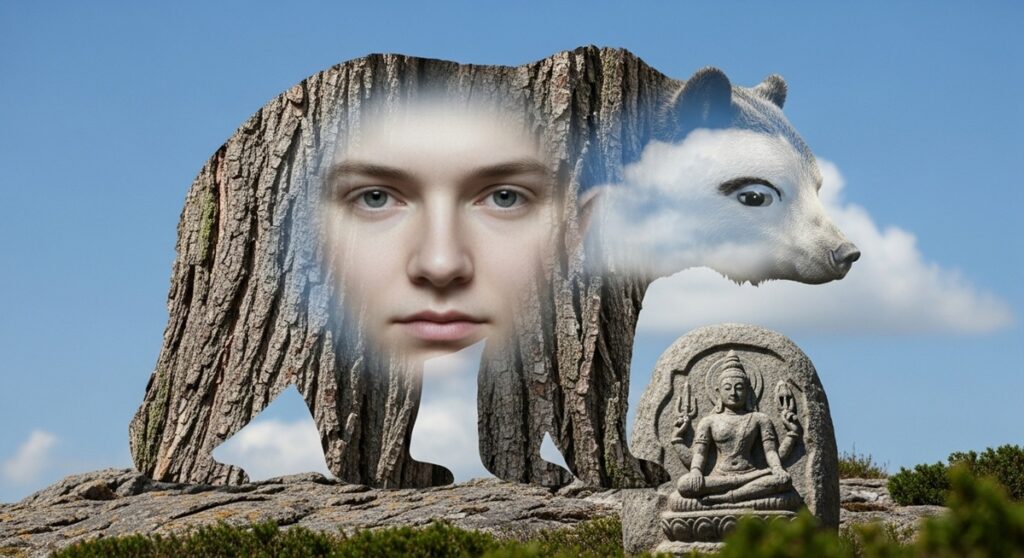
It’s not a hallucination, nor is it a sign of anything “wrong.” Instead, it’s a testament to the incredible power and efficiency of your cognitive processes. Your brain is wired to find meaning, even in randomness, because for most of human history, spotting a pattern quickly (like a predator in the bushes, or a fruit-bearing tree among dense foliage) was vital for survival.
The Genius Behind the Groovy Ghost in Your Grout
So, why does our brain do this? It boils down to a few key insights into the peculiar psyche:
- Evolutionary Advantage: Our ancient ancestors relied heavily on rapid pattern recognition for survival. Was that a predator lurking, or just shadows? Better to assume it’s a predator and be wrong than ignore it and become lunch. This “better safe than sorry” mechanism is deeply ingrained.
- Facial Recognition Focus: As social creatures, humans are exceptionally good at recognizing faces. Our brains have specialized areas dedicated to this task. This hypersensitivity means we’re constantly scanning our environment for facial cues, leading us to “find” them even in places where they genuinely don’t exist.
- Cognitive Efficiency: Your brain loves shortcuts. Instead of painstakingly analyzing every detail of a random shape, it quickly tries to match it to something familiar in its vast internal database. Faces are high on that list of familiar things. It’s a quick, energy-saving assumption.
- Expectation & Context: Sometimes, our expectations prime us to see things. If you’re looking for faces, you’re more likely to find them. The “Modern Madness” of living in a world full of visual stimuli (and a playful inclination to share quirky finds) also encourages this.
From Mars to Memes | Pareidolia in Pop Culture
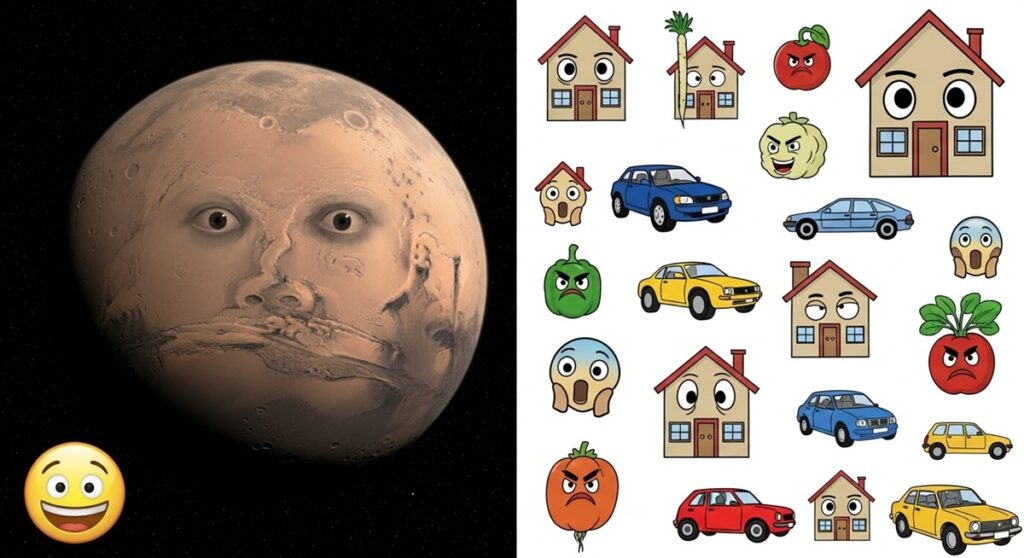
Pareidolia isn’t just about your breakfast; it’s woven into the fabric of human culture and even fuels some classic internet moments. Remember the infamous “Face on Mars” captured by NASA’s Viking 1 orbiter in 1976? Or how about the countless internet memes of startled houses, angry vegetables, or surprised cars? These are all prime examples of pareidolia at play, uniting us in a shared laugh at the absurdity and brilliance of our own minds.
It shows that our beautiful brains are constantly engaged, interpreting, and even creating meaning from the world around us, blurring the lines between what’s real and what’s perceived in a wonderfully playful way. It’s why we see animals in cloud formations, figures in abstract art, or even hear hidden messages in backward recordings. It’s a testament to the active, imaginative, and endlessly curious nature of the human condition.
Embracing Your Beautifully Weird Brain
So, the next time you spot a grumpy kettle or a cheerful wall socket, don’t just dismiss it. Take a moment to appreciate the incredible, pattern-seeking machinery humming along inside your head. It’s part of what makes you uniquely human, exceptionally perceptive, and wonderfully weird.
At Psyness.com, we believe that understanding these behavioral quirks is a crucial part of Unpacking Your Beautiful Brain and embarking on your Journeys of Discovery. Knowing yourself doesn’t have to be boring – it can be a riot! It’s a key step in cultivating wellness (the “Very Nice!” Edition) and truly finding your tribe among wonderfully self-aware humans.
Welcome to the delightful madness. Your mind is amazing
// Protocol · Next Transmission
The glitch is the signal. — Psyness Protocol