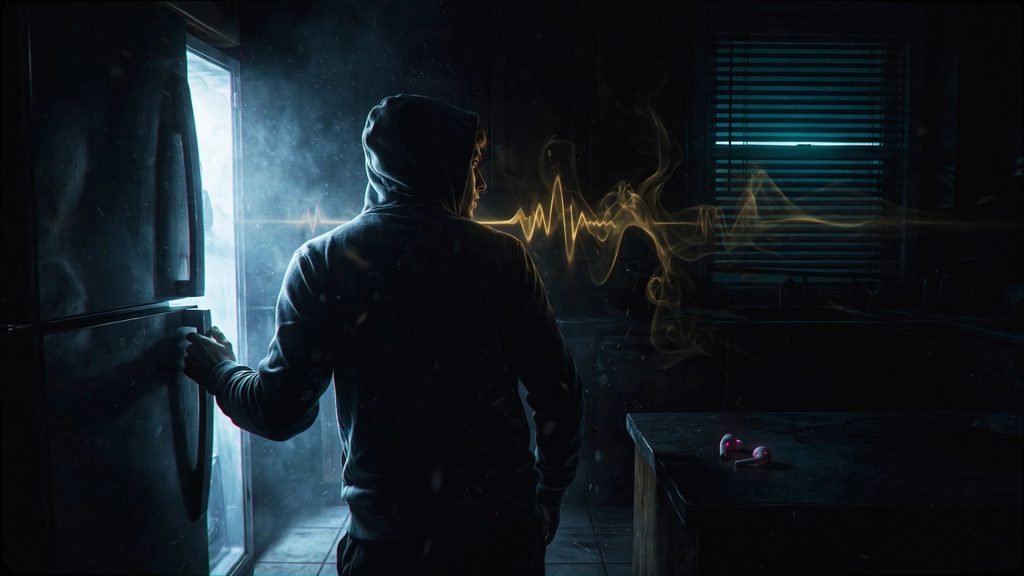
You’re elbow-deep in the fridge, three rooms from anyone, and a voice cuts through the hum and says your name. You turn around. Nobody’s there. Just the fridge, the traffic outside, and the usual background hiss of a house that isn’t talking to you.
Psychology explains this through: the cocktail party effect, the auditory system’s hair-trigger sensitivity to your own name, a detector so finely tuned that it occasionally fires on nothing at all.
Researchers running classic dichotic listening experiments fed people two different conversations at once, one in each ear, and asked them to repeat back only one. Most listeners couldn’t recall a single word from the ignored side, except when their own name appeared in it, which roughly a third of them caught instantly.
Madness Meter: 🧠🧠🧠 The Name Beacon (You’ve spun around in a crowded room certain someone called you, only to find two strangers mid-conversation about an entirely different Chris.)
That’s a different glitch than the one covered in Is Your Phone Vibrating, Or Is Your Brain Just Messing With You?, a device habit firing on your skin. This one fires on your ears, aimed specifically at the one word your brain refuses to ever stop listening for.
This creates the Name Beacon, the everyday name for the cocktail party effect running quietly in your own ears, a detector so sensitive to your name that it sometimes lights up on pure noise, a cough, a stranger’s sentence, the wind.

S³ – Story • Stakes • Surprise
Story | The Fridge, the Podcast, and the Phantom “Hey”
The Setup: You’re deep in a podcast, headphones on, half the world tuned out, when a voice slices through with what sounds exactly like your name.
The Twist: You pull off a headphone, pause the episode, say “what?” out loud to an empty room, and get nothing back except the faint hiss of a house doing its usual nothing.
The Reading: This isn’t your imagination going rogue, it’s the Name Beacon, the cocktail party effect in action, doing exactly what it’s built to do, treating a vague sound as a probable hit because missing a real one feels like the bigger risk.
The Pattern: It fires hardest in exactly the conditions where real detection also matters most, noisy rooms, crowded platforms, half-focused moments, the same settings where missing your actual name would carry a real cost.
Stakes | What the Name Beacon Costs
A cocktail party effect running a little hot is harmless. Left unmanaged, the costs add up:
The Startle Cost. Every false alarm triggers a small jolt of attention and adrenaline, a tiny but real tax paid dozens of times a week for a sound that was never there.
The Social Cost. Spinning around, saying “what?” to a room, or interrupting a conversation to check who called you starts to read as jumpy, even though it’s just a sensitive detector doing its job.
The Sleep Cost. The same hair-trigger system stays active at the edges of sleep, which is why a phantom “hey” is a common reason for jolting awake right as you’re drifting off.
The Free-Pass Cost. Writing off every phantom call as a very nice, harmless quirk skips past how much low-grade vigilance your brain is quietly running in the background all day.
Surprise | The Detector Was Never Broken
There’s nothing to fix here, the cocktail party effect was never broken. The false alarms are simply the price of a detector sensitive enough to actually work when it counts.
The Cure: Turn a startle into information instead of mystery:
- Name the Beacon Out Loud: The moment you catch yourself scanning after a phantom call, say “Name Beacon,” and notice the startle drop immediately.
- Check Once, Then Drop It: Give yourself one quick look or listen, then consciously move on. Repeated checking just rehearses the false alarm.
- Lower the Background Noise: A quieter room gives the detector less raw material to misfire on in the first place.
- Expect It With Headphones In: Knowing the effect runs strongest with one ear occupied takes most of the mystery, and the jolt, out of it next time.
A² – Apply • Amplify
The cocktail party effect is a well-studied, decades-old finding about how attention works, not a sign that your ears or your sanity are malfunctioning.
The Psychology Bits
- The Cocktail Party Effect Was Found By Accident, Then Confirmed in the Lab: It takes its name from classic experiments testing how well people could follow one conversation while a completely different one played in the other ear.
- Your Own Name Breaks Every Rule: In those same experiments, listeners who couldn’t recall a single word from the ignored conversation still caught their own name almost every time it appeared in it.
- It Was Measured, Not Just Assumed: Later researchers quantified exactly how often the cocktail party effect happens and found the attention shift is real but far from universal, roughly a third of people catch it on any given try.
- It’s a Specific Case of a Bigger Pattern: A related but different habit, zeroing in on three words of an entire conversation and treating them as the whole message, is covered in The ‘I Only Heard That Bit!’ Brain. That one filters real words you did hear down to the ones you wanted. This one occasionally invents a word, your name, that was never said at all.
Applying the Name Beacon Habit
Turn the cocktail party effect from a startle into something you manage on purpose:
- Name the Beacon When It Fires: Say “Name Beacon” the instant you catch a phantom call, and let the explanation do the calming for you.
- Run the One-Check Rule: Look or listen once, briefly, then consciously return to what you were doing instead of scanning further.
- Flag Your High-Risk Settings: Headphones, white noise, and busy rooms are exactly when the detector misfires most, expect it there specifically.
- Retire the Mystery Story: Replace “something strange just happened” with “my name detector just had a false alarm,” the less dramatic, more accurate version.
FAQ
Q | Is hearing my name when no one said it a sign of a real hallucination? A | On its own, no, it’s just the cocktail party effect being a little overzealous. Mishearing your name occasionally in noise or distraction is an extremely common experience, not a sign of a hearing or mental health problem.
Q | Why is it specifically my name that breaks through? A | Your own name carries more automatic significance to your brain than almost any other word, so it gets flagged for attention even in sound you’re actively ignoring.
Q | Does this happen to everyone equally? A | No. Classic experiments on the cocktail party effect found roughly a third of people catch their name in an ignored conversation on a given attempt, so it’s common but not universal or constant.
Q | Why does it happen more with headphones in? A | One ear occupied with speech or a podcast leaves the detector listening to everything else with less competing signal to filter against, making a false alarm more likely.
Q | How is this different from The ‘I Only Heard That Bit!’ Brain? A | That one covers real words you heard and selectively kept. This one covers your name occasionally appearing in sound where it was never actually said.
Q | What’s the fastest way to stop the startle? A | Name it. Saying “Name Beacon” to yourself turns the cocktail party effect from an unsettling mystery into a known, harmless, well-documented glitch.
Citations & Caveats
- Source 1: Cherry, E. C. (1953). Some Experiments on the Recognition of Speech, with One and with Two Ears. Journal of the Acoustical Society of America, 25(5), 975-979.
- Source 2: Moray, N. (1959). Attention in Dichotic Listening | Affective Cues and the Influence of Instructions. Quarterly Journal of Experimental Psychology, 11(1), 56-60.
- Source 3: Wood, N., & Cowan, N. (1995). The Cocktail Party Phenomenon Revisited | How Frequent Are Attention Shifts to One’s Name in an Irrelevant Auditory Channel? Journal of Experimental Psychology | Learning, Memory, and Cognition, 21(1), 255-260.
Disclaimer: This article is for informational purposes only and is not a substitute for professional psychological or medical advice. The cocktail party effect, including its occasional false alarms, is a normal, well-documented quirk of attention. If you’re regularly hearing clear voices with words or sentences, or it’s distressing, that’s worth discussing with a qualified professional.
// Protocol · Next Transmission
The glitch is the signal. — Psyness Protocol