“Show me the incentive and I will show you the outcome.” — Charlie Munger
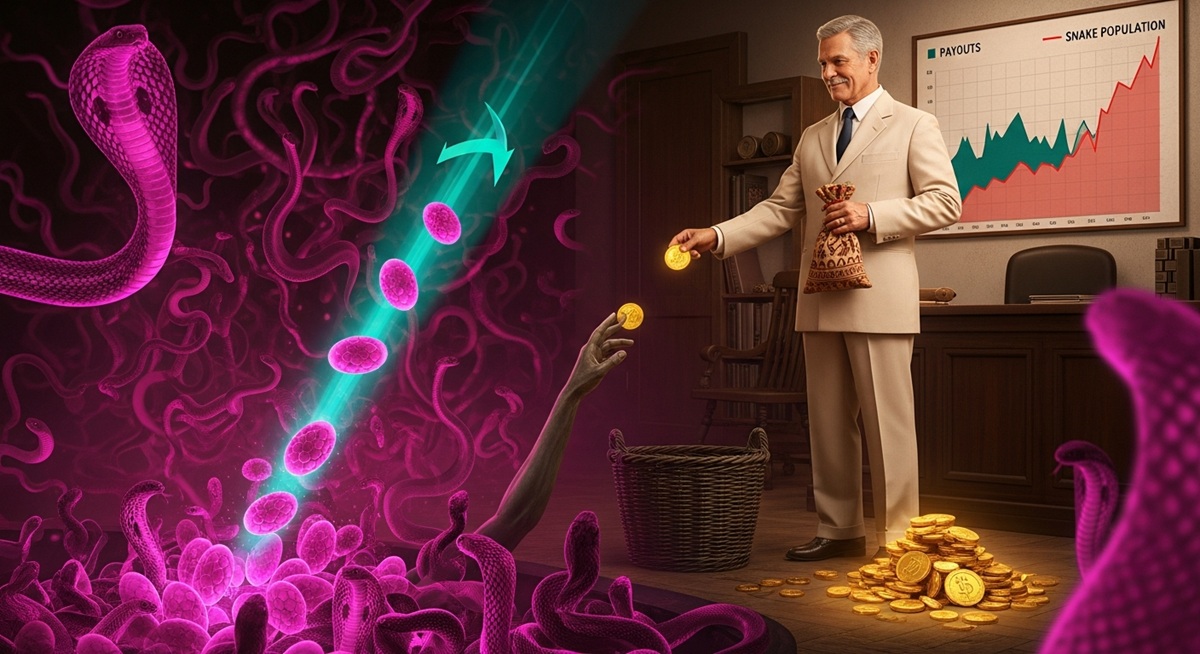
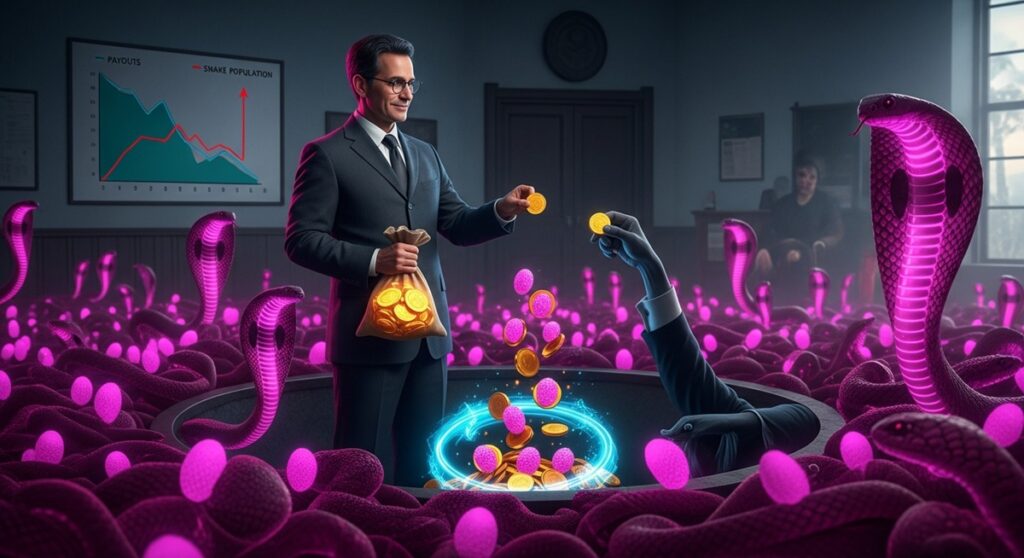
The Cobra Effect occurs when an attempted solution to a problem actually makes the problem worse, usually due to unintended consequences of perverse incentives. The ‘Backfire’ Brain assumes people will follow the spirit of a rule, while in reality, people optimize for the Vibrant Gold letter of the reward, often destroying the original goal. The very nice solution is the Deep Teal/Cyan Metric Audit, which aligns incentives with Cheerful Mustard Yellow genuine value creation.
Economics explains this through: Campbell’s Law—”The more any quantitative social indicator is used for social decision-making, the more subject it will be to corruption pressures.”
You get what you inspect, not what you expect.
Madness Meter: 🌀🌀🌀 Systemic Irony (The tragic comedy of a solution creating a bigger crisis.)
The Cobra Effect is the ultimate cautionary tale of unintended consequences. It highlights a fundamental flaw in human logic | linear thinking in a complex world. We think | “I want less X, so I will punish X” or “I want more Y, so I will pay for Y.”
This creates the ‘Backfire’ Brain | a mind that ignores human adaptability. Humans are creative maximization machines. If you define success by a single, narrow metric (money for snakes, grades for students, clicks for media), humans will find the shortest path to that metric, even if it burns down the entire Vibrant Gold ecosystem the metric was supposed to protect.
The tragedy is that the incentive usually works technically (lots of dead snakes were turned in!), but fails fundamentally (there are now more live snakes than ever).
S³ – Story • Stakes • Surprise
Story | The Rat Massacre of Hanoi
The Sequel: A similar event happened in French colonial Hanoi. The government wanted to kill rats. They offered a bounty for every rat tail handed in. The Outcome: Officials started seeing rats running around the city without tails. The Mechanism: The rat catchers knew that if they killed the rat, they couldn’t breed more rats. So, they would catch the rat, cut off the tail (to get the Vibrant Gold bounty), and release the rat to breed more rats (to ensure future Fuchsia-pink revenue). The incentive didn’t reward “pest control”; it rewarded “rat farming.”
Stakes | The KPI Trap
The unchecked power of the ‘Backfire’ Brain has severe consequences:
Corporate Sabotage: If a call center rewards employees for “short call times,” employees will hang up on difficult customers to keep their average down. The metric improves, but customer satisfaction (Deep Teal/Cyan the actual goal) tanks.
Educational Decay: If schools are funded based solely on standardized test scores, teachers stop teaching critical thinking and start “teaching to the test.” The scores go up, but student intelligence stagnates.
Crypto Farming: In DAOs, if you reward “engagement” (messages sent), you get spam. If you reward “liquidity” with high inflation tokens, you get mercenary capital that dumps the token the moment the reward drops. The Vibrant Gold incentive attracts parasites, not members.
Surprise | The Metric Audit
The very nice path is to assume everyone is a genius who will try to game your system.
The Cure: Institute the Deep Teal/Cyan ‘Metric Audit’ protocol:
- Define the Goal: What do you actually want? (e.g., “A clean city,” “Happy customers”).
- Define the Metric: What are you measuring? (e.g., “Trash collected,” “Call time”).
- The Evil Genius Test: Ask | “If I were an evil genius who wanted to maximize this metric while doing the LEAST amount of actual work, what would I do?”
- If the answer destroys the Goal (e.g., “I would bring trash from my house to work to get the bonus”), the metric is flawed.
- Pair the Metrics: Never use one metric alone. Pair a Quantity metric (Call time) with a Quality metric (Customer rating). One balances the other, preventing the Fuchsia-pink Cobra Effect.
A² – Apply • Amplify
Don’t pave the path to hell with good incentives.
The Economics Bits
- Goodhart’s Law: “When a measure becomes a target, it ceases to be a good measure.”
- Perverse Incentive: An incentive that has an unintended and undesirable result which is contrary to the intentions of its designers.
Applying Anti-Cobra Architecture
Adopt these Deep Teal/Cyan rules to align behavior:
- The “Outcome Over Output” Rule: Reward the final result (the problem is solved), not the activity (hours worked). If you pay by the hour, the work will expand to fill the time. If you pay for the project, efficiency skyrockets.
- The ‘Surprise Bonus’ System: Predictable rewards are easily gamed. Occasional, Vibrant Gold retrospective rewards for “Good Citizenship” or “Innovation” are harder to game because the criteria weren’t announced in advance.
- The ‘Skin in the Game’ Mandate: Ensure the person making the decision shares the risk. A banker who gets a bonus for risky loans but no penalty for defaults creates a Cobra Effect (2008 Financial Crisis). They must share the Fuchsia-pink downside to act rationally.
The PSS Ecosystem | An Idea in Action
The PSS DAO can use the Cobra Effect to design bot-resistant community rewards.
The ‘Quality-gated’ PSS Airdrop
- Mechanism: Instead of rewarding “Most Messages Sent” (which creates spam bots—the Cobra Effect), the PSS DAO uses a Deep Teal/Cyan “Peer-Validation” model. Rewards are calculated based on the number of “Helpful” reactions received from high-reputation members only.
- Justification: You cannot automate “being helpful” to a senior member. By pairing the quantity (messages) with a quality filter (peer review), the DAO ensures the incentive produces Cheerful Mustard Yellow genuine community value rather than noise.
- Reward: Members who maintain a high “Signal-to-Noise” ratio receive a “Community Architect” status, rewarding precision over volume.
FAQ
Q | Are all incentives bad? A | No. Incentives work great for simple, mechanical tasks (e.g., picking fruit). They fail for complex, cognitive, or creative tasks where the goal is quality, not just volume.
Q | How do I motivate without money? A | Use intrinsic motivators | Autonomy, Mastery, and Purpose (Pink’s Drive Theory). People work harder for a cause they believe in than for a bounty they can exploit.
Q | Did the British really breed cobras? A | Historical accounts vary on the scale, but the logic holds true and has been replicated in modern examples (like the Hanoi rats, or carbon credit scams). The principle is undeniable.
Citations & Caveats
- Source 1: Siebert, H. (2001). Der Kobra-Effekt. (The book that popularized the term and the anecdote).
- Source 2: Kerr, S. (1975). On the folly of rewarding A, while hoping for B. (The classic management paper on perverse incentives).
Disclaimer: This article discusses the economic phenomena of the Cobra Effect. The PSS DAO token model described is theoretical. Be careful what you wish for; you might just pay for it.