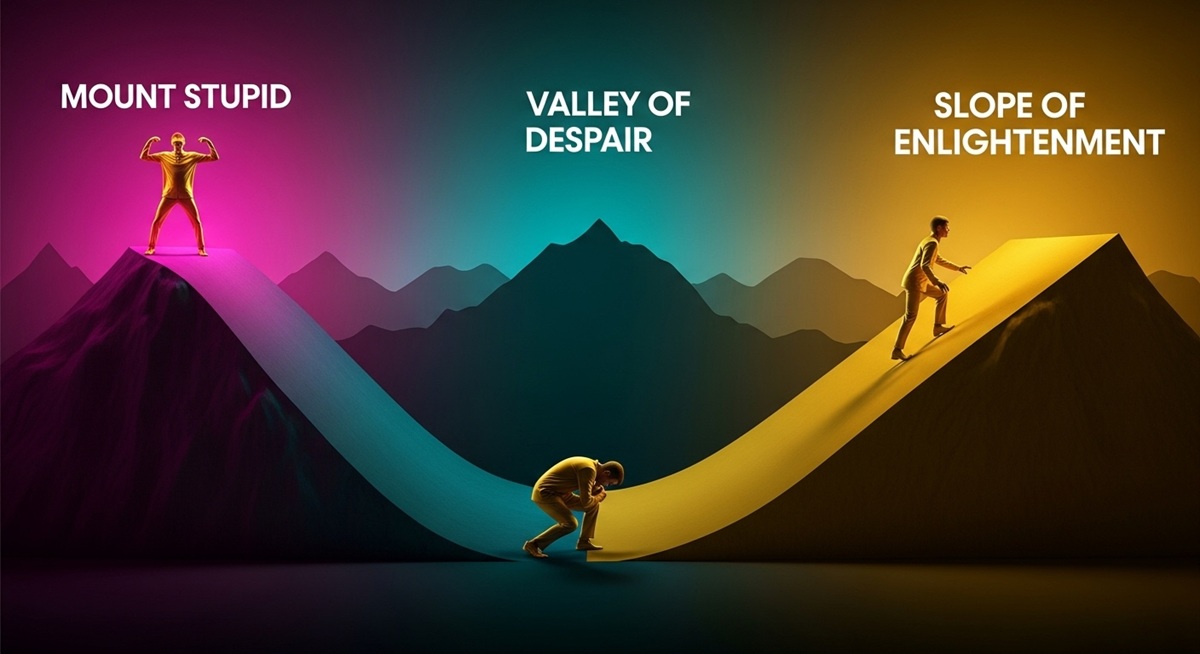
The Dunning-Kruger Effect describes how the least skilled often have the highest confidence, while experts tend to underestimate their abilities. The ‘Loudest-Loser’ Brain resides on Mount Stupid—the initial, illusory peak of competence. This Fuchsia-pink overconfidence is a barrier to Deep Teal/Cyan genuine learning. The very nice solution is to seek painful feedback to cross the Valley of Despair and reach Cheerful Mustard Yellow humility and true expertise.
Psychology explains this through: metacognitive error (the inability to recognize one’s own lack of skill).
Ignorance is bliss, but competence is a responsibility.
Madness Meter: 🌀🌀🌀 Mount Stupid (The delusional peak of initial, minimal skill.)
The Dunning-Kruger Effect is a cognitive bias where people with low competence at a task overestimate their own ability, and, conversely, highly competent people tend to underestimate theirs. It is fundamentally a failure of metacognition—the ability to think about one’s own thinking. The unskilled lack the very expertise needed to recognize how unskilled they are.
This creates the ‘Loudest-Loser’ Brain | the person who gains just enough knowledge (a few key terms, one successful trade) to feel like an expert, instantly placing them on Mount Stupid, the first and most dangerous peak of the competence curve. They mistake their low skill for Vibrant Gold genius. Meanwhile, the true expert is painfully aware of the vast, expanding territory of what they don’t know, trapping them in the low confidence of the Valley of Despair.
S³ – Story • Stakes • Surprise
Story | The Illusion of Superiority
The Paradox: The effect was proven when researchers found that the bottom quartile of performers in tests of logic, grammar, and humor rated themselves far above average.
The Mechanism: The unskilled person is blissfully unaware that the fundamental skills required for success (like critical self-assessment) are absent. This lack of self-awareness creates a self-reinforcing delusion where the loudest confidence often replaces Deep Teal/Cyan competence in social settings.
Stakes | The Cost of Blind Confidence
The failure to recognize one’s own skill level has severe consequences:
Bad Governance and Consensus: In decentralized or flat organizations, the most assertive voices often have the least understanding. The Fuchsia-pink confidence of the Dunning-Kruger individual drowns out the measured hesitancy of the expert, leading to poor decisions based on illusion, not data.
Stagnation: The overconfident individual never seeks to improve because they believe they are already skilled. They bypass the necessary Deep Teal/Cyan struggle, remaining trapped on the initial plateau of ignorance.
Self-Sabotage: The rare moment a Dunning-Kruger individual fails, they rarely attribute it to lack of skill. Instead, they blame external forces, ensuring their Fuchsia-pink delusion remains intact and preventing any corrective action.
Surprise | How to Climb the Slope of Enlightenment
The very nice path to expertise requires accepting a temporary descent into the Valley of Despair.
The Cure: The path out of the Fuchsia-pink arrogance of Mount Stupid is brutal, structural feedback. You must seek out data, critics, and mentors who are willing to expose the gaps in your knowledge. Embrace the acute, painful feeling of incompetence—the Deep Teal/Cyan valley—as proof that you are finally learning enough to recognize how much you don’t know. The reward is the Cheerful Mustard Yellow peak of the Slope of Enlightenment, where high skill is paired with rational, justified confidence.
A² – Apply • Amplify

Design systems that reward the humility of self-correction over the arrogance of certainty.
The Psychology Bits
- Metacognition: The ability to accurately monitor and regulate one’s thinking processes. Dunning-Kruger is the failure of this system.
- Double Burden: The unskilled suffer twice | they make errors, and they lack the skill to know they made them.
Applying Feedback Architecture
Adopt these Deep Teal/Cyan rules to leverage the Dunning-Kruger Effect for growth:
- The Competence Filter: For any new topic, assume you are on Mount Stupid. Your first goal is to define the five essential vocabulary words that an expert would use. If you cannot do this, you have not left the initial plateau.
- The Anti-Arrogance Contract: Before starting a project, designate a specific expert (a mentor or peer) whose feedback you are mandated to accept, even if it feels painful. This is your structural Deep Teal/Cyan defense against Fuchsia-pink self-delusion.
- The Quiet Rule: When you feel the intense rush of Vibrant Gold conviction after initial success, immediately enforce a quiet period. Before speaking or acting, force yourself to write three high-quality, complex counter-arguments to your own idea.
The PSS Ecosystem | An Idea in Action
The PSS DAO can use Dunning-Kruger principles to ensure competence in governance.
The ‘Expert-Doubt’ PSS Voting System
- Mechanism: In high-stakes PSS governance votes, users must pass a low-level, quick, objective quiz related to the proposal’s content before voting. This forces the unskilled to confront their knowledge gap and provides the necessary Deep Teal/Cyan friction.
- Justification: This system gently nudges members off Mount Stupid by making the Vibrant Gold reward (voting power) conditional on confronting competence. It rewards the humility to step back and learn.
- Reward: A special Cheerful Mustard Yellow ‘Doubt-Learner’ PSS badge can be awarded to members who fail the quiz, but then return to vote correctly after a self-imposed 48-hour learning window.
FAQ
Q | Does Dunning-Kruger mean I should doubt everything I know A | No. It means you should doubt your confidence when you have minimal experience. True competence is marked by high skill and an accurate, humble assessment of that skill.
Q | Can experts suffer from Dunning-Kruger A | Yes. They often suffer from the “imposter syndrome” form—underestimating their ability (The Valley of Despair). They assume that because the topic is easy for them, it must be easy for everyone else.
Q | Is this why people argue so much online A | Yes. Digital anonymity removes the social cost of being wrong, allowing Dunning-Kruger overconfidence to dominate discussions and making it easy to remain in the Fuchsia-pink comfort of Mount Stupid.
Citations & Caveats
- Source 1: Kruger, J., & Dunning, D. (1999). Unskilled and unaware of it | How difficulties in recognizing one’s own incompetence lead to inflated self-assessments. (The original study defining the effect).
- Source 2: Ehrlinger, J., et al. (2008). Why the unskilled are unaware | Further explorations of (un)awareness of incompetence across domains. (Follow-up research showing the effect is domain-specific).
Disclaimer: This article discusses the psychological phenomena of the Dunning-Kruger Effect. The PSS DAO token model described is theoretical and intended for conceptual discussion on improving collective decision-making. Learning is a life-long, humbling process.