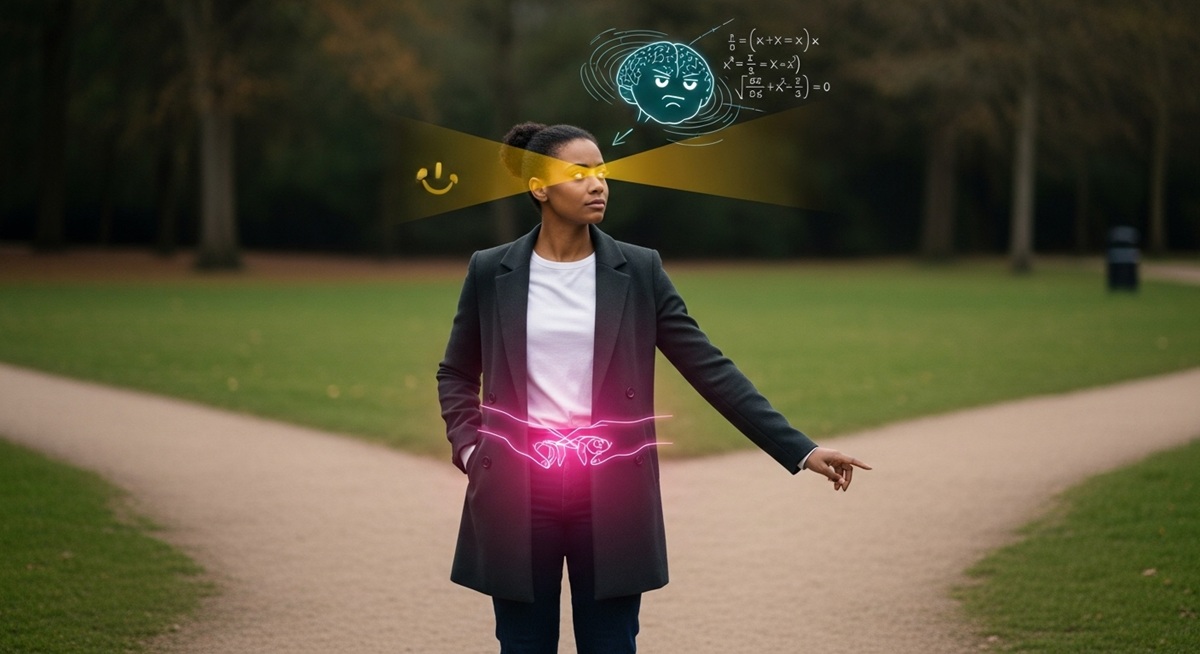
You’re about to make a big decision – a new job, a new city, or even just picking a different route home. Logically, all the facts might point one way, but deep down, in your gut, you just have a feeling. A sudden, non-conscious sense of knowing, a strong inclination, or a subtle pull that you can’t quite explain. Your magnificent, weird brain is whispering something, but it’s not in words, and it’s certainly not a spreadsheet. You tell yourself it’s “just a hunch” or “irrational,” but often, it’s a powerful and mysterious form of intelligence | Intuition, where your mind processes vast amounts of information unconsciously, delivering a sudden insight or a strong “gut feeling” without a clear logical pathway. My brain says ‘this is very good idea!’ I say ‘why?’ My brain says ‘no why, just very good feeling!’ Very nice, but now I must trust very strange feeling!
Welcome, fellow traveler, to the delightfully unhinged, universally experienced realm of the ‘I Just Had a Feeling!’ Brain, a potent manifestation of Intuition. It’s the glorious absurdity of your mind providing you with a sudden, non-conscious sense of knowing or a strong inclination, even when you can’t logically explain why. This often mysterious phenomenon highlights the psychological and neurological mechanisms behind “gut feelings,” linking them to rapid pattern recognition, unconscious processing of vast amounts of data, and emotional intelligence. Is it just a lucky guess? A peculiar form of psychic ability? Or is your beautiful brain simply doing its very nice, very efficient (though profoundly intriguing) job of synthesizing complex information beyond conscious awareness, offering insights that feel like magic? At Psyness.com, we take a “very nice!” look at this pervasive mental quirk, proving that understanding why you just had a feeling doesn’t have to be boring – it can be a riot.
Your Brain’s Inner Oracle | The Unconscious Synthesizer
Why does your mind sometimes deliver these sudden, inexplicable “gut feelings” or flashes of insight? It’s a fascinating testament to your magnificent brain’s ability to process information outside of conscious awareness, its incredible pattern-matching capabilities, and its deep connection to your emotional landscape.
The Architect | The Pattern Finder
Your brain, bless its tirelessly processing heart, is constantly taking in information – consciously and unconsciously. Intuition isn’t magic; it’s your brain’s super-fast, non-conscious pattern recognition system at work. It rapidly sifts through past experiences, learned knowledge, subtle cues, and emotional data, synthesizing it all into a “feeling” or a sudden insight, often before your conscious mind can catch up. It’s like your brain has already run a million simulations and is just giving you the very nice, very quick answer.
- Rapid Pattern Recognition: This is a core mechanism. Your brain is a master at recognizing patterns, even subtle ones. Intuition often arises when your brain quickly matches a current situation to similar patterns from your past experiences, without consciously recalling all the details. “This new person feels very familiar, but I do not know why! My brain says ‘I have seen this pattern before!’ Very nice, now I feel very trusting or very not trusting!”
- Unconscious Processing: A vast amount of information is processed below the level of conscious awareness. Your brain is constantly taking in sensory data, social cues, and emotional signals that you don’t explicitly notice. Intuition is often the output of this massive unconscious computation.
- Emotional Intelligence: Your emotions play a crucial role. A “gut feeling” is often an emotional signal – a subtle sense of comfort, unease, excitement, or dread – that your brain uses to communicate its unconscious assessment of a situation. These emotional signals can be a powerful fuchsia-pink indicator.
- Experience & Expertise: The more experience you have in a particular domain, the more robust your intuitive abilities become. Experts often make rapid, accurate decisions based on intuition, drawing on years of accumulated, often tacit, knowledge.
- Somatic Markers: Your brain links past experiences with emotional states and physical sensations. When a new situation arises that resembles a past experience, your brain can trigger those same physical sensations (e.g., a knot in your stomach, a feeling of lightness), acting as a “somatic marker” or deep teal/cyan signal that informs your intuition.
- Heuristics (Mental Shortcuts): Your brain uses mental shortcuts (heuristics) to make quick decisions. While sometimes leading to biases, they can also be the basis of effective intuitive judgments.
- “Thin Slicing”: This is the ability to find patterns in events based on “thin slices,” or very narrow windows, of experience. Your brain can make surprisingly accurate judgments from minimal information.
The paradox? Your brain’s admirable ability to process information at lightning speed and synthesize it into powerful insights, while essential for navigating complex situations, can feel mysterious or even irrational because it bypasses conscious thought, leading to moments of profound knowing that defy logical explanation. Your brain’s “inner oracle” is magnificent, but gloriously unhinged in its unconscious synthesizer.
Pop Culture’s Psychic Detectives & Gut Instinct Heroes | Our Shared Intuitive Journeys
From the detective who “just has a feeling” about a suspect, to the hero who trusts their gut in a life-or-death situation, to the whimsical portrayal of someone whose intuition always leads them to strange adventures, to songs that perfectly capture the feeling of an unexplained pull, pop culture constantly reflects and often celebrates our universal experience of intuition. We see the power of inner knowing and the allure of insights that defy logic.

The glorious absurdity? We are taught to be very logical, yet our brains sometimes deliver very important messages through a feeling in our stomach, convinced that the answers are found in the mysterious depths. It’s a shared, delightful madness where our wisdom comes from a place beyond words. Your inner Borat might meet very nice person and declare, “My brain says ‘this person is very good!’ My stomach feels very warm! Very nice, now I trust very strange feeling!”
How to Trust Your Gut (Very Nice! And Truly Liberating!)
Understanding that your brain’s ‘I Just Had a Feeling!’ tendency (Intuition) is a natural, powerful cognitive and emotional process is the first step to liberation. It’s not about abandoning logic; it’s about learning to work with your magnificent, weird brain to discern genuine intuitive insights from mere biases or anxieties, cultivating a deeper connection to your inner wisdom and making more aligned decisions.
Here’s how to nudge your brain towards more discerning, “very nice!” intuition:
- Acknowledge the Feeling, Then Pause: When you get a “gut feeling,” acknowledge it without judgment. “My brain has very strong feeling! Very nice, I will listen.” Pause before acting on it immediately.
- Reality-Test (But Don’t Over-Analyze!): Don’t dismiss intuition, but don’t blindly follow it either. Briefly consider if there’s any logical basis or if it’s a familiar bias. Is it a calm, clear feeling, or a frantic, anxious one? A calm, clear feeling is often a cheerful mustard yellow signal of true intuition.
- Tune Into Your Body (Somatic Awareness): Pay attention to the physical sensations that accompany your gut feelings. A sense of lightness, expansion, or calm often signals positive intuition. Tension, tightness, or a sinking feeling might signal caution or anxiety. These are your deep teal/cyan somatic markers.
- Reflect on Past Intuitive Hits (and Misses!): Think about times your intuition was right, and times it led you astray. This helps your brain learn to differentiate genuine insight from anxiety or wishful thinking.
- Gather Information, Then Step Back: For important decisions, gather all the logical information you can. Then, step away from the problem and allow your unconscious mind to work. The intuitive insight might emerge later.
- Practice Mindfulness & Self-Awareness: The more you are attuned to your internal states, emotions, and subtle bodily sensations, the better you become at recognizing the subtle signals of intuition.
- Reduce Noise (Internal & External): Overthinking, chronic stress, and constant external stimulation can drown out your intuitive voice. Create space for quiet reflection.
- Trust Your Expertise: In areas where you have significant experience, your intuition is likely highly reliable. Trust it more in those domains.
- Distinguish Intuition from Anxiety: Anxiety often feels frantic, urgent, and is accompanied by specific worries. Intuition often feels calmer, clearer, and more like a gentle knowing, a fuchsia-pink nudge without a specific “why.”
The ‘I Just Had a Feeling!’ Brain is a truly special window into our complex psychology, a reminder that our minds, while magnificent, are also prone to delightful (and profound) forms of non-conscious knowing. Knowing this doesn’t make you irrational; it makes you self-aware, wonderfully weird, and very nice! Embrace your inner oracle, understand your brain’s unconscious synthesizer, and prove that you can trust your gut, making more aligned and insightful decisions, even when the logic isn’t immediately clear.
// Protocol · Next Transmission
The glitch is the signal. — Psyness Protocol