
The alarm blares, a jarring intrusion into your peaceful slumber. You slap the snooze button, just for five more minutes. Then ten. Then twenty. Even after a full night’s rest, your magnificent, weird brain leaves you feeling groggy, disoriented, and craving nothing more than to pull the covers back over your head. Getting out of bed feels like an Olympic sport, and your brain feels like it’s wading through treacle. You tell yourself you’re “not a morning person,” but often, it’s a common and frustrating physiological phenomenon | Sleep Inertia, where your mind and body struggle to fully transition from sleep to wakefulness, leaving you in a temporary state of impaired cognitive and motor function. “My bed is very warm! My brain says ‘stay here, it is very nice!’ Very nice, but now I am very late for work!
Welcome, fellow traveler, to the delightfully unhinged, universally experienced realm of the ‘Why Do I Keep Hitting Snooze?’ Brain, a potent manifestation of Sleep Inertia. It’s the glorious absurdity of your mind leaving you feeling groggy, disoriented, and craving more sleep even after a full night’s rest, making it incredibly difficult to wake up and start the day. This pervasive physiological and psychological quirk highlights the brain’s complex transition between sleep stages, the lingering effects of sleep-inducing chemicals, and the disruption of your natural circadian rhythm. Is it just laziness? A peculiar form of morning madness? Or is your beautiful brain simply doing its very nice, very efficient (though profoundly frustrating) job of holding onto the precious state of sleep, sometimes making the transition to wakefulness a truly Herculean task? At Psyness.com, we take a “very nice!” look at this pervasive mental quirk, proving that understanding why you keep hitting snooze doesn’t have to be boring – it can be a riot.
Your Brain’s Wake-Up Call | The Groggy Gatekeeper
Why does your mind sometimes cling to sleep so fiercely, leaving you in a disoriented fog even after sufficient rest? It’s a fascinating testament to your magnificent brain’s intricate sleep architecture, its chemical balancing act, and its deep-seated preference for gradual transitions.
The Architect | The Sleep Stage Manager
Your brain, bless its tirelessly resting heart, cycles through different sleep stages throughout the night, including light sleep, deep sleep (slow-wave sleep), and REM sleep. When your alarm goes off during deep sleep, your brain is particularly resistant to waking, leading to more severe sleep inertia. It’s like being abruptly pulled from a very deep, very comfortable well.
- Sleep Stage Disruption: This is a core mechanism. Waking up during deep sleep (slow-wave sleep) leads to the most pronounced sleep inertia. Your brain needs time to “boot up” from this very restorative, but very deep, state. Hitting snooze repeatedly can pull you back into these deeper stages, only to yank you out again, exacerbating the grogginess. “My alarm says ‘wake up now!’ My brain says ‘no, I am in very deep sleep!’ Very nice, now I feel very confused!”
- Adenosine Buildup: Throughout the day, a sleep-inducing chemical called adenosine accumulates in your brain. During sleep, adenosine levels decrease. However, some residual adenosine can linger upon waking, contributing to the feeling of grogginess.
- Circadian Rhythm Mismatch: Your body has an internal clock, your circadian rhythm, which regulates your sleep-wake cycle. If your alarm consistently forces you to wake up significantly before your natural waking time (the low point of your body temperature), your brain will fight against it, leading to more severe sleep inertia.
- Brain Activity Slowdown: During sleep, your brain’s activity slows down, especially in the prefrontal cortex (responsible for executive functions like decision-making and planning). Sleep inertia is characterized by a temporary sluggishness in these areas, making morning tasks feel harder.
- Melatonin Levels: If you wake up when your body’s melatonin levels (the sleep hormone) are still high, it can contribute to the feeling of grogginess and difficulty waking.
- Sleep Deprivation (Cumulative Effect): While sleep inertia can happen even after enough sleep, chronic sleep deprivation significantly worsens its effects, making it harder to shake off the morning fog.
The paradox? Your brain’s admirable system for resting and restoring itself, while essential for overall health, can lead to a temporary but frustrating impairment upon waking because it struggles to transition rapidly between sleep stages, making the simple act of getting out of bed a profound challenge. Your brain’s “wake-up call” is magnificent, but gloriously unhinged in its groggy gatekeeper.
Pop Culture’s Morning Zombies & Snooze Button Addicts | Our Shared Groggy Realities
From the classic movie scene of a character stumbling through their morning routine like a zombie, to the comedic portrayal of someone battling their alarm clock with an army of snooze buttons, to the relatable struggles of trying to have a coherent conversation before coffee, to songs about the misery of Monday mornings, pop culture constantly reflects and often satirizes our universal experience of sleep inertia. We see the struggle to emerge from slumber and the yearning for a truly fresh start.
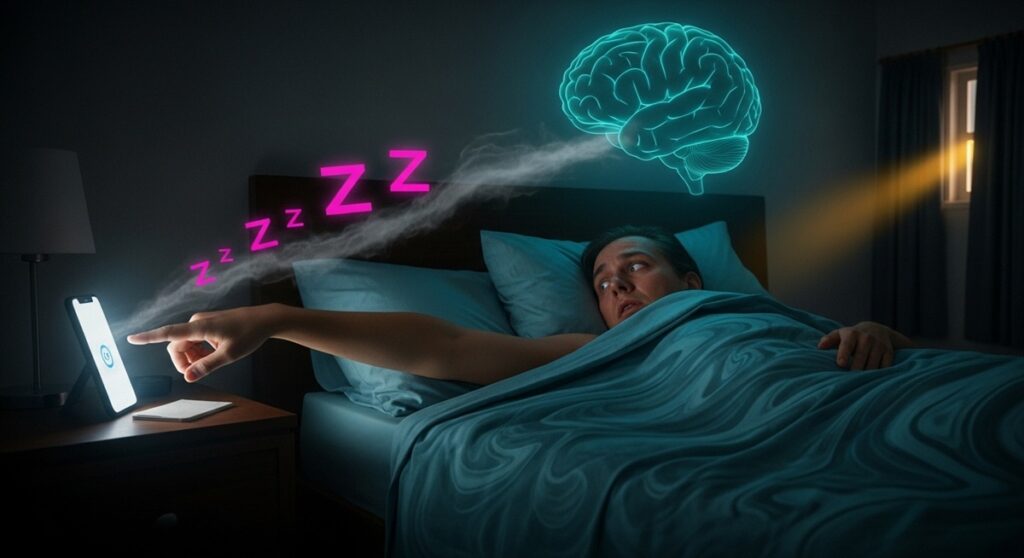
The glorious absurdity? We have very important things to do, yet our brains sometimes insist on remaining in a half-asleep coma, convinced that five more minutes will solve all our problems. It’s a shared, delightful madness where our mornings begin with a battle against our own biology. Your inner Borat might hear very loud alarm and declare, “My bed is very nice! My brain says ‘sleep more!’ Very nice, but now I am very late and very grumpy!”
How to Wake Up Fresh (Very Nice! And Truly Liberating!)
Understanding that your brain’s ‘Why Do I Keep Hitting Snooze?’ tendency (Sleep Inertia) is a natural, powerful physiological response is the first step to liberation. It’s not about becoming a superhuman morning person overnight; it’s about learning to work with your magnificent, weird brain to optimize your sleep-wake transition, fostering greater alertness, productivity, and a more “very nice!” start to your day.
Here’s how to nudge your brain towards more refreshed, “very nice!” mornings:
- Acknowledge Sleep Inertia, Then Resist the Snooze!: Understand that the grogginess is normal but temporary. Consciously commit to not hitting snooze. Place your alarm across the room so you physically have to get up to turn it off. “My brain says ‘snooze is very good!’ I say ‘no, snooze is very bad for me!’ Very nice, now I get out of bed!”
- Consistent Sleep Schedule (Even Weekends!): Go to bed and wake up at roughly the same time every day, even on weekends. This helps regulate your circadian rhythm, making waking up easier.
- Optimize Your Wake-Up Time: Try to align your alarm with the end of a light sleep cycle. There are apps that can help track your sleep stages and wake you during an optimal window.
- Expose Yourself to Bright Light Immediately: As soon as you wake, expose yourself to natural sunlight or a bright artificial light. Light signals to your brain to stop melatonin production and start waking up. Open curtains, turn on lights.
- Hydrate Immediately: Keep a glass of water by your bed and drink it as soon as you wake up. Hydration helps kickstart your metabolism and brain activity.
- Move Your Body (Even a Little!): Gentle movement (stretching, a quick walk, jumping jacks) increases blood flow and signals to your brain that it’s time to be active, helping to shake off grogginess.
- Avoid “Sleep In” Bingeing: While tempting, sleeping in significantly on weekends can disrupt your circadian rhythm, making Monday mornings even harder. Aim for consistency.
- Cool Down Your Room for Sleep: A slightly cooler room (around 65°F/18°C) is optimal for sleep. This helps your body temperature drop, signaling sleep.
- Limit Evening Caffeine & Alcohol: Both can disrupt sleep quality, leading to more pronounced sleep inertia the next morning.
- Create a Relaxing Bedtime Routine: A consistent routine signals to your brain that it’s time to wind down, promoting deeper, more restorative sleep and an easier wake-up.
The ‘Why Do I Keep Hitting Snooze?’ Brain is a truly special window into our complex psychology, a reminder that our minds, while magnificent, are also prone to delightful (and draining) forms of morning grogginess. Knowing this doesn’t make you lazy; it makes you self-aware, wonderfully weird, and very nice! Embrace your inner early bird, understand your brain’s groggy gatekeeper, and prove that you can master your mornings, waking up fresh, alert, and ready to conquer the day.