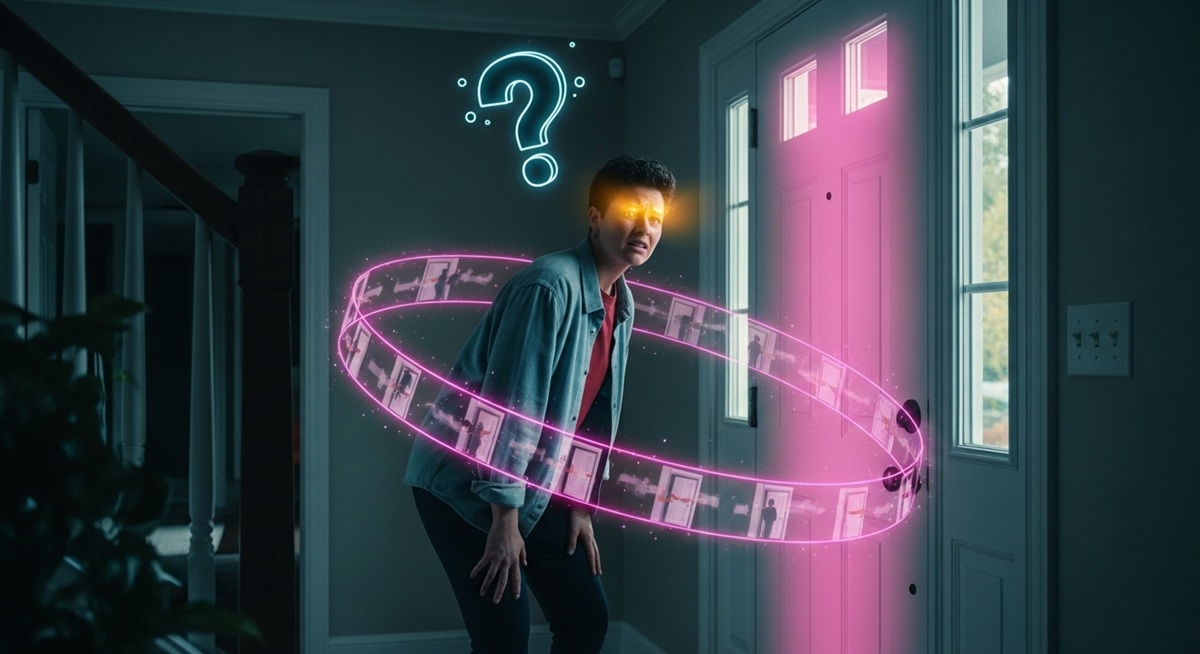
Retrospective doubt is the tendency to lose confidence in a routine action you’ve already completed, with no new evidence that anything actually went wrong. The ‘Did I Lock the Door?’ Brain is the version that hits halfway down the street, or seconds after hitting send. The very nice fix is a short habit called The One-Check Rule, giving the doubt exactly one honest check instead of an endless loop of them.
Psychology explains this through: action-outcome uncertainty, the finding that confidence in having performed a routine, automatic action erodes on its own over time, purely from being revisited, with no new information involved at all.
The door was locked. Checking it again is what starts to make it feel otherwise.
Madness Meter: 🔁🔁🔁 The Checking Paradox (Participants who repeatedly “checked” a virtual stove on a screen rated their memory of turning it off as less vivid and less trustworthy than participants who checked it only once.)
Most people assume double-checking is just being careful, extra diligence that can only help. Research on repeated checking finds the opposite. Each re-check adds a new memory of the act of checking, layered on top of the original memory of doing the thing itself, and over time the brain has trouble telling which memory is the real one. The checking doesn’t confirm the action. It quietly replaces the confident memory of it with a blurrier one.
This creates the ‘Did I Lock the Door?’ Brain, a mind that treats its own repeated verification as a reason for more doubt instead of less.
S³ – Story • Stakes • Surprise
Story | The Checking Paradox
The Classic Experiment: researchers Marcel van den Hout and Merel Kindt had participants “check” a virtual gas stove on a computer screen, turning off a series of knobs, either a single time or repeatedly, over and over, the way someone with checking compulsions might.
The Task: afterward, every participant rated how confident, vivid, and detailed their memory of turning off the stove actually felt.
The Result: the group that checked repeatedly rated their memory as significantly less vivid and less trustworthy than the group that checked only once, despite having “verified” the action many more times over.
The Mechanism: each repeated check without new information adds another memory of checking on top of the original memory of the act, and the brain increasingly struggles to tell the two apart, which is exactly what turns a locked door into an open question the more times it gets re-verified.
Stakes | What the ‘Did I Lock the Door’ Brain Costs
A habit that feels like caution can quietly turn into a real cost:
The Confidence Erosion. Exactly as the stove study found, every extra check makes the original memory less trustworthy, not more, so the doubt that prompted the checking ends up worse afterward.
The Time Sink. A few minutes spent circling back to re-verify a door, an email, or a stove adds up fast once it happens several times a week, for actions that were almost always fine the first time.
The Escalation Trap. The brief relief that follows a check quietly rewards the checking itself, which is how doubt about one thing can spread into doubt about several unrelated routine actions over time.
Surprise | The One-Check Rule
The fix isn’t never checking. It’s making the first check count, and stopping there.
The Cure: run “The One-Check Rule” the next time a completed action starts to feel uncertain:
- Anchor It Once. Narrate the action out loud or notice a specific sensory detail as you do it, the click of the lock, the weight of the door, so the first memory is vivid enough to actually hold up later.
- Allow Exactly One Check. If the doubt still shows up, permit a single deliberate re-check, then treat the question as closed, on purpose, rather than leaving it open for a second or third pass.
- Label the Urge. When the doubt returns after that, name it as “just a doubt” rather than new evidence, since by definition nothing has actually changed since the one-time check.
- Build External Proof for the Big Stuff. For anything genuinely high-stakes, a smart lock’s app log, a sent-mail confirmation, let an outside record settle it instead of asking your memory to do that job alone.
A² – Apply • Amplify
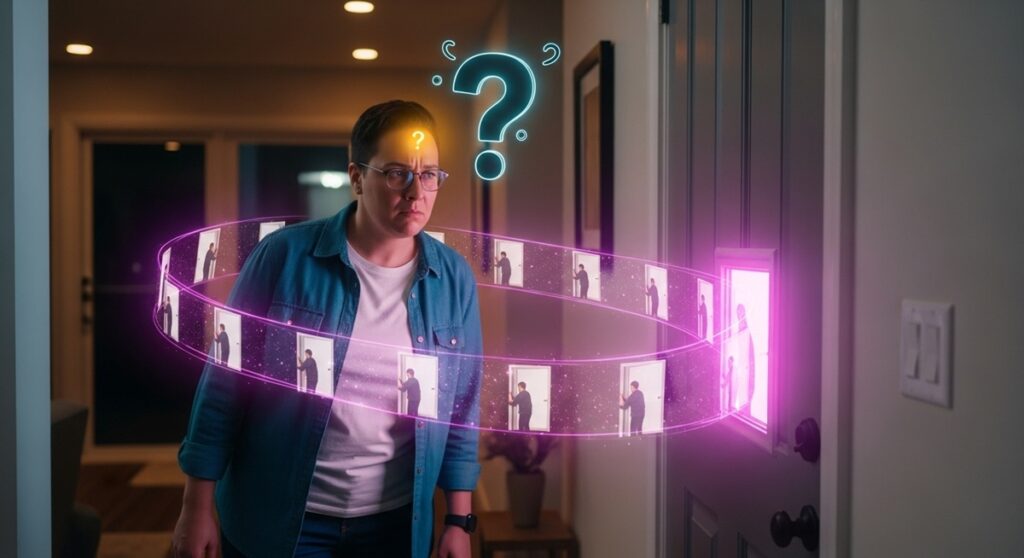
You didn’t forget to lock the door. You just checked it one too many times.
The Psychology Bits
- Compulsive Checking (Related): the more persistent, anxiety-driven version of this same loop, where the checking itself becomes the main event, covered in full in The ‘Why Do I Keep Checking?’ Brain.
- Automatic Action (Related): the reason routine actions get such a weak conscious memory trace in the first place, leaving room for doubt to move in, covered in full in The ‘Auto-Pilot’ Brain.
Applying One-Check-Rule Architecture
Adopt these rules for any routine action that tends to trigger a doubt loop:
- The Anchor Rule. Give the first pass at any doubt-prone action one small, deliberate sensory detail to hold onto, rather than performing it on autopilot.
- The Single-Check Rule. Decide in advance that one re-check is the maximum, so the decision isn’t being renegotiated in the moment, when the doubt is loudest.
- The External-Proof Rule. For anything where the cost of being wrong is genuinely high, build in an outside record up front instead of relying on memory to settle it after the fact.
FAQ
Q | Is this the same thing as OCD? A | No. An occasional “did I lock the door” moment is a normal, mild version of a very common mental glitch. Clinical checking compulsions are a separate, more persistent, and genuinely distressing pattern, and it’s worth talking to a professional if checking is taking up real time or causing real distress.
Q | Why does checking again make it worse instead of better? A | Because each check adds a new memory of the act of checking on top of the original memory, and the brain starts to lose track of which one it’s actually recalling, which is the exact mechanism behind this piece’s Story.
Q | Is there ever a good reason to check twice? A | Sometimes. A single deliberate re-check for something genuinely high-stakes is reasonable. The problem isn’t the second check, it’s the third, fourth, and fifth one that follow it without adding anything new.
Citations & Caveats
- Source 1: van den Hout, M., & Kindt, M. (2003). Repeated Checking Causes Memory Distrust. Behaviour Research and Therapy. (The study behind this piece’s Story.)
- Source 2: Bargh, J.A., & Chartrand, T.L. (1999). The Unbearable Automaticity of Being. American Psychologist. (Explains why routine, automatic actions get such a weak conscious memory trace to begin with.)
Disclaimer: This article discusses ordinary, occasional retrospective doubt as documented in psychological research, not a claim about clinical checking compulsions or OCD. If checking is frequent, time-consuming, or genuinely distressing, a mental health professional can help far more than any habit tweak here.
Part of this site’s ongoing look at how the mind second-guesses its own recent past. For the more persistent, anxiety-driven version of this same loop, see The ‘Why Do I Keep Checking?’ Brain. For why the original action left such a faint memory trace in the first place, see The ‘Auto-Pilot’ Brain.
// Protocol · Next Transmission
The glitch is the signal. — Psyness Protocol