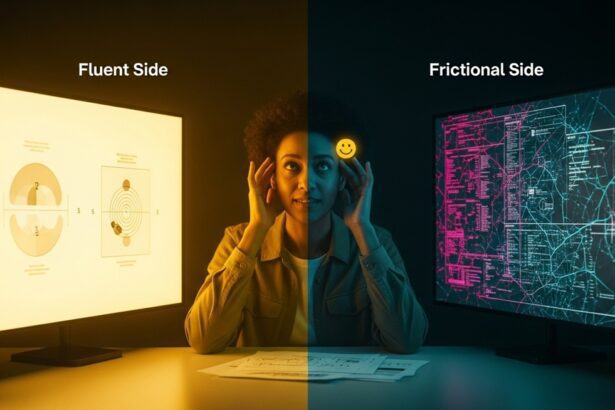
The Frequency Illusion is the reason something you just learned suddenly seems to show up everywhere, not because it actually became more common, but because your attention just got trained to catch it. The ‘Suddenly Everywhere’ Brain is the version that runs the moment a new word, product, or idea enters your radar. Nothing about the world changed. What changed is which parts of it your brain now bothers to flag. The very nice fix is a short habit called The Base Rate Check, counting the real occurrences instead of trusting the felt sense of a sudden surge.
Psychology explains this through: selective attention, confirmation bias, and a filtering system that was never built to track frequency accurately in the first place.
The thing didn’t multiply. Your filter just got told to stop ignoring it.
Madness Meter: 📡📡📡 The Self-Naming Loop (This phenomenon’s own nickname, the Baader-Meinhof Phenomenon, comes from a 1994 internet forum poster who kept hearing the name of a German militant group right after learning it for the first time, a real-time example of the exact glitch he was describing.)
Most people assume that if something feels suddenly everywhere, it probably is, that a sharp jump in noticing must track a real jump in occurrence. The actual mechanism runs in the opposite direction. Your brain filters almost everything by default, and it only lifts the filter on something specific once that thing has been marked relevant, by a recent purchase, a new word, a diagnosis, a name. Once the filter lifts, every instance that was always there starts registering, and the sudden flood feels like new information about the world instead of what it actually is, new information about your own attention.
This creates the ‘Suddenly Everywhere’ Brain, a mind that mistakes a change in what it’s tracking for a change in what actually exists.
S³ – Story • Stakes • Surprise
Story | The Cocktail Party Filter
The Classic Experiment: in 1953, researcher Colin Cherry studied how people follow one conversation in a room full of competing ones, a problem he called the cocktail party effect, by playing two different spoken messages into a listener’s two ears at once.
The Task: participants wore headphones playing a different message in each ear and were asked to repeat one assigned stream aloud, word for word, as it played, while the other stream ran unattended in the background.
The Result: listeners could accurately repeat the assigned stream while registering almost nothing about the unattended one, not its language, not its topic, sometimes not even whether the speaker had changed. One thing broke through the ignored stream almost every time: the listener’s own name.
The Mechanism: the brain doesn’t process incoming information evenly. It runs a filter that mutes nearly everything except whatever has been flagged as currently relevant, and your own name is permanently flagged. A newly learned word or concept gets a temporary version of that same flag, which is why it starts breaking through a stream of information that was always running in the background.
Stakes | What the ‘Suddenly Everywhere’ Brain Costs
The cost of the Suddenly Everywhere Brain shows up anywhere a felt increase gets treated as a measured one:
The Symptom Spiral. After learning about a specific medical symptom or rare condition, people reliably start noticing it in themselves and in others far more often, not because the symptom became more common, but because it’s now on the list of things worth flagging.
The Purchase Echo. After buying something, noticing the same product everywhere afterward quietly reinforces that the purchase was popular and correct, when the only thing that actually changed is which products your attention now bothers to register.
The Cluster Scare. One report of a specific danger primes attention to catch every subsequent report of the same thing, and the resulting cluster of noticed stories can feel like proof of a real spike even when the underlying rate never moved.
Surprise | The Base Rate Check
The fix isn’t ignoring the pattern you’re noticing. It’s checking whether the count actually moved, or only your attention did.
The Cure: run “The Base Rate Check” any time something feels like it’s suddenly everywhere:
- Name the Trigger Moment. Identify exactly when the noticing started. If it lines up with learning, buying, or being diagnosed with something, treat the “increase” as suspect by default.
- Count, Don’t Feel. Track actual occurrences over a fixed window instead of relying on the impression of frequency, which is exactly the measurement your filter is bad at.
- Look for the Misses. Deliberately search for stretches of time where the thing didn’t appear at all, to rebalance a sample your brain has been curating in one direction.
- Split the Two Claims. Separate “I’m now more likely to notice this” from “this is now more common.” Only act on the second one once you’ve actually checked it.
A² – Apply • Amplify

A count settles the question in a minute. A feeling of sudden ubiquity can run for weeks without ever being checked.
The Psychology Bits
- Confirmation Bias (Related): the mechanism that takes over once the noticing starts, weighting each new sighting as proof while quietly discounting the stretches where nothing appeared, covered in full in The ‘Always Right’ Brain.
- The Availability Heuristic (Related): a close cousin that distorts risk instead of frequency, judging how likely something is by how easily an example comes to mind, covered in full in The ‘Loudest Voice’ Brain.
Applying Base-Rate Architecture
Adopt these rules anywhere a felt pattern might get treated as a measured fact:
- The Fixed Window. Pick a specific, bounded period before counting anything, a week, a month, rather than an open-ended “lately” that keeps stretching to fit the impression.
- The Trigger Log. Keep a short note of when a new noticing habit started, so a real spike months later doesn’t get credited to a pattern that was actually just attention catching up.
- The Outside Check. Ask someone with no reason to be primed on the topic whether they’ve noticed the same increase, since their unfiltered baseline is the closest thing to a real count you’ll get quickly.
FAQ
Q | Is the Frequency Illusion the same thing as the Baader-Meinhof Phenomenon? A | Yes. Baader-Meinhof Phenomenon is the informal name that started the idea, and Frequency Illusion is the term linguist Arnold Zwicky proposed once he traced where the informal name actually came from.
Q | Is this just confirmation bias with a different name? A | No. Confirmation bias is about how you weigh evidence once you’re already looking for it. The Frequency Illusion is about what gets flagged for your attention in the first place, before any weighing happens.
Q | Can this happen with something that isn’t real at all? A | Yes. Even a word invented for a lab study will start “appearing” more often to someone once they’ve been primed to notice it, since the filter responds to the flag, not to whether the thing is genuinely significant.
Citations & Caveats
- Source 1: Cherry, E.C. (1953). Some Experiments on the Recognition of Speech, with One and with Two Ears. Journal of the Acoustical Society of America. (The cocktail party study behind this piece’s Story.)
- Source 2: Zwicky, A. (2005). Just Between Dr. Language and I. Language Log. (The post credited with naming the Frequency Illusion out of the earlier Baader-Meinhof internet folklore.)
Disclaimer: This article discusses the Frequency Illusion as documented in attention and perception research, not a claim that every pattern you’ve noticed recently is imaginary. Some really are new. The point is that noticing more isn’t proof of that on its own.
Part of this site’s ongoing look at how attention shapes what feels true. For the mechanism that takes over once the noticing starts, see The ‘Always Right’ Brain. For the version that distorts risk instead of frequency, see The ‘Loudest Voice’ Brain.
// Protocol · Next Transmission
The glitch is the signal. — Psyness Protocol