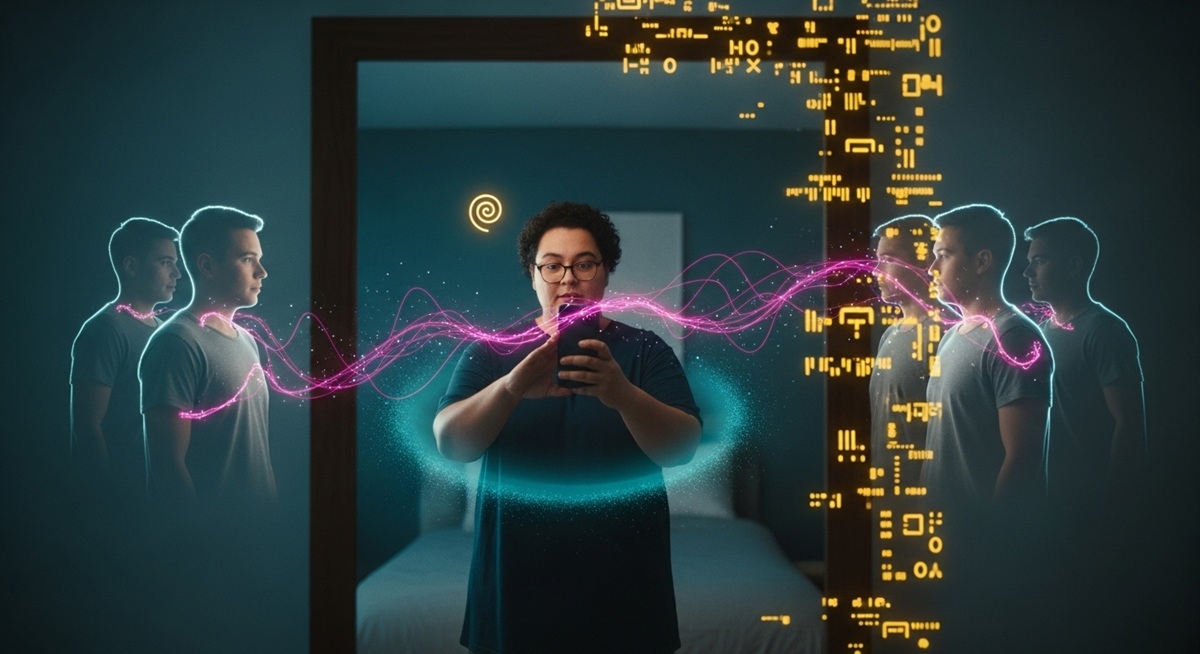
That perfectly angled mirror pic? The quick video you filmed of yourself just because? The voice note you sent your friend just to hear yourself talk? It’s your Mirror Selfie Brain at work! Psychology calls this self-referential processing and identity reinforcement—tiny, often quirky habits your mind uses to anchor your sense of self, solidify memories, and feel very nice and seen. They’re ancient brain code for broadcasting, “I exist!” and building your own personal story.
Your “selfie habit” isn’t weird or vain; it’s a very nice survival strategy.
Spotting it means realizing your camera roll is a sacred archive of your beautiful, unhinged evolution.
Madness Meter: 🌀🌀 Medium (Warning | may cause an urge to re-open your camera roll and admire your journey.)
You’re in the bathroom. The light hits just right. You glance at yourself and think | this deserves a snap. One click, maybe two, maybe twenty. Later, scrolling back, you find that selfie and smile. It’s not narcissism. It’s not useless. It’s the glorious absurdity of your brain inventing tiny rituals out of nothing to keep a record of you. This isn’t just quirky behavior; it’s the Mirror Selfie Brain in action, your mind’s very nice, beautifully unhinged “identity anchor.” These seemingly trivial habits are actually ancient brain code for creating self-awareness, personal narrative, and a sense of continuity. Is your mind simply being playful? Or is your beautiful brain merely doing its very nice, very efficient (though profoundly subconscious) job of creating a deeply felt sense of self-worth and belonging? At Psyness.com, we take a “very nice!” look at this peculiar psyche, proving that understanding this peculiar psyche doesn’t have to be boring—it can be a riot.
S³ – Story • Stakes • Surprise
Story
You’re in the bathroom. The light hits just right. You glance at yourself and think | this deserves a snap. One click, maybe two, maybe twenty.
Later, scrolling back, you find that selfie and smile.
Congrats | your brain just built a record of you.
Stakes
In a world of endless feeds and fleeting moments, self-documentation is how we anchor identity. Without it, memory blurs, self-image distorts, and our sense of who we are feels slippery.
Surprise
Science says selfies are less about vanity than self-awareness. They’re your brain’s way of checking in and saying | “Still me? Cool. Carry on.”
Why Your Brain Makes You Document Yourself
Your brain, bless its tirelessly self-aware heart, is primarily wired for building and maintaining a coherent sense of self. The Mirror Selfie Brain describes your mind’s tendency to create and participate in self-documentation, which acts as a powerful self-signal. This isn’t a flaw; it’s a testament to your brain’s constant, low-level engagement with building and maintaining personal identity. Several cognitive and psychological processes fuel this pervasive, peculiar drive for self-documentation:
- Self-Recognition: Humans are one of the few species who pass the mirror test (self-recognition). Every selfie you snap taps into that ancient “yes, that’s me” circuit, offering your brain a reassuring, fuchsia-pink sense of being.
- Identity Reinforcement: The pictures we take of ourselves confirm | “this is who I am, today.” They are a fundamental way your brain creates a concrete record of your evolving self, reinforcing a deep teal/cyan sense of who you are and where you’ve been.
- Narrative Building: Your brain loves a good story. By taking photos of yourself, you’re not just capturing a moment; you’re creating visual timestamps that your mind can slot into your personal narrative. This predictability offers a cheerful mustard yellow sense of security and shared knowledge between your past, present, and future selves.
- Memory Encoding: Thanks to the self-referencing effect, we remember information better when it’s tied to ourselves. By tagging a moment with a picture of you, your brain makes it more memorable, creating a powerful sense of permanence.
For example, the way you cringe at an old selfie but secretly love seeing how much you’ve grown—this shared, symbolic act, devoid of practical purpose, powerfully reinforces social connection. Research by Markus (1977) introduced the concept of self-schema theory, suggesting that we organize memory around the self. This is why selfies feel so powerful. Furthermore, studies by Uchida et al. (2019) demonstrated that selfies activate brain regions linked to self-referential thinking, highlighting their neurological significance. Even in digital culture, selfies often serve as rituals of belonging, not just vanity, as shown by research from Barasch et al. (2016) who found that sharing personal photos increases feelings of connection. Think of a group of friends taking a selfie—they’re not just capturing an image, they’re creating a digital tribal token. Online, it’s the same when thousands share a photo from a protest or a concert, creating a spontaneous, shared experience.
Why Your Brain Loves the Drama
While these self-documenting habits feel quirky, their deep psychological roots offer your brain some compelling benefits, alongside a few social pitfalls.
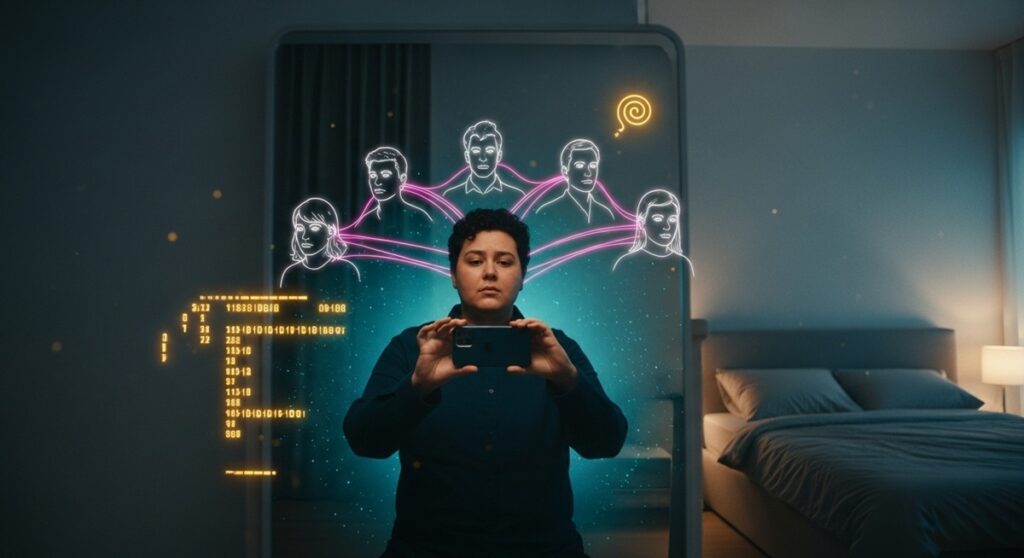
Short-term perks of Mirror Selfies
- Identity check-ins: Selfies are a quick way to affirm your self-image across time, helping your brain keep track of its beautiful, evolving you.
- Mood boosts: Engaging in self-affirmation can lead to a quick, satisfying rush of positive feelings, reinforcing your sense of control and self-worth.
- Bonding with your tribe: Shared selfies are a form of social signaling, broadcasting belonging and mood, which can strengthen social bonds.
Long-term pitfalls of Selfie Overdrive
- Obsessive comparison: Selfies can turn from a tool for self-awareness into a weapon for self-criticism if you constantly compare yourself to others.
- Anxiety over feedback: Tying your self-worth too tightly to likes or comments can create social anxiety and a fragile self-image.
- Distorted self-image: When your self-image becomes too tied to curated, polished moments, it can create a disconnect from your authentic, day-to-day self.
A² – Apply • Amplify
Apply (Very Nice! And Actually Fun)
- Notice your rituals: Become aware of the existing times you document yourself. Understanding their power helps you wield it more consciously. This is your cheerful mustard yellow signal for social awareness.
- Use selfies as a journal: Actively use selfies to track moods, outfits, or personal milestones. This fuchsia-pink creativity strengthens your relationship with yourself.
- Revisit old ones: Go back and reflect on how much you’ve grown and changed. Protect the cringe; it’s a very nice part of your story.
- Balance sharing vs. keeping: Understand that some selfies are just for you. This deep teal/cyan flexibility keeps your documentation healthy.
Amplify
- Try a “365 selfies” project: A living record of you and your evolution.
- Create private selfie rituals: A quick morning smile check, a pre-event hype pic—these are for your eyes only.
- Flip it: Take “anti-selfies” that show messy, real-life moments.
FAQ
Q | Isn’t selfie-taking narcissistic? A | Not necessarily. While it can be, studies show it’s more about identity and connection than pure ego. It’s an ancient brain function adapted for a modern medium.
Q | Why do I feel good when I look at old selfies? A | They trigger memory recall and affirm personal growth. Seeing your past self can offer a satisfying sense of continuity and evolution, reminding you of how far you’ve come.
Q | Do private selfies work the same as public ones? A | Yes! The psychological benefits of self-awareness and memory encoding are still at play, even when the selfie is never shared. The core power lies in the act of self-documentation itself.
Citations & Caveats
- Markus, H. (1977). Self-schemata and processing information about the self. Journal of Personality and Social Psychology.
- Uchida, M. et al. (2019). Neural correlates of self-photography | Selfies and brain activation. Social Cognitive and Affective Neuroscience.
- Barasch, A. et al. (2016). Selfies and connection | Why sharing personal photos feels good. Journal of Consumer Research
Disclaimer: This article is for informational purposes only and is not a substitute for professional psychological advice. While the desire to document oneself is universal, if you experience extreme anxiety over social feedback, obsessive self-comparison, or find your self-worth tied exclusively to your curated online image, please seek help from a qualified mental health professional.
// Protocol · Next Transmission
The glitch is the signal. — Psyness Protocol