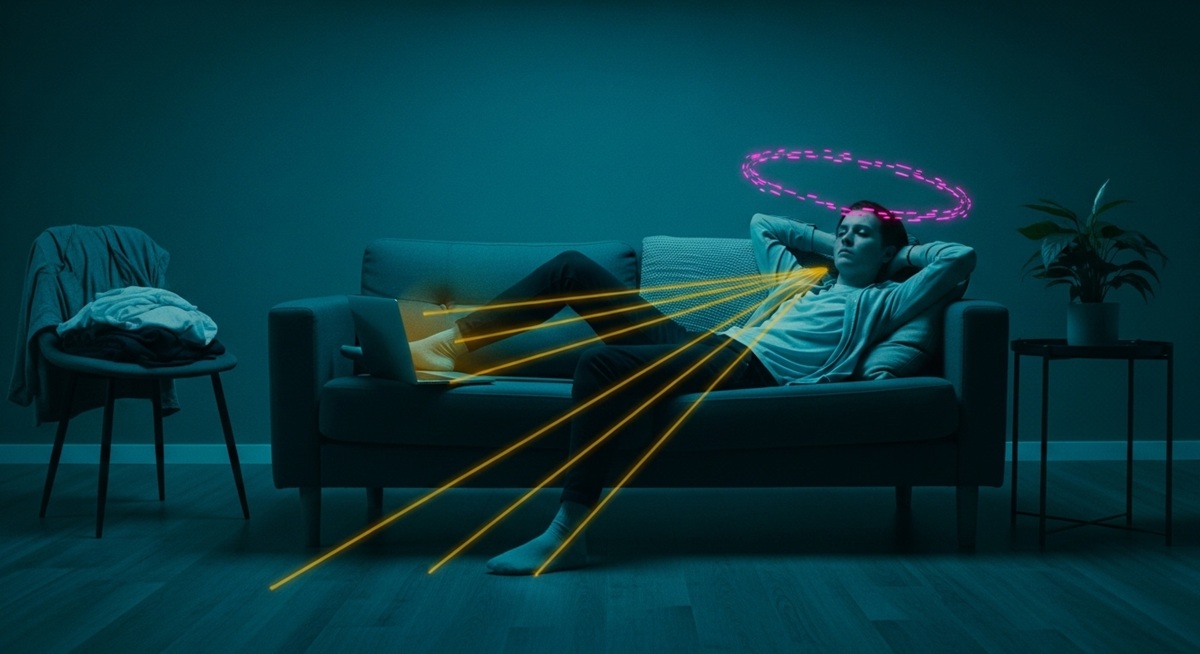
Ever sat down to “relax” only to feel twitchy, guilty, or like you should be doing something? That’s your Restless Relaxer Brain—a psychological quirk known as productivity culture conditioning. It’s a mash-up of anxiety loops and a craving for novelty. Far from lazy, it’s your brain’s survival wiring, mistaking stillness for danger.
Madness Meter: 🌀🌀 Medium (Warning | May cause sudden urge to alphabetize your bookshelf instead of napping.)
The ‘Restless Relaxer’ Brain | Why You Can’t Sit Still Even When You’re Resting
You finally clear an afternoon. You light a candle, fluff a pillow, sit down to “relax.” Within minutes, your brain whispers | “Shouldn’t you be folding laundry? Maybe check that one email. What if you started a side hustle?” Instead of blissful rest, you’re stuck in the anxious fidgets of the Restless Relaxer Brain—a psyche that treats stillness like a suspicious stranger. This is your mind’s very nice, beautifully unhinged way of feeling like a main character in a universe that’s not paying that close of attention. Is your mind just a little too self-absorbed? Or is your beautiful brain simply doing its very nice, very efficient (though profoundly challenging) job of keeping you safe, alert, and on your best behavior? At Psyness.com, we take a “very nice!” look at this peculiar psyche, proving that understanding this peculiar psyche doesn’t have to be boring – it can be a riot.
S³ – Story • Stakes • Surprise
Story
You hit the couch for “self-care” and end up scrolling TikTok for two hours, feeling both wired and guilty.
Stakes
Without true rest, your nervous system never downshifts—leaving you prone to burnout, anxiety, and irritability.
Surprise
Restlessness isn’t laziness in disguise. It’s your brain’s survival wiring—motion once meant safety, and in modern life, that wiring goes haywire.
Why Your Brain Resists Rest
At its core, your Restless Relaxer Brain reveals that your mind is deeply uncomfortable with uncertainty and idleness. Your brain is wired for prediction and agency, and it hates to feel helpless. When faced with an unstructured, “empty” moment, your brain creates a narrative where you should be doing something, anything, to feel productive. This isn’t a delusion; it’s a cognitive strategy to manage stress and motivate you to act. Your brain, bless its tirelessly optimistic heart, is primarily wired for empowerment.
The Psychology Bits
The Restless Relaxer Brain is a cognitive bias where we experience a feeling of dissonance between the need to rest and the urge to be productive. This phenomenon was first described by psychologists Thomas Gilovich, Victoria Medvec, and Kenneth Savitsky in the 1990s. The illusion of choice, however minor, created an exaggerated sense of control and confidence. This is how your brain works:
- Productivity Culture Conditioning: Society rewards busyness, making stillness feel like failure. This deep teal/cyan belief is a powerful driver of the Restless Relaxer Brain, creating a need for personal agency even when none exists.
- Novelty-Seeking Dopamine: Your brain craves stimulation, not blank space. This creates a very nice, but often manipulated, internal preference.
- Evolutionary Hypervigilance: For ancient humans, idleness meant vulnerability to predators. Your brain is always looking for an optimal path. This is where your cheerful mustard yellow decision-making is steered by the promise of avoiding a pitfall.
- Anxiety Loops | Idle time magnifies “what if” thinking. This tension is your fuchsia-pink alarm bell for anything that smells like losing.
For example, when a gambler blows on their dice before a roll, their brain isn’t being irrational; it’s attempting to assert control over a truly random event to alleviate the anxiety of uncertainty. The action is a psychological tool, not a physical one.
Why Your Brain Loves the Drama
While the Restless Relaxer Brain can lead to suboptimal decisions, it persists because it offers your brain some cognitive shortcuts and plays into fundamental psychological drivers.

Short-term perks (why it persists)
- Keeps you alert and ready.
- Rewards you with micro dopamine hits for small tasks.
- Signals social value (being “productive”).
Long-term pitfalls
- Chronic stress and burnout.
- Reduced creativity (your brain needs downtime to make connections).
- Poor emotional regulation from never resetting your nervous system.
How to Outsmart (or Befriend) Your Restless Relaxer Brain
Understanding that your brain’s Restless Relaxer tendency is a natural, powerful psychological process is the first step to liberation. It’s not about becoming a cynical fatalist; it’s about learning to work with your magnificent, weird brain to foster more intentional, “very nice!” understanding. Here’s how to nudge your brain towards a more intentional, “very nice!” understanding:
- Active Rest Trick: Swap “do nothing” with light activities (strolling, doodling, stretching). This simple act of identification can satisfy your brain’s need for closure. This is your cheerful mustard yellow signal for cognitive flexibility.
- Scheduled Stillness: Give rest a slot in your calendar to legitimize it. This is your fuchsia-pink push for comprehensive input.
- Guilt Swap: Reframe rest as brain maintenance, not laziness. This trains your brain to accept the role of chance and reduce the illusion of control. This is your deep teal/cyan exercise in objectivity.
- Novel Rest: Try playful downtime (lego building, hammock swinging, sketching nonsense).
The Restless Relaxer Brain is a truly special window into our complex psychology, a reminder that our minds, while magnificent, are also prone to delightful (and sometimes profoundly misleading) forms of interpretive bias. Knowing this doesn’t make you foolish; it makes you self-aware, wonderfully weird, and very nice! Embrace your inner critical thinker, understand your brain’s fascinating susceptibility to this feeling of control, and prove that you can navigate a world of carefully crafted messages with greater clarity, independence, and authentic choice. It’s not boring – it’s a riot!
FAQ
Q | Why do I feel guilty when I rest? A | Because culture and conditioning tell you productivity = worth. Your brain internalized it.
Q | Isn’t scrolling TikTok “rest”? A | Not really. It stimulates you instead of downshifting you—that’s fake rest.
Q | Does rest actually improve productivity? A | Yes. Studies show downtime boosts creativity, focus, and emotional resilience.
Citations & Caveats
- Kaplan, S. (1995). The restorative benefits of nature | Toward an integrative framework. Journal of Environmental Psychology.
- Sonnentag, S. (2018). The recovery paradox | Why rest is not always restful. Organizational Psychology Review.
- Berman, M. G., et al. (2008). The cognitive benefits of interacting with nature. Psychological Science.
Disclaimer: This article is for informational purposes only and is not a substitute for professional psychological advice. While the Illusion of Control is a pervasive cognitive bias, individual susceptibility can vary. If you feel consistently overwhelmed by a need for control or experience significant anxiety related to a compulsion to influence chance events, please consider seeking help from a qualified mental health professional.
// Protocol · Next Transmission
The glitch is the signal. — Psyness Protocol