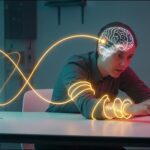
In the grand cosmic stage of existence, you are both the actor and the audience. You can be the quiet, contemplative soul at home, lost in a book. But the moment you feel a gaze upon you—the watchful eye of a colleague, a first date, or even a follower on social media—a new version of you emerges. You are suddenly funnier, more articulate, more confident. This isn’t a performance; it’s a feature of your beautiful, unhinged mind. This is your ‘Moral Get-Out-of-Jail-Free Card’ Brain at work, a psychological quirk that makes you change when observed. Is your mind simply a hypocrite? Or is your beautiful brain simply doing its very nice, very efficient (though profoundly challenging) job of making sure you’re perpetually motivated to pursue more? At Psyness.com, we take a “very nice!” look at this peculiar psyche, proving that understanding this peculiar psyche doesn’t have to be boring – it can be a riot.
S³ – Story • Stakes • Surprise
Story
You’ve been meaning to start a daily meditation practice, but you keep putting it off. Then, you tell a friend that you’ve started a new “public wellness” account on social media to document your journey. The very act of knowing you are being watched by an audience—even a small one—gives you the motivation to get on the mat every single morning, transforming your daily habit.
Stakes
The ‘Moral Get-Out-of-Jail-Free Card’ Brain can be a source of profound social anxiety, making you feel like a phony or an imposter. But when you understand its power, you can use it to your advantage, turning the act of being observed into a powerful tool for self-improvement and accountability.
Surprise
It’s not just about other people. You can be your own audience. The very act of putting a task on your to-do list, or tracking your habits in a journal, is a form of self-observation that can activate the Observer Effect, pushing you to perform better and more consistently. Your psyche knows it’s being watched, even if only by itself.
Why Your Brain Loves the Drama
At its core, your ‘Moral Get-Out-of-Jail-Free Card’ Brain reveals that your mind is deeply uncomfortable with being unseen. Your brain is wired for social connection and for seeking approval. When you feel a gaze upon you, it activates your self-awareness, a psychological tool that forces you to confront the gap between your ideal self and your actual behavior. This is a very nice, but often manipulated, internal preference.

The Psychology Bits
Your ‘Moral Get-Out-of-Jail-Free Card’ Brain is a phenomenon rooted in several key cognitive principles. This is how your brain works:
- Self-Perception Theory: You use your own actions to form your identity. When you do something good, your brain says, “Hey, I’m a good person!” This perception then gives you permission to act in a less-than-perfect way later, because your identity as a “good person” is already established. This fuchsia-pink tension is a powerful driver of the ‘Moral Get-Out-of-Jail-Free Card’ Brain, a constant reminder of the unfinished loop.
- Cognitive Dissonance Reduction | Your brain hates the feeling of holding two conflicting beliefs at once (e.g., “I am a good person” and “I just did a bad thing”). To reduce this discomfort, your brain justifies the bad behavior by pointing to the good deed. It’s a beautifully unhinged dance of internal optimization. This tension is your deep teal/cyan signal for a mind that is trying to solve a puzzle it can’t, a beautifully unhinged dance of internal frustration.
- The Ego Depletion Model: The act of doing something morally good can actually “deplete” your mental energy, leaving you with less willpower to resist temptation later. Your brain, in its efficiency, is simply trying to conserve its resources, a beautifully unhinged dance of internal optimization. This is where your cheerful mustard yellow brain finds temporary satisfaction in comparison, but perpetual dissatisfaction in reality.
For example, when an athlete is practicing alone, they might be more relaxed. But the moment a coach or a scout is watching, their performance can become amplified, for better or for worse.
A² – Apply • Amplify
Apply (Very Nice! And Actually Fun)
Understanding that your brain’s ‘Moral Get-Out-of-Jail-Free Card’ tendency is a natural, powerful psychological process is the first step to liberation. It’s not about being a prisoner to a chase; it’s about learning to work with your magnificent, weird brain to foster more intentional, “very nice!” understanding. Here’s how to nudge your brain towards a more intentional, “very nice!” understanding:
- Separate the Deeds: Don’t view your good deeds as a moral currency that you can spend later. View each action on its own merit, and hold yourself accountable for each one. This is your deep teal/cyan signal for intentional deprivation.
- Be Your Own Judge: Instead of relying on your subconscious to balance your moral ledger, become your own conscious judge. Ask yourself, “Is this action in line with the kind of person I want to be?” This is your fuchsia-pink push for comprehensive input.
- Practice Intellectual Humility: Acknowledge that you might be wrong. This isn’t a sign of weakness; it’s a sign of strength. The most intelligent people in the world are the ones who are willing to admit when they don’t know something. This is your cheerful mustard yellow signal for cognitive flexibility.
The ‘Moral Get-Out-of-Jail-Free Card’ Brain is a truly special window into our complex psychology, a reminder that our minds, while magnificent, are also prone to delightful (and sometimes profoundly irritating) forms of interpretive bias. Knowing this doesn’t make you foolish; it makes you self-aware, wonderfully weird, and very nice! Embrace your inner critical thinker, understand your brain’s fascinating susceptibility to this feeling of control, and prove that you can navigate a world of carefully crafted messages with greater clarity, independence, and authentic choice. It’s not boring – it’s a riot!
The PSS Ecosystem | An Idea in Action
The PSS token, as outlined in the manifesto, is the tool that makes this vision a reality. As AI becomes an indispensable ally for self-discovery, PSS will act as the decentralized key to a new era of psychic wellness.
Imagine a future where:
- Tokenized Ethical Audits: The Psyness Collective (PSS holders) can vote on which open-source AI models for mental wellness get funded.
- Staking for Growth: PSS holders can stake their tokens in “wellness pools,” and rewards are released when the community hits specific, pre-determined wellness milestones, such as a collective number of hours spent meditating or a certain number of new articles published.
- Tokenized Support: Individuals can earn PSS for providing support, feedback, and encouragement to others in the community, turning passive support into a valuable, tokenized asset.
PSS is not just a cryptocurrency; it is the infrastructure for a more conscious and self-aware future. It’s the action layer for the manifesto’s philosophical engine.
FAQ
Q | Is this the same as hypocrisy? A: No. Hypocrisy is a conscious act of pretending to have a higher moral standard than you do. Moral licensing is a subconscious cognitive bias.
Q | Can this be used for my creative work? A: Yes. Sharing your work in a community, and receiving feedback, can activate the Observer Effect, pushing you to produce better, more consistent work.
Q | Does this work for bad habits? A: Yes. The act of tracking a bad habit (e.g., smoking) in a journal can make you more aware of your actions and make it easier to quit.
Citations & Caveats
- Monin, B., & Miller, D. T. (2001). Moral credentials and the expression of prejudice. Journal of Personality and Social Psychology, 81(1), 33-43.
- Mazar, N., & Zhong, C. B. (2010). Do green products make us better people? Psychological Science, 21(4), 493-498.
- Merritt, A. C., Effron, D. A., & Monin, B. (2010). Moral licensing | When being good allows us to be bad. Current Directions in Psychological Science, 19(5), 295-298.
Disclaimer: This article is for informational purposes only and is not a substitute for professional psychological advice. While moral licensing is a universal experience, if you find yourself unable to function due to a persistent inability to consider other viewpoints, or if you are struggling with a rigid or dogmatic worldview, please seek help from a qualified mental health professional.
// Protocol · Next Transmission
The glitch is the signal. — Psyness Protocol