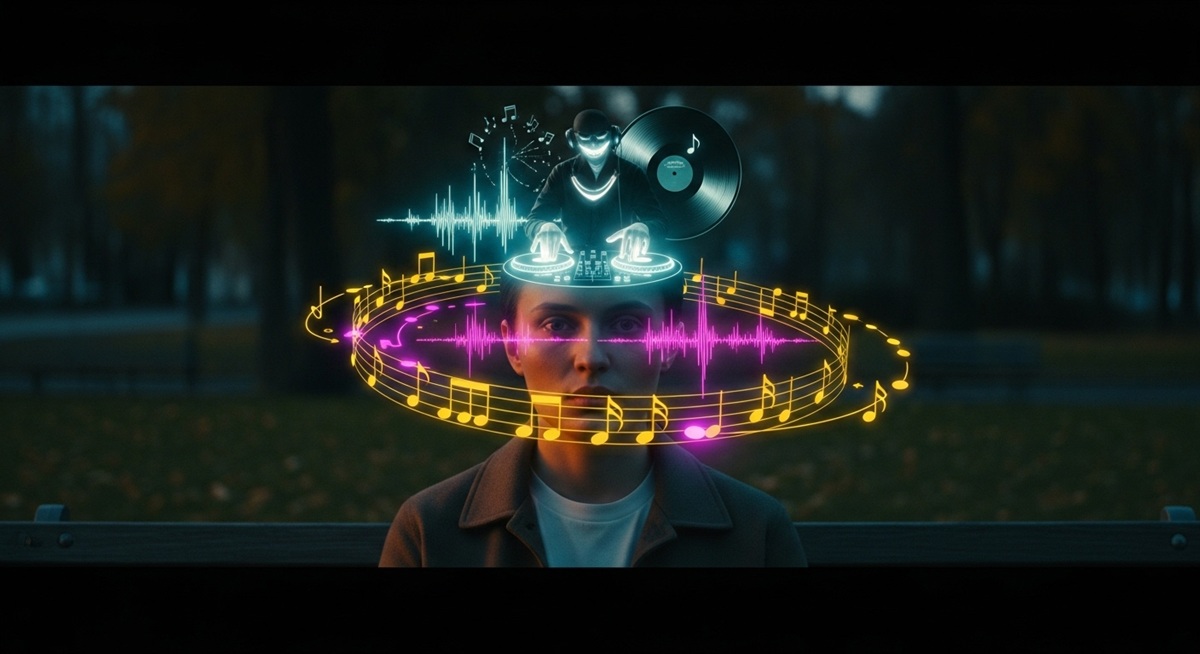
Your brain just hit repeat. That song stuck on an endless loop in your head? It’s not a coincidence; it’s an earworm, a beautifully unhinged piece of your psyche that exploits your brain’s peculiar love for patterns and its need for a cognitive “finish.” It’s your own personal, and often very annoying, sound system.
Psychology explains this through: the Zeigarnik Effect, repetition compulsion, and a “cognitive itch.”
Spotting it means your mind is a DJ, and you’re not allowed to change the song.
Madness Meter: 🌀🌀🌀 Medium-High (Warning | After this, every jingle will feel like a targeted attack.)
Your mind is a quiet room. And then, without an invitation, some ear-blasting pop song from the 90s shows up, unpacks its bags, and starts playing on an endless loop. It’s not just a passing thought; it’s a resident, a squatter, a relentless, tiny dictator of your inner monologue. This isn’t just annoying; it’s a fascinating glimpse into your brain’s weird obsession with patterns, repetition, and a sense of completion. This is your ‘Uninvited DJ’ Brain at work, a beautifully unhinged piece of cognitive machinery that turns a simple tune into a relentless, internal rhythm. Why does this happen, and why is it so hard to turn off? At Psyness.com, we take a “very nice!” look at this peculiar psyche, proving that understanding this peculiar psyche doesn’t have to be boring – it can be a riot.
S³ – Story • Stakes • Surprise
Story
You hear a brief snippet of a jingle from a coffee commercial. You barely register it at the time. An hour later, as you’re trying to focus on a presentation, the melody of that jingle starts playing in your head. It repeats. And repeats. And you can’t make it stop.
Stakes
An earworm isn’t just an annoyance. It can be a genuine distraction, a source of stress, and a maddening obstacle to focus, making your own thoughts feel like they’re no longer entirely your own.
Surprise
The reason you can’t get the song out of your head isn’t because you love it. It’s because you don’t know it completely. Your brain is caught in a cognitive loop—a tiny puzzle it desperately wants to solve but can’t, so it just keeps re-playing the part it knows.
Why Your Brain Loves the Drama
At its core, your ‘Uninvited DJ’ Brain reveals that your mind is deeply uncomfortable with unfinished business. Your brain is wired for prediction and agency, and it hates to feel helpless. When faced with an incomplete musical phrase, your brain latches onto it and plays it over and over, trying to find the missing notes. This isn’t a delusion; it’s a cognitive strategy to manage a psychological “itch.” This is why the best earworms are often simple, repetitive, and contain a recognizable pattern that isn’t fully resolved.

The Psychology Bits
Your ‘Uninvited DJ’ Brain is a phenomenon rooted in several key cognitive principles. This is how your brain works:
- The Zeigarnik Effect: Your brain remembers incomplete tasks much better than completed ones. A jingle that you’ve only heard a snippet of is a classic uncompleted task. Your brain is compelled to finish the song, and it will keep looping the known part until it finds the rest. This fuchsia-pink tension is a powerful driver of the ‘Uninvited DJ’ Brain, a constant reminder of the unfinished loop.
- The Cognitive Itch: When an earworm takes hold, your brain is essentially trying to “scratch” a repetitive cognitive loop. But the more you try to scratch it (by thinking about the song), the worse the itch gets. It’s a self-perpetuating cycle of mental irritation. This tension is your deep teal/cyan signal for a mind that is trying to solve a puzzle it can’t, a beautifully unhinged dance of internal frustration.
- Repetition Compulsion: Your brain is wired for pattern recognition. Simple, repetitive melodies are easy for your brain to grab onto, and once it has a hold, it doesn’t want to let go. This is your brain’s way of finding comfort and predictability in a chaotic world. It’s a very nice, but often manipulated, internal preference. This is where your cheerful mustard yellow brain finds temporary satisfaction in repetition.
For example, a song with a very simple and repetitive chorus, like the “Baby Shark” song, is a perfect earworm. Your brain easily latches onto the pattern and keeps replaying it, trying to get to the nonexistent “conclusion” of the pattern.
A² – Apply • Amplify
Apply (Very Nice! And Actually Fun)
Understanding that your brain’s ‘Uninvited DJ’ tendency is a natural, powerful psychological process is the first step to liberation. It’s not about being a prisoner to a tune; it’s about learning to work with your magnificent, weird brain to foster more intentional, “very nice!” understanding. Here’s how to nudge your brain towards a more intentional, “very nice!” understanding:
- Chew Gum: Seriously. Studies show that a task that engages your motor skills can disrupt the auditory loop in your brain. This deep teal/cyan disruption can give your mind the “out” it needs.
- Listen to the Whole Song: Remember the Zeigarnik Effect? Your brain wants to finish the song. The quickest way to get it to stop is to listen to the entire track from beginning to end. It’s like giving your brain the missing puzzle pieces it’s been searching for.
- Switch to Another Earworm: It’s often easier to replace one earworm with another than it is to get rid of it entirely. This is your fuchsia-pink push for comprehensive input. Choose a song you know and love and listen to it on repeat to give your brain something new to latch onto.
- Solve a Puzzle: Engage your mind in a mentally demanding task, like a crossword puzzle, a Sudoku, or even a simple math problem. This can distract your brain from the repetitive loop and give it a new focus. This is your cheerful mustard yellow signal for cognitive flexibility.
The ‘Uninvited DJ’ Brain is a truly special window into our complex psychology, a reminder that our minds, while magnificent, are also prone to delightful (and sometimes profoundly irritating) forms of interpretive bias. Knowing this doesn’t make you foolish; it makes you self-aware, wonderfully weird, and very nice! Embrace your inner critical thinker, understand your brain’s fascinating susceptibility to this feeling of control, and prove that you can navigate a world of carefully crafted messages with greater clarity, independence, and authentic choice. It’s not boring – it’s a riot!
FAQ
Q | Does music I hate get stuck in my head more easily? A: Yes, sometimes. Dislike can create a strong emotional reaction, which can make the song more memorable and more likely to get stuck.
Q | Can stress make earworms worse? A: Yes. When your brain is stressed, it may have less cognitive capacity to manage intrusive thoughts, making it harder to get rid of the loop.
Q | Does humming the tune make it worse or better? A: Worse. Humming a tune is a form of repetition, which can reinforce the earworm in your mind.
Citations & Caveats
- Kellaris, J. J. (2001). The anatomy of an earworm | Melodic features of tunes that stick in the mind. Music Perception | An Interdisciplinary Journal, 18(4), 381-390.
- Beaman, C. P., & Williams, T. I. (2010). Is the “cure” worse than the disease? The effects of chewing gum and other motor tasks on aural imagery. Quarterly Journal of Experimental Psychology, 63(4), 1–11.
- Sacks, O. (2007). Musicophilia | Tales of music and the brain. Vintage.
Disclaimer: This article is for informational purposes only and is not a substitute for professional psychological advice. While earworms are a universal experience, if you find yourself unable to function due to persistent, repetitive thoughts or sounds, please consider seeking help from a qualified mental health professional.