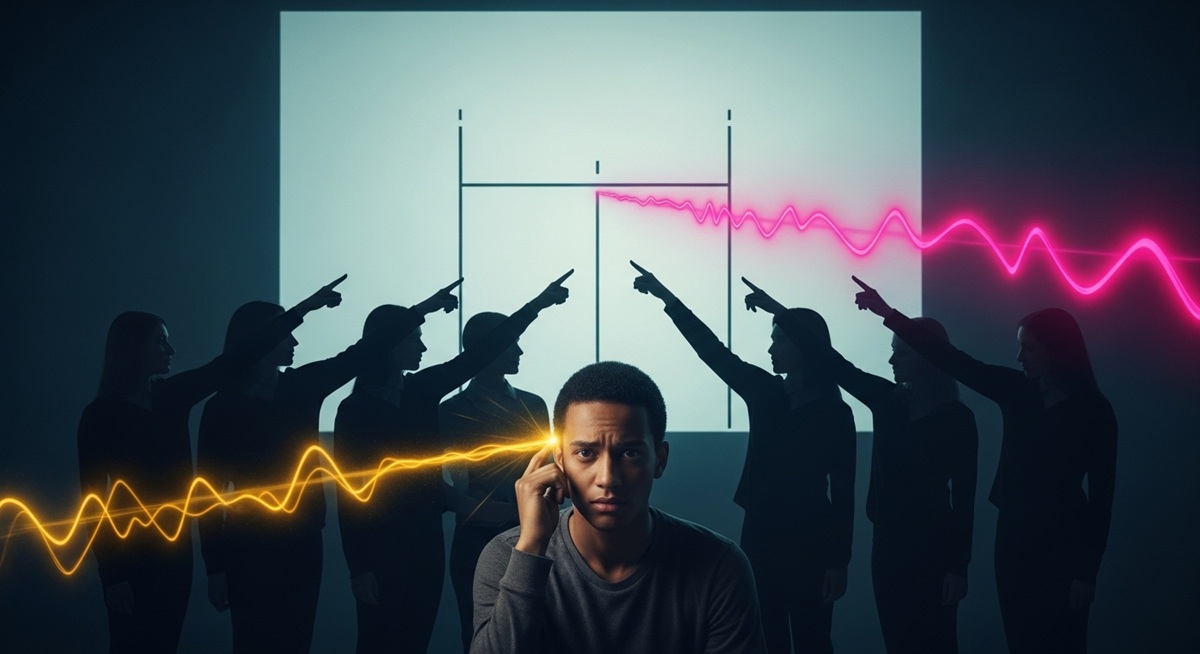
The Groupthink Glitch is what happens when group pressure stops changing what you say and starts changing what you think you saw. Solomon Asch’s original conformity experiments only ever measured the answer people gave out loud. A later brain-scanning follow-up went looking for what happens underneath it, in the parts of the brain that actually process sight. The very nice fix isn’t finding an ally after the pressure hits. It’s locking in your own read before the group ever opens its mouth.
Psychology explains this through: the difference between public compliance, saying what the group says while privately disagreeing, and genuine perceptual change, where the group’s answer gets folded into what you actually register as true.
Agreeing out loud is a choice. Agreeing with your own eyes is a glitch.
Madness Meter: 🧠🧠🧠 Borrowed Sight (A brain scan once caught the visual-processing regions shifting activity mid-task, not just the parts tied to social comfort.)
Most people assume that if they ever went along with an obviously wrong group answer, some part of them stayed quietly certain of the truth underneath the performance, the same assumption behind most everyday blind spots in perception. Brain-imaging research suggests that isn’t always what’s happening. Sometimes the disagreement never makes it to conscious awareness at all.
This creates the ‘Groupthink Glitch’ Brain, a mind that can be quietly overwritten by a confident-enough crowd, with no sense that anything was overwritten at all.
S³ – Story • Stakes • Surprise
Story | The Brain Scan Behind the Line Test
The Setup: In 2005, a research team put Asch’s basic idea inside an MRI scanner. Participants judged whether two rotated 3D shapes were the same object, a task with a clear right answer, while a group of other “participants” (actually confederates) called out answers first. On selected trials, the group unanimously gave the wrong one.
The Twist: When participants conformed to the group’s wrong answer, the brain activity that lit up wasn’t concentrated in the regions tied to decision-making or social discomfort. It showed up in the occipital and parietal areas responsible for spatial perception itself, the same regions doing the actual seeing. When participants held out and answered correctly against the group, a different signal appeared instead: activity in the amygdala, the brain’s alarm system for threat and distress.
The Reading: Neither outcome was free. Conforming looked less like a lie and more like the visual system quietly recalculating. Holding out looked less like confidence and more like tolerating a genuine jolt of fear. The line between changing your mind and changing your answer turned out to be far blurrier than Asch’s original experiment could show.
Stakes | What the Groupthink Glitch Costs
A perception that can be quietly rewritten by the room has consequences well outside a lab:
The Witness Room Cost. Eyewitnesses who discuss what they saw with a co-witness before giving a statement routinely report details they never actually observed, details picked up from the other person’s account and folded into their own memory as if they had been there. It’s a large part of why investigators are trained to separate witnesses before anyone talks.
The Consensus Forecast Cost. Financial analysts covering the same stock tend to cluster their earnings forecasts closer together than the underlying data would predict on its own. Publishing an outlier estimate carries a real professional cost if it turns out wrong, so private models quietly drift toward whatever the group already expects.
The Rating Cost. Give people a song or a product to judge alongside a visible crowd score, and their own stated enjoyment shifts to match it, not just their willingness to say so. Large-scale experiments with artificial music markets have found that visible popularity signals can reshape which songs people say they actually liked, not merely which ones they admit to liking.
Surprise | The Private Read
The countermeasure isn’t recruiting support after the pressure hits. It’s making sure your own read exists somewhere before the pressure arrives.
The Cure: Run the Private Read protocol on anything you’ll later be asked to judge alongside a group:
- Register Before You Compare: Form and note your own answer before hearing anyone else’s, even if it’s just a word in your own head. That first read is the version least touched by the room.
- Ask What Actually Changed: If you find yourself shifting, ask whether new evidence arrived or whether the only new information was that other people disagreed with you.
- Keep a Receipt: For anything consequential, write your first-instinct answer down somewhere retrievable. A record beats a memory that’s about to be renegotiated.
- Separate Before You Compare Notes: When a judgment genuinely matters, gather everyone’s independent read before the group discussion starts, not after.
A² – Apply • Amplify

Perception is supposed to be the one thing that’s yours alone. Under enough pressure, it stops being private.
The Psychology Bits
- Memory Conformity (Related): The same borrowing effect shows up after the fact, not just during a live judgment. See The Mandela Effect Brain for what happens when an entire crowd misremembers the same detail together.
- Confidence Isn’t Accuracy: A group that sounds completely sure of a wrong answer is far more persuasive than one that sounds tentative and right. Certainty is loud regardless of whether it’s earned.
Applying Perception-Guard Architecture
Adopt these rules before your own read gets absorbed into someone else’s:
- The Sealed Ballot: Before any group input, write your answer down and set it aside unseen, the way a sealed envelope works in a competition. It gives you a fixed record to check yourself against later.
- The Order Flip: When a group goes around the room for opinions, rotate or randomize who speaks first each time. The same confident early voice shouldn’t get to anchor everyone else by default.
- The Delphi Round: For a genuinely high-stakes call, collect everyone’s judgment anonymously first, share only the aggregated result, and let people revise privately before any live discussion happens. It’s the same structure professional forecasting panels use to keep the loudest voice from setting the frame.
FAQ
Q | Is this the same as being brainwashed? A | No. Brainwashing describes a deliberate, sustained campaign to install a belief. The Groupthink Glitch is a passive byproduct of ordinary uncertainty meeting ordinary social pressure, with no one necessarily trying to manipulate anyone.
Q | Does this mean eyewitnesses can never be trusted? A | Not never, but co-witness discussion is a documented contamination risk, which is exactly why investigators interview witnesses separately whenever possible.
Q | Can this happen even when no one’s technically watching me? A | Yes. Once a group norm gets internalized, it can keep shaping perception even without anyone present to enforce it, which is what separates it from simple public performance.
Citations & Caveats
- Source 1: Berns, G.S., Chappelow, J., Zink, C.F., Pagnoni, G., Martin-Skurski, M.E., & Richards, J. (2005). Neurobiological correlates of social conformity and independence during mental rotation. Biological Psychiatry.
- Source 2: Gabbert, F., Memon, A., & Allan, K. (2003). Memory conformity: Can eyewitnesses influence each other’s memories for an event? Applied Cognitive Psychology.
Disclaimer: This article discusses research on social conformity and perception. It isn’t a substitute for professional guidance on memory, testimony, or decision-making in high-stakes settings. See it first, say it second.
// Protocol · Next Transmission
The glitch is the signal. — Psyness Protocol