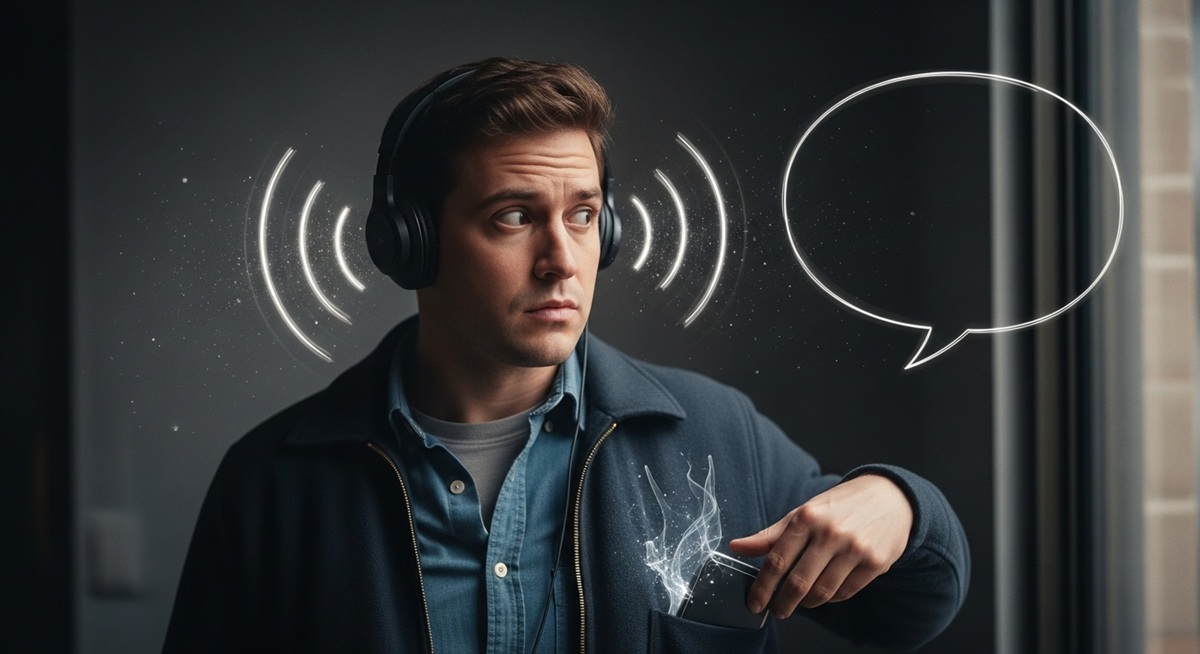
You’re elbow-deep in the fridge, searching for that elusive jar of pickles. Or maybe you’re absorbed in a true-crime podcast, headphones on, blissfully unaware of the world. Then, from the periphery of your hearing, a distinct sound cuts through | “Hey!” or “Your Name!” You whip around, expectant, only to find… no one. Just the hum of the fridge, or the continued murmur of the podcast. Did the ghosts finally decide to weigh in on your life choices? Or is your brain just audibly messing with you?
Welcome, fellow traveler, to the delightfully unhinged, universally experienced realm of phantom noise. It’s the glorious absurdity of your mind conjuring sounds that aren’t actually there – a phone ringing when it’s silent, a faint melody that vanishes when you focus, or most commonly, someone calling your name. Is your perception playing tricks? Or is your beautiful, weird brain simply too good at anticipating the next sound effect in your personal movie? At Psyness.com, we take a “very nice!” look at this pervasive behavioral quirk, proving that understanding why your ears sometimes hear whispers of the nonexistent doesn’t have to be boring – it can be a riot.
Your Brain’s Sonic Illusions | The Ear-Mind Connection
On the surface, hearing things that aren’t there might seem like a glitch in the grand operating system of your mind. But like much of your brain’s beautiful madness, there’s a fascinating neurological and psychological rationale behind these auditory apparitions.
The Architect | Anticipation & The Data Gap
Your brain isn’t just a passive receiver of sensory data; it’s an active interpreter, constantly predicting and filling in gaps based on past experiences and current expectations. When it comes to sound, particularly familiar and significant ones (like your own name or a phone ring), this anticipatory system can sometimes create its own reality.
- Auditory Priming: We’re constantly primed to listen for certain sounds. If you’re expecting a call, your brain is hyper-vigilant for a ring. If you’re in a quiet room, your brain might amplify subtle ambient noises (like the wind or house settling) and try to make sense of them by overlaying a familiar pattern, such as a voice. Your brain is trying to be “very nice!” by giving you what it thinks you want to hear.
- Sensory Ambiguity & Misinterpretation: The world is full of low-level, ambiguous noises – a distant fan, rustling clothes, blood rushing in your ears. When your brain is looking for a specific sound, it can easily misinterpret these benign inputs as the desired signal. It’s like your brain is an overzealous sound engineer, mistaking static for a melody.
- Cognitive Load & Boredom: When your brain is either overloaded (stress, fatigue) or underloaded (boredom, quiet environments), it becomes more susceptible to these internal fabrications. A bored brain might create its own entertainment, while an overwhelmed brain might misprocess signals.
Pop Culture’s Echo Chamber | Our Shared Auditory Madness
In our always-connected, often-noisy world, phantom noises have a distinctly modern flavor. Our phones are extensions of our beings, and our brains are conditioned to their summons. The line between a real alert and a phantom one can blur, especially after hours of scrolling, calling, or listening. This is the “modern madness” at play, where our technology subtly rewires our perception.

The glorious absurdity? We carry devices designed to connect us, but our very anticipation of their connection can make us “hear” them even when they’re silent. It’s a testament to how deeply ingrained technology has become, not just in our pockets, but in the neural pathways of our magnificent, weird brains. Your inner Borat might pick up a silent phone and proclaim, “It ringed! No? My brain is confused! Very nice!”
Quieting the Phantom Orchestra (Very Nice! And Peaceful!)
Understanding that these phantom sounds are mostly your brain being wonderfully overzealous is incredibly liberating. It’s not about losing your mind; it’s about recognizing its intricate (and sometimes goofy) internal workings.
Here’s how to nudge your brain towards clearer hearing and a little more peace:
- Acknowledge, Don’t React: When you hear a phantom sound, consciously acknowledge it without immediately reacting. “Ah, there’s that phantom again! Very nice, brain.” Don’t judge it; just observe it.
- Reality Check (The “Look and Listen” Method): Briefly verify. Check your phone. Listen intently. Often, the absence of the actual sound is quickly confirmed.
- Mindful Awareness of Surroundings: When you’re in a quiet environment, pay attention to the subtle, real ambient sounds. This helps your brain differentiate true signals from misinterpretations.
- Give Your Brain a Break: Reduce constant sensory input. Take short breaks from headphones, silence notifications, and spend time in genuinely quiet spaces. This allows your auditory system to recalibrate.
- Humor as Your Ally: When your brain plays another trick, chuckle. It’s a funny quirk of being human. Acknowledge the glorious absurdity. Your inner Borat would nod, “My ears, they are very active! Very nice, but also very sleepy!”
Phantom noise is a fascinating window into our complex psychology, a reminder that our brains, while magnificent, are also prone to creative interpretations of sensory input. Knowing this doesn’t make you crazy; it makes you self-aware, wonderfully weird, and very nice! Embrace the freedom, understand your brain’s auditory quirks, and prove that you can master even the most persistent imaginary sound.