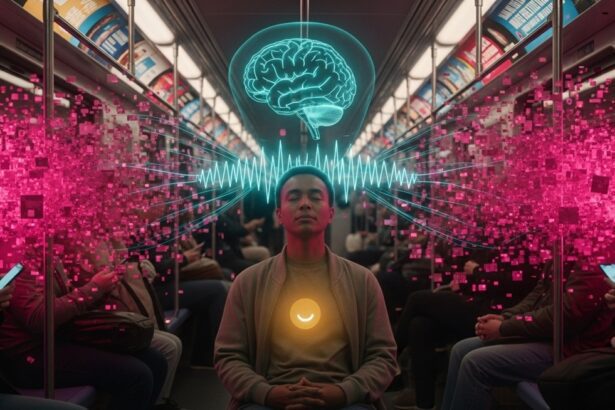
Imagine this | Every time you hear the sharp, clear note of a trumpet, you don’t just hear it – you also vividly see a flash of bright emerald green. Or perhaps, when you read the number seven, you instantly taste blueberries. Maybe your Tuesdays are always painted in a rich, velvety purple, and the name “Sarah” always gives you the sensation of smooth, cool glass.
Is this magic? A glitch in reality’s matrix? Or… is this just how some beautiful, weird brains roll?
Welcome, fellow traveler, to the delightfully unhinged, truly extraordinary realm of Synesthesia. It’s the glorious absurdity where your senses don’t play in separate orchestras, but rather merge into one magnificent, multisensory symphony. It’s a condition where stimulating one sense involuntarily triggers an experience in another. At Psyness.com, we take a “very nice!” look at this enigmatic phenomenon, proving that understanding these blended perceptions doesn’t have to be boring – it can be a riot.
The Brain’s Masterpiece | A Cross-Wired Wonderland
Why do some minds blend sensory input in such spectacular and consistent ways? It’s a profound testament to the incredible, and sometimes wild, flexibility of the human brain’s wiring.
The Architect | Neural Bridges and Perception
While the exact mechanisms are still a deliciously tantalizing mystery, the leading theory for synesthesia points to unique neural connections within the brain.
- Cross-Activation: It’s believed that in synesthetes, areas of the brain that are usually separate become unusually interconnected, or “cross-activated.” For example, the region processing sound might have extra neural bridges directly to the region processing color. So, when the sound area lights up, the color area does too. It’s like having a sensory superhighway, very nice!
- Enhanced Connectivity: Another idea suggests that all human brains have some degree of cross-wiring, but in synesthetes, these connections are stronger or more active. We all might have a subtle association (e.g., bright sounds feel “lighter”), but synesthetes experience it with intense, involuntary vividness.
- Developmental Quirk: Synesthesia often manifests early in childhood and remains stable throughout life. This hints that it might be a developmental difference in brain organization, rather than something acquired later. It’s just how their magnificent, weird operating system was built.
The Experience | More Than Just Associations
Crucially, synesthetic experiences aren’t just conscious metaphors (“that song reminds me of blue”). They are:
- Involuntary: The perception happens automatically, without conscious effort.
- Consistent: The associations are stable over time (e.g., ‘A’ is always red, forever).
- Vivid: The experiences are real and often sensory, not just conceptual.
Common forms include grapheme-color synesthesia (seeing colors for letters/numbers), chromesthesia (seeing colors for sounds/music), and lexical-gustatory synesthesia (tasting words). Each type is a unique peek into a subjective sensory world.
Pop Culture’s Sensory Extravaganza | Our Shared Fascination
While not everyone experiences synesthesia, the concept itself is deeply intriguing to the wider human tribe. Pop culture often explores sensory blending in art, music videos, and cinematic experiences, tapping into our universal fascination with altered perception. From artists who describe “seeing” music to fictional characters with unique sensory abilities, we are constantly drawn to the idea of experiencing the world differently.
The glorious absurdity? For some, reality is literally a kaleidoscope of blended senses, a constant, unscripted light-and-sound show. It’s a reminder that what we perceive as “normal” is just one narrow slice of the brain’s full potential. Your inner Borat might listen to a symphony and, if he were synesthetic, exclaim, “This music, it is like taste of sweet melon, and color of shiny gold! My ears and mouth, they are having very nice party!”
Embracing the Synesthetic Symphony (Very Nice! And Enriching!)
Understanding synesthesia isn’t about diagnosing; it’s about appreciating the incredible diversity of human perception and the brain’s limitless capacity for generating unique subjective realities. For those who experience it, synesthesia is often a cherished, enriching part of their lives, not a hindrance.
Here’s how to lean into the wonder of blended senses:
- Acknowledge the Phenomenon: Recognize that for some, the world isn’t just seen, heard, or tasted, but experienced in a rich, multi-dimensional blend.
- Cultivate Curiosity: If you meet someone who identifies as synesthetic, approach with genuine curiosity and respect. Their reality is different, and wonderfully so.
- Reflect on Your Own Associations: While not true synesthesia, we all have subtle cross-sensory associations (e.g., sharp sounds feel pointed). Ponder these, and appreciate your own brain’s capacity for connection.
- Celebrate Neurodiversity: Synesthesia reminds us that there’s no single “correct” way to experience the world. Differences in perception are “very nice!” and contribute to the richness of the human tapestry.
- Seek Sensory Delights: Even without synesthesia, you can consciously seek out experiences that engage multiple senses, like a perfectly plated meal, a multi-layered piece of music, or a vibrant piece of art.
Synesthesia is a beautiful window into our complex psychology, a reminder that our brains, while magnificent, can also wire themselves in ways that create entirely new, vibrant realities. Knowing this doesn’t make their experience less real; it makes us more self-aware, wonderfully weird, and very nice! Embrace the blend, understand your brain’s boundless possibilities, and prove that perception is a riot of endless discovery.