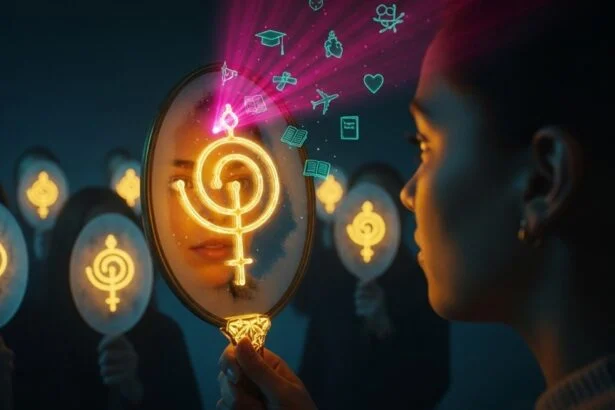
You’re having coffee with a friend. Ten minutes in, you notice you’ve both leaned back at the same time. You’re sipping your drinks in sync, even tilting your heads the same way. Later, you watch a clip of yourself talking to your boss — and there it is again. Same crossed arms. Same tilted eyebrow. Same nervous laugh. “Very nice,” you mutter. “I’ve become… a copy-paste human.” This isn’t just quirky; it’s a powerful, often unconscious, way your brain connects with others. But it can also leave you feeling strangely exhausted from constantly shape-shifting to fit in. Welcome, fellow traveler, to the delightfully unhinged, universally experienced realm of the ‘Chameleon’ Brain, a potent manifestation of social mirroring. It’s the glorious absurdity of your brain literally wiring itself to become a mini-version of whoever you’re with. This pervasive psychological and emotional quirk highlights a fascinating paradox | neuroscience shows your brain has built-in mirror neurons that fire both when you act and when you observe someone else. Is your mind just a master mimic? Or is your beautiful brain simply doing its very nice, very efficient (though profoundly challenging) job of building your secret tribe? At Psyness.com, we take a “very nice!” look at this peculiar psyche, proving that understanding this peculiar psyche doesn’t have to be boring – it can be a riot.
Your Brain’s Copy-Paste Feature | Mirror Neurons at Work
Why does your mind sometimes trick you into unconsciously mimicking the people around you? It’s a fascinating testament to your magnificent brain’s ancient wiring for social bonding, its powerful need for connection, and its complex system for rapid learning and empathy.
Your brain, bless its tirelessly observant heart, is primarily wired to understand and connect with others. Mirroring is your shortcut to social bonding. It’s pre-verbal, primal, and mostly unconscious. It works because humans are predictive creatures — if you sync with me, my brain assumes you’re safe, trustworthy, maybe even part of the tribe. First discovered in the 1990s in macaque monkeys, mirror neurons are brain cells that activate both when you perform an action and when you observe someone else performing that same action. In humans, these mirror neuron systems are constantly firing, influencing everything from our speech patterns and body language to our emotional responses.
Several cognitive and social processes fuel this mimicry:
- The Chameleon Effect: This is a core mechanism. Psychologists Chartrand and Bargh (1999) extensively researched this phenomenon, showing that we unconsciously mimic the posture, mannerisms, and other motor behaviors of our interaction partners. This subtle mimicry tends to foster greater rapport and liking between individuals. This is where your fuchsia-pink of subtle imitation glows.
- Emotional Contagion: Beyond just physical actions, your ‘Chameleon Brain’ also mirrors emotions. When you see someone yawn, you often yawn too. When someone laughs, you might find yourself smiling. This rapid spread of emotions helps to synchronize feelings within a group, boosting empathy and collective experience. This is a very nice, but often invisible, influence on your mood.
- Tribe Glue: Mirroring acts as a powerful, unspoken signal of affiliation and acceptance. When you subtly mirror someone, their brain unconsciously registers you as “one of us,” boosting feelings of trust and rapport. This is where your deep teal/cyan logical processing builds unspoken connections.
- Social Learning: Mirror neurons are crucial for learning new skills and behaviors by observation. From infants learning to talk by mimicking sounds to athletes perfecting a move by watching others, your brain is wired to copy for rapid acquisition. This is where your cheerful mustard yellow of vivid social learning shines.
However, beware | while powerful, excessive or inauthentic mirroring can sometimes backfire, making you appear mocking or insincere. And constant shape-shifting to fit different social groups can lead to “chameleon fatigue,” where you might feel drained or lose touch with your authentic self.
Pop Culture’s Master Mimics | Our Shared Social Dance
The subtle art of mirroring is a powerful force in human interaction, and pop culture has long reflected this fascinating social dance. Think of a concert crowd swaying in rhythm to the music; no memo was sent, no instructions needed. The collective mirroring builds instant “tribe energy” and a shared sense of belonging. Politicians and charismatic leaders are often implicitly (or explicitly) trained in “rapport mirroring” because it makes them perceived as more likable and trustworthy, fostering a deeper connection with their audience.

From the almost uncanny synchronization seen in close-knit friend groups to the subtle adoption of a new friend’s slang after just one hangout, our lives are filled with examples of the ‘Chameleon Brain’ at work. It’s like that scene in The Office where Jim often unconsciously mirrors Pam’s body language or expressions during their earliest, tentative interactions, subtly building their connection and unspoken rapport before they even realize their feelings for each other. This unconscious mimicry, the “copy-paste” feature of our brains, helps bridge gaps and establish a sense of shared experience even without words. It’s a shared, delightful madness where our social harmony is often dictated by our brain’s tireless, but often unconscious, drive to synchronize. Your inner Borat might see new friend and declare, “Very nice, this friend walks like me! My brain says ‘no, you walk like him now!’ Very nice, now we are twin humans, very confusing for my very good brain!”
How to Guide Your ‘Chameleon’ Brain (Very Nice! And Truly Liberating!)
Understanding that your brain’s ‘Chameleon’ tendency is a natural, powerful psychological process is the first step to liberation. It’s not about stopping connection; it’s about learning to work with your magnificent, weird brain to foster greater authenticity, intentional social bonding, and self-awareness. Here’s how to nudge your brain towards a more intentional, “very nice!” understanding:
- Notice Your Shifts (The Self-Observer): Start by simply becoming aware. Pay attention to your posture, voice tone, and gestures when you’re interacting with different people. When do you unconsciously shift? This is your cheerful mustard yellow signal for self-awareness.
- Use Mirroring Intentionally (The Rapport Builder): Instead of unconscious mimicry, try subtle, conscious mirroring when you want to build rapport. For instance, gently match someone’s speaking pace, or subtly align your posture. Subtlety is key here; don’t overdo it, or it will feel fake.
- Dial It Back (The Energy Check): If you find yourself feeling drained or disingenuous after social interactions, check if you’ve been shape-shifting too much to fit in. Sometimes, the best way to recharge is to simply be yourself without the need to adapt.
- Experiment with Stillness (Setting the Rhythm): In some interactions, try consciously not mirroring. See what happens when you maintain your own posture and natural cadence. You might find you can set the rhythm of the interaction, rather than always following.
- Mirror Positivity (The Mood Lifter): This is a powerful application! If you want to uplift someone, consciously offer a genuine smile. Mirror neurons mean they’re likely to smile back, creating a positive feedback loop.
- Check Authenticity (The Inner Scan): Regularly ask yourself | Am I genuinely connecting with this person, or am I just contorting myself to be liked? Mirroring works best when paired with genuine interest and care.
- Build Awareness in Groups (The Social Scientist): In group settings, notice how quickly one person’s mood or energy can spread across a whole team. This highlights the power of emotional contagion and collective mirroring.
The ‘Chameleon’ Brain is a truly special window into our complex psychology, a reminder that our minds, while magnificent, are also prone to delightful (and sometimes draining) forms of social mimicry. Knowing this doesn’t make you manipulative; it makes you self-aware, wonderfully weird, and very nice! Embrace your inner social architect, understand your brain’s fascinating bonding mechanisms, and prove that you can navigate social interactions with greater presence, authenticity, and profound connection.