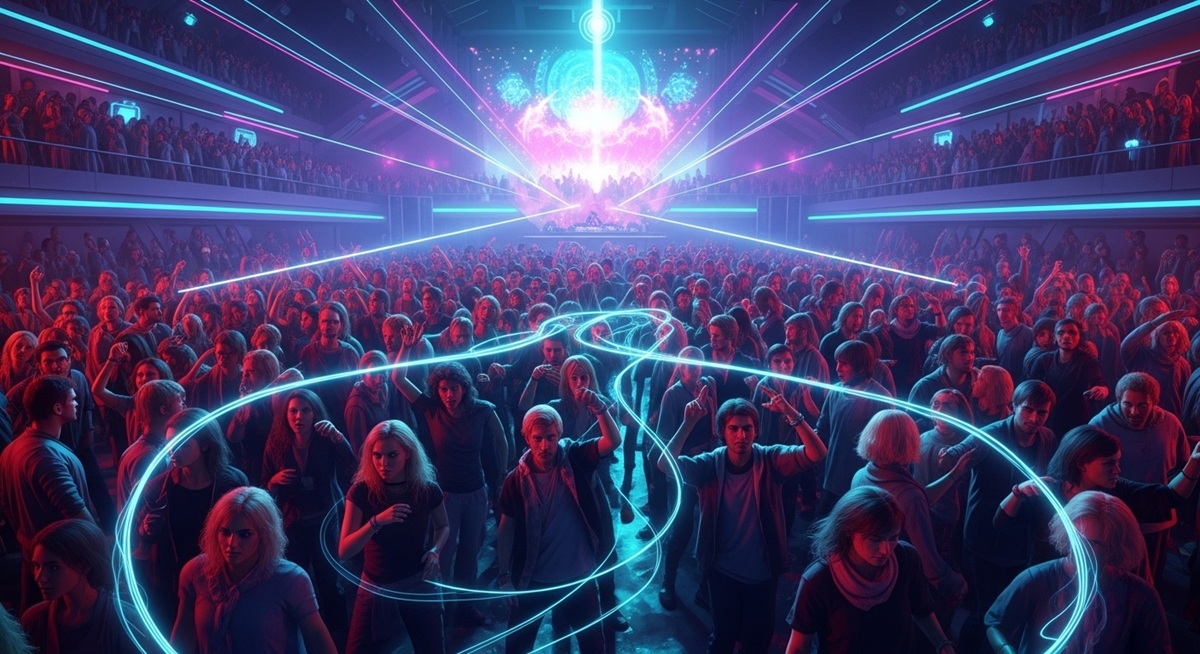
The bass hits your chest, thousands of people are singing the same line, and suddenly you are not just feeling your own joy. You are feeling a current that runs through everyone in the room, you included. Strangers become friends for three minutes, and nobody seems to mind.
Psychology explains this through: collective effervescence, the shared surge of energy and emotion that rises when people gather, move, and feel the same thing at the same time.
In a study of a fire-walking ritual, the heart rates of the walkers and their relatives watching from the crowd rose and fell in step, while the heart rates of unrelated spectators did not.
Madness Meter: 🧠🧠🧠 The Hive Hum (You are in a roaring crowd and your own heartbeat starts to feel like it belongs to everyone around you.)
It is the social twin of the solo awe in The Sublime Shiver. That one happens when something vast makes you feel small. This one happens when other people make you feel bigger, because you are suddenly part of something.
This creates the Hive Hum, the low buzz of shared feeling that builds when many brains tune to the same rhythm, a crowd that begins to behave like one large nervous system.
S³ – Story • Stakes • Surprise
Story | The Goal Nobody Saw Coming
The Setup: You are in a packed stadium during a tense, scoreless game. Everyone around you is quiet and leaning forward.
The Twist: Your team scores, and a wall of sound erupts. You are shouting, hugging a stranger, and laughing, and you could not tell anyone who started it.
The Reading: This is collective effervescence at its loudest, the Hive Hum turned all the way up. The emotion did not stay inside any single head. It spread, amplified, and came back at you from every direction.
The Pattern: Collective effervescence shows up at concerts, matches, festivals, protests, weddings, and religious services, and it grows with the size of the crowd and how closely it moves together.
Stakes | What Missing the Hive Hum Costs
Modern life offers fewer shared moments, and going without them has quiet costs:
The Isolation Cost. Without regular moments of shared emotion, belonging has to be built entirely out of one-on-one conversations, which is slow and fragile.
The Screen Cost. Watching a concert or game alone on a screen gives you the content, but usually not the physical, shared surge that made it feel electric.
The Ritual Cost. Communities that stop gathering lose the repeated moments that turn a group of individuals into something that feels like a tribe.
The Free-Pass Cost. Treating a thrilling crowd as just a very nice night out skips the chance to notice what it does for your sense of connection.
Surprise | Being Near Is Not the Same as Being Linked
Here is the twist about collective effervescence. In the fire-walking study, sharing a crowd was not enough. The heart rates lined up between performers and the spectators who were connected to them, not between performers and strangers standing right beside those spectators. The Hive Hum follows relationships and shared meaning, not just a shared location.
The Cure: Build shared moments on purpose:
- Show Up in Person: Pick a live event this month, even a small one, and go instead of watching from the couch.
- Move With Them: Sing, clap, sway, or cheer along. Synchrony works through doing, not through observing from the edge.
- Join Something Regular: A choir, a fan group, a running club, or a community class gives you the Hive Hum on a schedule.
- Make a Small Version: A game night, a shared meal, or a group walk can create a small, real surge among people you actually know.
A² – Apply • Amplify

The sociologist Emile Durkheim coined the term more than a century ago, and modern research has since measured its effects on bodies and on feelings of belonging.
The Psychology Bits
- It Has a Famous Origin: Durkheim described collective effervescence as the heightened energy that arises when a group gathers for a shared ritual, and argued it bonds people to the group.
- Bodies Can Sync: Researchers have recorded heart rates rising and falling together between people who share a bond during a ritual, a physical trace of collective effervescence.
- Feeling in Sync Matters: Studies of gatherings link the sense of being emotionally in step with others to stronger group bonds and more positive feelings.
- It’s a Specific Case of a Bigger Pattern: The same loss of self-consciousness in a crowd has a darker version in The ‘Mob-Mind’ Brain. That one is what anonymity can unleash. This one is the joyful side, where blending in feels like belonging.
Applying the Hive Hum Habit
Seek out collective effervescence deliberately, and stay aware of where it leads:
- Name the Hum: When you feel the crowd lift you, say “Hive Hum” quietly and notice how your mood shifted.
- Schedule One Shared Thing a Month: Put a concert, match, class, or community event on the calendar before the month fills up.
- Bring Someone: Going with a friend or family member deepens the link, since the surge follows connection.
- Keep One Foot in Your Own Head: Enjoy the blend, but stay aware of what the crowd is amplifying, since the same pull can carry anger and panic.
FAQ
Q | What is collective effervescence? A | It is the shared emotional energy that rises when people gather and act together, famously described by the sociologist Emile Durkheim.
Q | Why does a crowd feel different from being alone? A | Emotions spread between people through expression, movement, and sound, so a shared moment can feel stronger and more meaningful than the same one alone.
Q | Does collective effervescence only happen at concerts? A | No. It shows up at sports events, festivals, weddings, religious services, protests, and any gathering built around a shared focus.
Q | Can I get collective effervescence online? A | Sometimes a little, but being physically present and moving in rhythm with others tends to deliver far more of the effect.
Q | Is it always positive? A | No. The same pull that lifts joy can amplify anger or panic, which is why it helps to stay aware of what the crowd is feeding.
Q | How is it different from awe? A | Awe usually comes from something vast, like the night sky. Collective effervescence comes from other people, and it makes you feel connected rather than small.
Citations & Caveats
- Source 1: Durkheim, E. (1995). The Elementary Forms of Religious Life (K. E. Fields, Trans.). Free Press. (Original work published 1912.)
- Source 2: Konvalinka, I., Xygalatas, D., Bulbulia, J., Schjodt, U., Jegindo, E.-M., Wallot, S., Van Orden, G., & Roepstorff, A. (2011). Synchronized Arousal Between Performers and Related Spectators in a Fire-Walking Ritual. Proceedings of the National Academy of Sciences, 108(20).
- Source 3: Paez, D., Rime, B., Basabe, N., Wlodarczyk, A., & Zumeta, L. (2015). Psychosocial Effects of Perceived Emotional Synchrony in Collective Gatherings. Journal of Personality and Social Psychology, 108(5), 711-729.
Disclaimer: This article is for informational purposes only and is not a substitute for professional psychological advice. Collective effervescence is a normal social experience, but crowds can also be unsafe or overwhelming. Look after your own safety and wellbeing at large events, and speak with a qualified professional if crowds trigger significant distress.
// Protocol · Next Transmission
The glitch is the signal. — Psyness Protocol