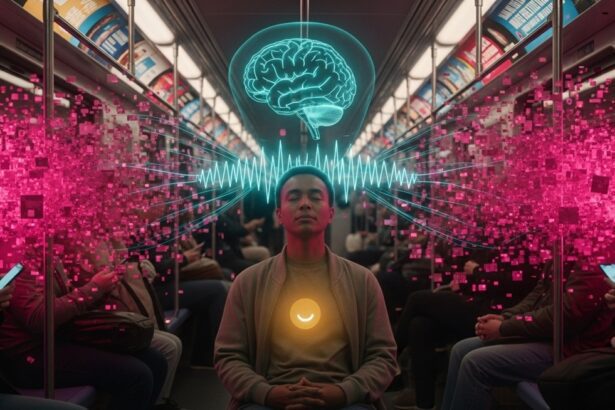
The ‘Daydream Machine’ Brain engages the Default Mode Network (DMN)—a core set of brain regions that activates when you are not focused on the outside world. The Fuchsia-pink dread of modern boredom forces us to fill all quiet time, suppressing the DMN. The very nice solution is to schedule Deep Teal/Cyan low-stimulus activities to unleash the Vibrant Gold creative power of mind-wandering, resulting in Cheerful Mustard Yellow insights.
Psychology explains this through: neurological activity during passive states, introspection, and memory consolidation.
Your greatest ideas are waiting in the quiet spaces.
Madness Meter: 🌀🌀 Structured Boredom (The calculated use of quiet time for high-level creative work.)
The Default Mode Network (DMN) is a collection of interconnected brain regions that becomes active when an individual is not engaged in a specific external task. It’s the brain’s “idle state.” Far from being lazy, the DMN is incredibly busy with internal processes | reflecting on the past, simulating the future, understanding others’ perspectives, and, crucially, making creative connections between seemingly disparate pieces of information.
This phenomenon creates the ‘Daydream Machine’ Brain | a mind that solves complex, multi-step problems in the background, like a computer running a heavy render job. The problem in the digital age is that we are terrified of the DMN. The moment external stimulus ceases—waiting in line, taking a break—we reflexively reach for the phone, flooding the brain with new information. This Fuchsia-pink anxiety and need for constant input suppresses the DMN, stopping the complex background rendering job right when it’s about to finish, leaving us both creatively dry and perpetually exhausted.
S³ – Story • Stakes • Surprise
Story
The DMN is the engine behind all those “Eureka!” moments—the solution to the puzzle that arrives while you’re in the shower, on a walk, or staring blankly out a window. These moments occur precisely because your conscious, Deep Teal/Cyan task-focused brain has switched off, allowing the associative, free-form DMN to take over. The DMN connects the fact you read yesterday with the problem you had this morning, creating the Vibrant Gold insight. When you interrupt this process with a dopamine hit from a phone, the valuable integration work stops cold.
Stakes
The cost of suppressing the ‘Daydream Machine’ is profound:
- Creative Sterility: We sacrifice our most valuable ideas. True innovation often requires blending old concepts in new ways, which is the DMN’s specialty. By constantly feeding the brain new, shallow information, we give it no time to chew on the deep, complex problems.
- Lack of Self-Cohesion: The DMN is essential for self-reflection and building a cohesive sense of self over time. Without scheduled internal processing, our sense of identity remains fragmented, constantly shifting with the latest Fuchsia-pink trend or external stimulus.
- Chronic Exhaustion: We mistake constant external focus for productivity. The brain desperately needs low-stimulus time to consolidate memories and thoughts, achieving Deep Teal/Cyan systemic maintenance. Denial of this time leads to burnout and poor decision-making.
Surprise
The very nice path is counterintuitive | the harder you try to focus, the less creative you become.
The cure is the structured embrace of boredom. The goal is to schedule deliberate ‘nothing time’ and treat any low-stimulus activity—a quiet walk, ten minutes of staring at the ceiling, washing dishes—as a vital part of your Vibrant Gold creative workflow. You must recognize that the feeling of Fuchsia-pink boredom is actually a Deep Teal/Cyan indicator that your DMN is spinning up. By resisting the urge to reach for a phone in these moments, you harness the engine and allow the Cheerful Mustard Yellow insights to arrive.
A² – Apply • Amplify
Design your work structure to actively leverage the brain’s internal creative downtime.
The Psychology Bits
- Mind-Wandering: The psychological state associated with DMN activity. It is linked to increased creativity, future planning, and self-reflection.
- Controlling the Attention Network: The DMN works in opposition to the Task-Positive Network (TPN). The TPN is for external focus. To access the DMN, you must actively disengage the TPN by removing external demands.
Applying Low-Stimulus Architecture
Adopt these Deep Teal/Cyan rules to maximize the DMN’s power:
- The Ten-Minute Walk: After any mentally exhausting task, immediately enforce a Vibrant Gold ten-minute walk with no phone, audio, or podcasts. This dedicated low-stimulus movement is a direct command to the DMN to begin its consolidation work.
- The ‘Ugly’ Task Filter: Identify repetitive, low-cognitive tasks (dishes, organizing files) and designate them as your Fuchsia-pink “DMN Activators.” When you are creatively blocked, switch to one of these tasks to trigger background processing.
- The Insight Journal: Carry a small notebook to capture the Cheerful Mustard Yellow insights that arrive during DMN time. Don’t try to force them; simply log the fully formed thoughts that bubble up from the subconscious.
The PSS Ecosystem | An Idea in Action

The PSS DAO can reward members for providing synthesis and creative solutions generated during ‘downtime.’
The ‘Background-Render’ PSS Bounty
This feature incentivizes the value of creative non-work.
- Mechanism: PSS governance can include “Synthesis Bounties” for members who provide truly novel, cross-domain solutions to complex, long-standing community issues (problems that require DMN-level lateral thinking).
- Justification: Instead of rewarding high-activity metrics (the TPN), this system rewards unique, high-value Vibrant Gold insights. The Deep Teal/Cyan focus is on quality of thought derived from internal processing, not hours spent scrolling Discord.
- Reward: The PSS token yield is tied to the proven creative value of the submitted solutions, acknowledging that the most valuable contributions often come from moments of Cheerful Mustard Yellow quiet.
FAQ
Q | Is daydreaming just procrastination A | It can be, but there’s a difference. Procrastination avoids a task. DMN activity (beneficial mind-wandering) occurs after you’ve focused on the problem and then intentionally stepped away.
Q | Why does the shower work so well A | Showers are low-stimulus, repetitive, and lack visual input. They force the TPN to shut down, giving the DMN a prime, uninterrupted opportunity to connect complex ideas in the background.
Q | Does meditation activate the DMN A | Paradoxically, early meditation can decrease DMN activity. Advanced meditation, however, helps you observe DMN activity without getting lost in its noise, achieving a Deep Teal/Cyan balance between focus and introspection.
Citations & Caveats
- Source 1: Raichle, M. E., et al. (2001). A default mode of brain function. (The seminal paper that formally identified and named the Default Mode Network).
- Source 2: Christoff, K., et al. (2016). Mind-wandering as spontaneous thought | a dynamic framework. (Research linking DMN activity to creativity and future planning).
Disclaimer: This article discusses the neurological phenomena of the Default Mode Network. The PSS DAO token model described is theoretical and intended for conceptual discussion on optimizing cognitive function. If severe mental wandering or lack of focus is impacting your life, consult a professional.