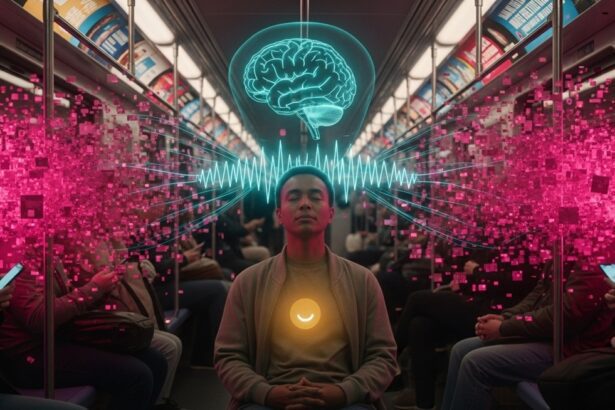
It’s 7:13 a.m. You’re stirring coffee, the morning still fuzzy around the edges, when your news app flashes an article. You freeze. The headline, the photo, the weirdly specific font choice — you’ve seen this before. Not yesterday. Not last week. In a dream. You can picture the moment vividly | you, in that same bathrobe, reading these exact words. For a second, you’re standing on the edge of what’s explainable, a thrilling tug at something deep. Are you psychic? Is time a loop? “Very nice,” your brain purrs, “but what sorcery is this?” Welcome, fellow traveler, to the delightfully unhinged, universally experienced realm of the ‘Déjà Rêvé’ Brain, a potent manifestation of memory’s playful trickery. It’s the glorious absurdity of your mind feeling like it’s bending time – but it’s often less prophecy and more… magnificent post-production. This pervasive psychological and emotional quirk highlights a fascinating paradox | your mind’s incredible capacity for creating narrative can sometimes lead to a humorous (and sometimes chilling) feeling that your dreams are sneak previews of reality. Is your mind just a fabulously unreliable narrator? Or is your beautiful brain simply doing its very nice, very efficient (though profoundly challenging) job of making sense of a messy world? At Psyness.com, we take a “very nice!” look at this peculiar psyche, proving that understanding this peculiar psyche doesn’t have to be boring – it can be a riot.
Your Brain’s Story Editor | Writing the Past in Real Time
Why does your brain sometimes trick you into thinking you’ve dreamed something before it actually happens? It’s a fascinating testament to your magnificent brain’s ancient wiring for pattern recognition, its powerful need for coherent narratives, and its complex system for memory storage and retrieval.
Your brain, bless its tirelessly diligent heart, is primarily wired to make sense of the world and your experiences. Déjà rêvé, or the feeling that you’ve dreamed something before it happened, occurs when your dream memories and waking experiences subtly collide. Instead of storing your memories in neat, separate folders (like “dream folder” vs. “real life folder”), your brain sometimes drops fragments of dreams and reality into the same mental drawer. Later, when a real-life event closely matches a dream fragment, your brain, in its eagerness to create a neat and tidy story, retroactively re-labels the dream as a premonition.
Several cognitive processes are at play here:
- Source-monitoring errors: This is a core mechanism. Your brain vividly recalls the content of a memory – the visual, the feeling, the specific details – but it misplaces or forgets its source. Was it from a dream, a movie, a conversation, or real life? When the source is misattributed to a dream, especially a prophetic one, the magic begins. This is where your fuchsia-pink of misremembered origins glows.
- Pattern completion: Your hippocampus, a key player in memory, is excellent at filling in missing details. When a real-life event offers a few matching pieces to a vague dream fragment, your brain’s pattern-completion mechanism kicks into overdrive, fabricating a more complete match where none truly existed. It fills in the gaps to create a perfect (but illusory) fit. This is a very nice, but often misleading, internal shortcut.
- Emotional tagging: Strong feelings from the present moment – surprise, wonder, anxiety – can glue themselves to old, often vague dream fragments. This emotional intensity gives the dream memory “this already happened” weight and salience, making it feel more significant and true than it was. This is where your deep teal/cyan logical processing gets creatively biased.
For example, imagine a month ago, you vaguely dreamed of “standing in a crowd, holding a red umbrella” amidst some indistinct chatter. Today, you walk through a bustling farmers’ market, spot someone holding a bright red umbrella, and then hear a snatch of conversation that vaguely echoes something from your dream. Click! Your brain instantly overlays the dream onto reality like a ghost image, convinced it foresaw this exact moment.
Pop Culture’s Time Benders | Our Shared Narrative Obsession
The idea of dreams predicting the future is a powerful, ancient one, and pop culture has long tapped into this fascination. From the mind-bending realities of The Matrix, where glitches in the system hint at a pre-programmed reality, to the multi-layered dream architectures of Inception, where dreamscapes feel hyper-real and influence waking life, we love stories where the boundaries of consciousness are blurred. Even on platforms like TikTok, the “I dreamt this before!” trend sees countless people sharing their everyday déjà rêvé experiences, keeping the mystique alive and proving how universally relatable this mental quirk is.

Consider the famous story of Mark Twain, who claimed he dreamed of his brother’s funeral – down to the specific coffin and flowers – days before it tragically happened. Whether this was a powerful coincidence or a fascinating cognitive trick, stories like this stick with us because they fuse emotion, narrative, and the alluring possibility that dreams can genuinely slip into daylight, offering glimpses into what’s to come. It’s a shared, delightful madness where our perceived reality is often dictated by our brain’s tireless, but often unnecessary, need to find meaning in every pattern. Your inner Borat might have a dream and declare, “Very nice, this dream means much future for me! My brain says ‘no, it means you just very like good story!’ Very nice, now I believe it more, very confusing for my very good brain!”
How to Befriend Your ‘Déjà Rêvé’ Brain (Very Nice! And Truly Liberating!)
Understanding that your brain’s ‘Déjà Rêvé’ tendency is a natural, powerful psychological process is the first step to liberation. It’s not about dismissing the magic entirely; it’s about learning to work with your magnificent, weird brain to foster greater self-awareness, enhance your creativity, and enjoy the mystery. Here’s how to nudge your brain towards a more intentional, “very nice!” understanding:
- Keep a Dream Journal (Your Reality Check): As soon as you wake up, before your memories fade, quickly jot down your dreams. Date them precisely. This creates an objective record, allowing you to actually check if future events truly match. This is your cheerful mustard yellow signal for conscious tracking.
- Mark Your Matches (The Detective Game): When déjà rêvé strikes, go back to your dream journal. Log both the dream and the real-life details. Note where the match is strong and where your brain might be filling in the blanks.
- Play the Storyteller (Creative Outlet): Instead of worrying about psychic abilities, treat these “matches” as fantastic writing prompts, artistic inspiration, or simply intriguing anecdotes. Your brain is a master storyteller; leverage it!
- Use as a Reflection Cue (Inner Wisdom): If the match feels particularly strong or resonates emotionally, pause. What feelings is it trying to highlight? Is your subconscious trying to bring a specific issue or pattern to your attention? It might not be prophecy, but it could be valuable self-reflection.
- Enjoy the Mystery (Embrace the Weird): Ultimately, accept that some mental phenomena are deliciously unexplained. Even if science offers a cognitive explanation, the feeling of déjà rêvé is a unique human experience. Revel in the strange, wonderful ways your brain works.
The ‘Déjà Rêvé’ Brain is a truly special window into our complex psychology, a reminder that our minds, while magnificent, are also prone to delightful (and sometimes puzzling) forms of self-generated narrative. Knowing this doesn’t make you a failure; it makes you self-aware, wonderfully weird, and very nice! Embrace your inner dream detective, understand your brain’s fascinating memory biases, and prove that you can navigate the mysteries of consciousness with greater presence, gratitude, and authentic wonder.