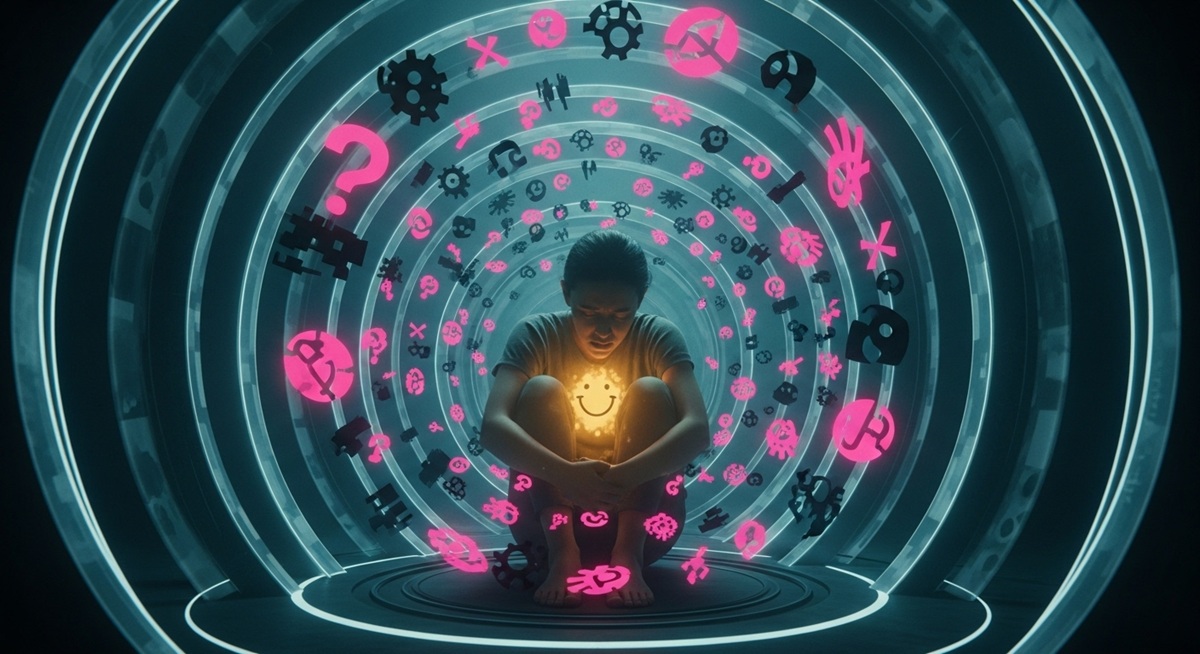
You had a minor disagreement with a colleague yesterday, or perhaps you made a small mistake on a project last week. Now, your magnificent, weird brain has latched onto it. You replay the conversation endlessly, dissecting every word, imagining alternative scenarios, or mentally chastising yourself for what you “should” have done. Or maybe you’re just dwelling on a general feeling of unhappiness, endlessly analyzing why you feel this way, without ever finding a solution. This repetitive, negative thought pattern consumes your mental energy, fuels anxiety and sadness, and creates a mental “loop” that is incredibly hard to break. Your brain is convinced it’s problem-solving or gaining insight, but often, it’s just spinning its wheels, deepening your distress without any productive outcome. “Bad thing happened! My brain says ‘think about it very much, forever!’ Very nice, but now I am very sad and very stuck!
Welcome, fellow traveler, to the delightfully unhinged, universally experienced realm of the ‘I Can’t Stop Thinking About It!’ Brain, a potent manifestation of Rumination. It’s the glorious absurdity of your mind getting stuck in a repetitive, negative thought loop, endlessly replaying past events, worrying about future ones, or dwelling on perceived flaws, without leading to any productive problem-solving. This cognitive quirk is a core component of many mental health challenges, fueling anxiety, depression, and a sense of being trapped in your own head. Is it just overthinking? A peculiar form of self-sabotage? Or is your beautiful brain simply doing its very nice, very efficient (though profoundly exhausting) job of trying to make sense of distress, even if it means getting stuck in an unhelpful cycle? At Psyness.com, we take a “very nice!” look at this pervasive mental quirk, proving that understanding why you can’t stop thinking about it doesn’t have to be boring – it can be a riot.
Your Brain’s Stuck Record | The Unproductive Loop
Why does your mind get caught in these repetitive, negative thought patterns, endlessly replaying issues without resolution? It’s a fascinating testament to your magnificent brain’s drive for problem-solving, its emotional regulation attempts, and its susceptibility to unhelpful cognitive habits.
The Architect | The Problem-Solving Imposter
Your brain, bless its tirelessly analytical heart, is designed to identify and solve problems. When faced with distress, it instinctively tries to analyze the situation to understand it and prevent future occurrences. However, with rumination, this analytical process goes awry, becoming circular and unproductive.
- Perceived Threat & Avoidance: This is a core mechanism. When something negative happens or is perceived (a mistake, a perceived slight, a bad feeling), your brain interprets it as a threat. Rumination can be an attempt to “solve” this threat, or ironically, a way to avoid confronting the actual problem or difficult emotions by staying in the realm of thought. “Bad feeling! My brain says ‘think about it very much, then it will go away!’ Very nice, but feeling stays!”
- Negative Affect Regulation: Rumination can be a maladaptive coping strategy for negative emotions. Instead of processing or expressing feelings, the brain tries to intellectualize or analyze them, which often intensifies rather than alleviates distress.
- Beliefs About Rumination: People often believe that rumination is a necessary step towards understanding or solving a problem (“I need to think about this until I figure it out”). This belief reinforces the behavior, even when it’s unproductive.
- Lack of Problem-Solving Skills: If your brain lacks effective strategies for dealing with certain types of problems or emotions, it might default to rumination as its only known (though ineffective) response.
- Cognitive Bias (Subtle): A tendency towards negative thinking or catastrophizing can make the content of rumination more pervasive and distressing.
- Stress & Anxiety Amplification: Rumination feeds on itself. The more you ruminate, the more anxious or distressed you become, which in turn fuels more rumination, creating a vicious cycle.
The paradox? Your brain’s admirable drive to understand and solve problems, while essential for growth, can trap you in an exhausting cycle of unproductive thought, leading to increased anxiety, depression, and a diminished ability to engage with the present moment because it’s constantly replaying the past or dwelling on the present in an unhelpful way. Your brain’s “stuck record” is magnificent, but gloriously unhinged in its unproductive loop.
Pop Culture’s Overthinkers & Brooders | Our Shared Mental Prisons
From characters who spend entire scenes agonizing over past mistakes, to the dramatic portrayal of individuals consumed by their own thoughts, to songs that perfectly capture the feeling of being trapped in a mental loop, pop culture constantly reflects and often romanticizes our universal tendency towards rumination. We see the intensity of internal struggle and the isolating nature of being stuck in one’s own head.

The glorious absurdity? We want to move forward, yet our brains insist on replaying the past, convinced that if we just think about it one more time, the answer will appear. It’s a shared, delightful madness where our minds can become our own prisons. Your inner Borat might make a small mistake and declare, “I made very small mistake! My brain says ‘think about it very much, all night!’ Very nice, but now I cannot sleep!”
How to Break the Loop (Very Nice! And Truly Liberating!)
Understanding that your brain’s ‘I Can’t Stop Thinking About It!’ tendency (Rumination) is a natural, powerful cognitive habit is the first step to liberation. It’s not about never thinking deeply; it’s about learning to work with your magnificent, weird brain to interrupt unproductive loops, redirect your attention, and engage in more effective problem-solving or emotional processing, fostering greater mental freedom and well-being.
Here’s how to nudge your brain towards more constructive, “very nice!” thinking:
- Acknowledge the Ruminative Thought, Then Label It: When you catch yourself ruminating, acknowledge the thought. “My brain is ruminating about X! Very nice, it is doing its thing.” Then, consciously label it as “rumination” or “unproductive thought.” This creates distance.
- Practice “Thought Stopping” (Briefly!): When a ruminative thought appears, mentally (or even verbally) say “STOP!” or “NOT NOW!” This is a quick interruption technique. Then, immediately pivot to step 3.
- Engage in Distraction (Productively!): Immediately shift your attention to an engaging activity that requires focus and can’t be done while ruminating. This could be a complex puzzle, intense exercise, listening to music, or a conversation. “My brain says ‘think bad thoughts!’ I say ‘no, think about very good puzzle!’ Very nice, now brain is busy!”
- Schedule “Worry Time” (or “Rumination Time”): Designate a specific, limited time each day (e.g., 15-20 minutes) to allow yourself to ruminate or worry. If a thought comes up outside this time, tell your brain, “I’ll think about this during my scheduled time.” This gives your brain permission to postpone.
- Focus on Problem-Solving (Action-Oriented): If the rumination is about a solvable problem, shift from endless analysis to concrete action steps. Ask | “What is one small thing I can do about this right now?”
- Practice Mindfulness & Grounding: Bring your attention to the present moment. Focus on your senses (what you see, hear, smell, feel). This pulls your brain out of the past/future loop and into the “now.”
- Challenge Unhelpful Beliefs About Rumination: Remind your brain that rumination is not productive problem-solving. It often makes things worse.
- Express Emotions (Healthily!): Instead of bottling up feelings and ruminating, find healthy outlets for emotional expression – talking to a trusted friend, journaling, creative outlets.
- Seek Professional Support: If rumination is severe and impacting your daily life, a therapist can provide tools and strategies (like Cognitive Behavioral Therapy) to break the cycle.
The ‘I Can’t Stop Thinking About It!’ Brain is a truly special window into our complex psychology, a reminder that our minds, while magnificent, are also prone to delightful (and draining) forms of unproductive thought. Knowing this doesn’t make you weak; it makes you self-aware, wonderfully weird, and very nice! Embrace your inner thought-manager, understand your brain’s stuck record, and prove that you can break the loop, reclaiming your mental energy for more productive and joyful pursuits.