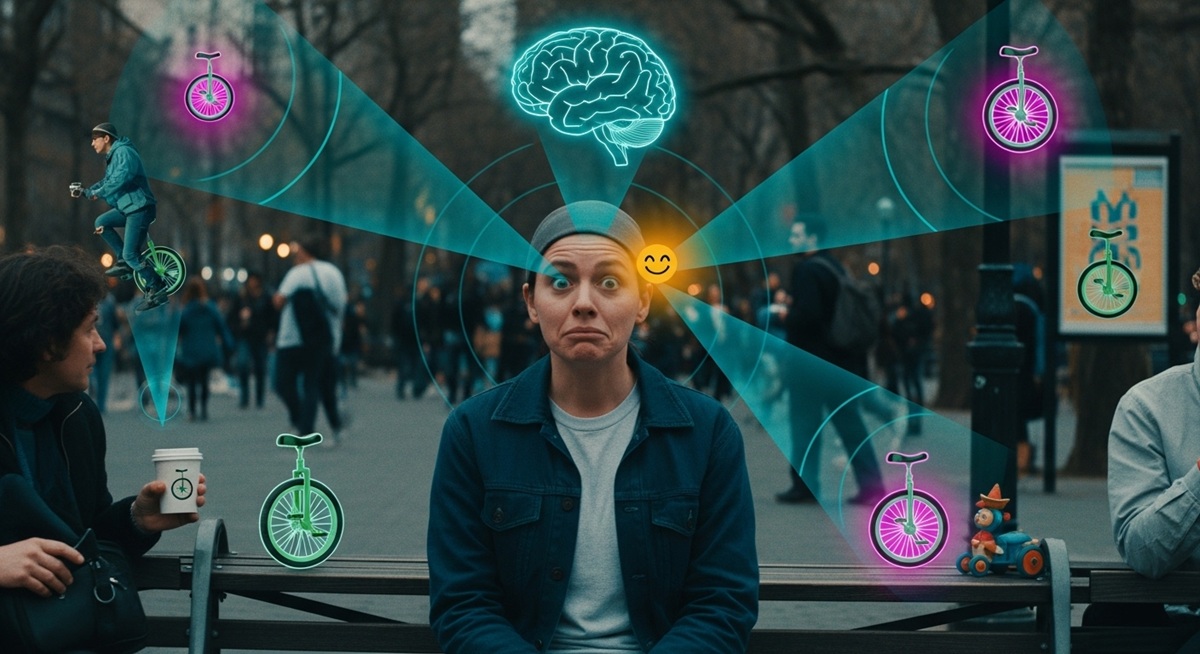
You learn a new word, a new car model, or a new psychological concept. Suddenly, it seems to be everywhere. You hear the word on the radio, see the car on the road, and read the concept in an article. You feel a strange sense of déjà vu, a kind of spooky feeling that the universe is sending you a very good sign. You tell yourself, “It’s a new trend!” but often, it’s a powerful psychological quirk at play | Frequency Illusion, also known as the Baader-Meinhof Phenomenon. Your magnificent, weird brain just learned something new and is now actively seeking it out, making it seem far more common than it actually is. “I learn very new word! My brain says ‘very nice, now I see it all the time!’ Very nice, but it was there all the time, I just did not see it!”
Welcome, fellow traveler, to the delightfully unhinged, universally experienced realm of the ‘I See It Everywhere Now!’ Brain, a potent manifestation of Frequency Illusion. It’s the glorious absurdity of your mind getting a strange feeling of déjà vu after learning something new, suddenly perceiving it everywhere. This pervasive psychological and perceptual quirk highlights a fascinating battle between your brain’s selective attention and its need for confirmation, linking it to your brain’s incredible knack for finding patterns, even when they’re not there. Is it just a coincidence? A peculiar form of delusion? Or is your beautiful brain simply doing its very nice, very efficient (though profoundly challenging) job of reinforcing new information, getting caught in a cognitive loop that’s hard to break? At Psyness.com, we take a “very nice!” look at this pervasive mental quirk, proving that understanding this mysterious phenomenon doesn’t have to be boring – it can be a riot.
Your Brain’s New Info Radar | The Pattern Confirmer
Why does your mind sometimes get so easily convinced that a new piece of information is suddenly, inexplicably, everywhere? It’s a fascinating testament to your magnificent brain’s ancient wiring for survival, its incredible ability to find patterns, and its complex system for processing new information.
The Architect | The Selective Observer
Your brain, bless its tirelessly organizing heart, is a highly efficient filter. Every second, it is bombarded with a staggering amount of sensory information, and it can’t possibly process it all. To avoid being overwhelmed, your brain has developed a system of selective attention, which allows it to filter out most of the information and focus only on what is relevant to you. When you learn something new, your brain’s definition of “relevant” changes, and it starts to actively look for that new information in your environment.
- Selective Attention: This is a core mechanism. Before you learned about a new thing, your brain’s filter considered it irrelevant and simply ignored it. After you learn about it, your brain’s filter flags it as important, and it begins to stand out from the background noise. This creates a powerful illusion that the new thing is suddenly more common, when in reality, your perception of it has just changed. “My brain sees many car! Very nice, but after I learn about very specific car, I see that one very much! Very nice, but all the others were still there!”
- Confirmation Bias: Your brain has a powerful tendency to seek out and interpret information that confirms its existing beliefs or new knowledge. Once you’ve learned about something, your brain is more likely to notice it and interpret its presence as a confirmation that it’s, in fact, a very common thing. This creates a positive feedback loop that reinforces the illusion.
- The “Reticular Activation System” (RAS): Your brain has a part called the RAS, which acts as a kind of gatekeeper for information, filtering out what’s not important. When you learn something new, you’re essentially telling your RAS to pay attention to it, and it begins to flag that information as important, making it seem more common. This is where your deep teal/cyan info-radar comes into play.
- The “Aha!” Moment: The feeling of “aha!” when you notice the new thing is a very good feeling. This emotional reward, a small spike of fuchsia-pink dopamine, reinforces the behavior of seeking out new information, creating a self-perpetuating cycle.
- Recency Effect: The new information is fresh in your brain, and it’s easier to recall. This makes it more likely to pop into your mind when you encounter something similar, reinforcing the illusion.
- Pattern Recognition: Your brain is a magnificent pattern-finding machine. It’s constantly looking for connections and patterns in the world, and it’s so good at it that it will sometimes find them even when they’re not there. Frequency Illusion is a symptom of this powerful, but sometimes overzealous, ability.
The paradox? Your brain’s admirable drive for efficiency and its powerful ability to find patterns, while essential for survival, can lead to a funny, surprising, and sometimes unsettling illusion of frequency because it prioritizes confirmation and new knowledge over a more objective reality. Your brain’s “new info radar” is magnificent, but gloriously unhinged in its pattern confirmer.
Pop Culture’s “The Thing That Keeps Coming Back” & New Trends | Our Shared Pattern Seeking
From the classic comedic scene of a character noticing a new trend they’re a part of, to the dramatic narratives of a person’s life changing after learning a new piece of information, to the revival of a retro trend that suddenly seems to be everywhere, to songs that perfectly capture the feeling of something old becoming new again, pop culture constantly reflects and often capitalizes on our universal experience of Frequency Illusion. We see the humor, the surprise, and the profound impact it has on our perception of reality.
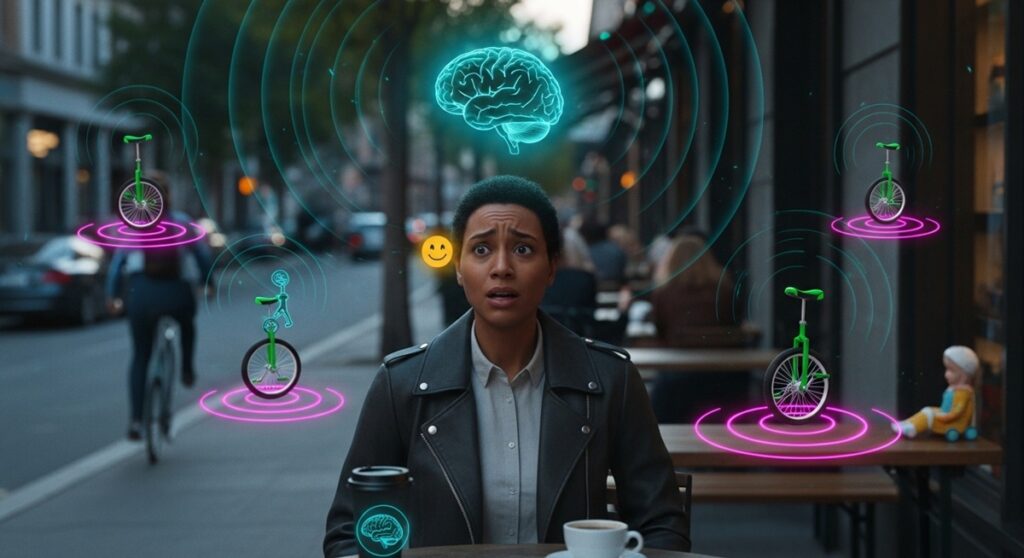
The glorious absurdity? We have a world of things to see with our own very good eyes, yet our brains sometimes insist that the newest thing we’ve learned is the most important thing, convinced that the world is now revolving around it. It’s a shared, delightful madness where our perception of reality is more about what’s new than what’s real. Your inner Borat might learn about very special car and declare, “Very nice, now I see this car everywhere! My brain says ‘this car is very popular now!’ Very nice, but I was not even looking before!”
How to Understand the Sensation (Very Nice! And Truly Liberating!)
Understanding that your brain’s ‘I See It Everywhere Now!’ tendency (Frequency Illusion) is a natural, powerful psychological quirk is the first step to liberation. It’s not about convincing yourself you’re not going crazy; it’s about learning to work with your magnificent, weird brain to understand its processes, reducing the feeling of spooky coincidence, and re-establishing your sense of calm.
Here’s how to nudge your brain towards a more rational, “very nice!” understanding:
- Acknowledge the Feeling, Then Rationalize: When you feel the sensation of a new thing being everywhere, acknowledge it without judgment. “My brain is experiencing Frequency Illusion! Very nice, it is now paying attention to this thing.” This is your cheerful mustard yellow signal for self-awareness.
- Separate the Perception from the Reality: Understand that your brain’s perception of a thing’s frequency is not the same as its actual frequency. This helps you understand that you’re not seeing it more often; you’re just noticing it more.
- Use It to Your Advantage: The next time you learn a new skill or a new piece of information, use Frequency Illusion to your advantage. Actively look for that new thing in your environment. This will help you learn it faster and more effectively.
- Engage Your Other Senses: Actively focus on what you see, hear, and feel that is not related to the new thing you’ve learned. This helps ground your brain in objective reality.
- Reframe the Feeling: Instead of thinking, “The universe is sending me a sign!”, try thinking, “My brain is doing a very good job of learning and paying attention!” This reframes the sensation from a spooky coincidence to an interesting cognitive quirk.
- Understand the Survival Instinct: Remind your brain that this is an old survival instinct, but that in a modern, safe environment, it’s often a fun, harmless quirk.
- Keep Learning New Things: The more you learn, the more your brain’s “new info radar” is active. Embrace this feeling as a sign of your magnificent brain’s curiosity and ability to learn.
- Talk it Out: Share your experience with a trusted friend or family member. They will likely have experienced it themselves, and the act of externalizing the feeling can help you understand it better.
The ‘I See It Everywhere Now!’ Brain is a truly special window into our complex psychology, a reminder that our minds, while magnificent, are also prone to delightful (and sometimes spooky) forms of perceptual quirks. Knowing this doesn’t make you crazy; it makes you self-aware, wonderfully weird, and very nice! Embrace your inner pattern seeker, understand your brain’s new info radar, and prove that you can master your sensations, living a life of greater calm, clarity, and control.