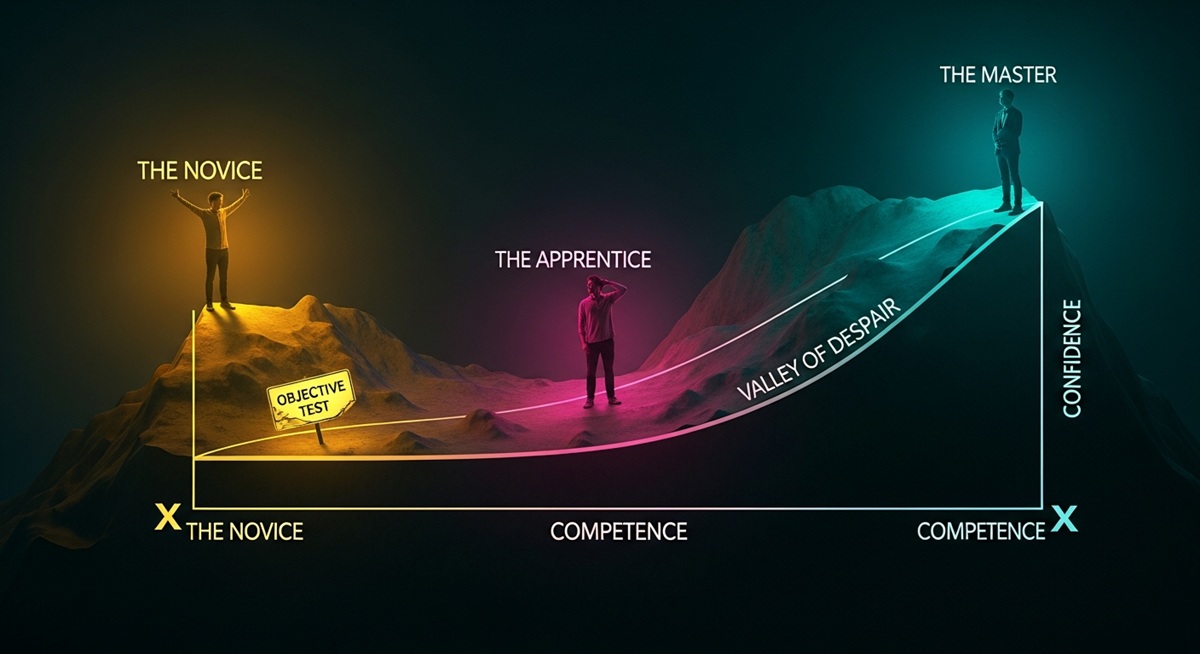
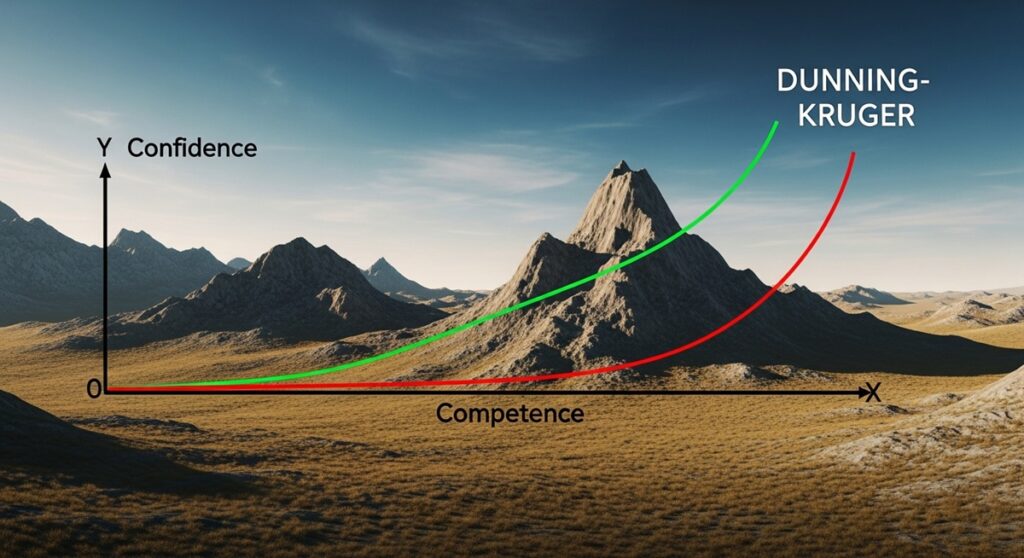
The Dunning-Kruger Effect is the tendency for people with the least skill in a subject to rate themselves the highest, while genuine experts tend to underrate their own ability. The ‘I’m an Expert!’ Brain shows up clearest at work, in the colleague who speaks with total certainty about a subject they’ve barely touched. The very nice fix is the Objective Test Protocol, which replaces confident opinion with an actual, checkable result.
Psychology explains this through: a failure of metacognition, the specific skill of judging your own skill accurately, which is usually the first thing missing in people who lack the underlying expertise too.
Confidence is silent. Incompetence is loud.
Madness Meter: 🌀🌀🌀 Meta-Ignorance (The blissful inability to know that you don’t know.)
The Dunning-Kruger Effect is named for the psychologists who first documented it in 1999, and it holds up in office after office since. Ignorance produces confidence more reliably than knowledge does, because knowledge is what shows you how much of a subject you haven’t covered yet.
This creates the ‘I’m an Expert!’ Brain | a colleague who sits comfortably at what’s colloquially called Mount Stupid, the first and loudest peak of the competence curve. The bias runs on the same three failures in every meeting room:
- Overestimating Yourself. A skim of one article or one good quarter gets rounded up to expertise, because nothing in the brain flags that the sample size was one.
- Underestimating Everyone Else. Real expertise looks unremarkable from the outside, since an expert makes hard things sound simple, so the confidently wrong assume the expert doesn’t know much more than they do.
- Missing the Size of the Gap. The bias doesn’t just inflate the score. It hides the whole shape of the subject, so the person genuinely cannot picture how much is missing.
None of this is arrogance in the usual sense. It’s a missing tool, not a bad attitude. The person lacks the specific mental equipment needed to judge their own output, so they default to the only opinion available, which is a high one.
S³ – Story • Stakes • Surprise
Story | The Man Who Robbed a Bank in Lemon Juice
The Classic Origin: The effect takes its name partly from McArthur Wheeler, a bank robber who covered his face in lemon juice before robbing two banks in broad daylight, believing that lemon juice, being usable as invisible ink, would make his face invisible to security cameras. He was arrested within hours. Told the cameras had caught him clearly, he reportedly said, “But I wore the juice.”
The Mechanism: Wheeler wasn’t unintelligent in general. He was simply missing every piece of chemistry and optics needed to know his plan was absurd, and missing knowledge doesn’t come with a warning label attached. The same gap shows up smaller and quieter in a meeting, when someone argues a position with total certainty in a field they learned about last week.
The Callback: Months later, the same colleague can be just as certain about the next unfamiliar subject, with no memory of having been wrong before. Being corrected once doesn’t install caution generally. It only teaches caution about that one specific mistake.
Stakes | The ‘I’m an Expert!’ Tax on Every Room
The unchecked power of the ‘I’m an Expert!’ Brain has a specific cost at work:
Confidence Gets Mistaken for Competence. The genuinely skilled tend to speak in qualifiers, because they can see the exceptions. The confidently wrong speak in absolutes, because they can’t. In a room that rewards certainty, the wrong voice often wins the argument.
Promotions Follow the Wrong Signal. An organization that promotes on perceived confidence rather than track record ends up installing the least self-aware people in the roles with the most authority.
Nobody Asks for Help. The person convinced they’re near the top of the skill curve sees no reason to check their own work, which is exactly the group most likely to need to.
The Room Adjusts Down. Once a confidently wrong voice goes unchallenged a few times, quieter, more accurate colleagues start pre-editing their own input to match the room’s tolerance for nuance, which is a second, quieter loss on top of the first.
Surprise | The Objective Test Protocol
The very nice path to accurate self-assessment is to stop asking how confident you feel, and start asking for a result that doesn’t care how you feel.
The Cure: Install a standing rule before any high-stakes call:
- Name the Test. Before trusting your own judgment, decide in advance what a real pass or fail would look like, not a vague sense of things going well.
- Seek the Hardest Version. Don’t check your work against an easy question. Check it against the person most likely to find the hole in it.
- Let the Failure Count. A failed check is the only thing that reliably installs the missing self-awareness. Treat it as data collected, not a verdict on your worth.
- Write It Down Before the Result. Record your prediction before you see the outcome. Comparing the two afterward is the one habit that quietly and permanently corrects overconfidence.
A² – Apply • Amplify
Humility here is knowledge gained, not arrogance lost.
The Psychology Bits
- Metacognition: The ability to accurately monitor your own thinking, and the specific skill missing at the center of this bias.
- Illusory Superiority: The broader tendency to rate your own abilities as better than average, which this effect sharpens into something measurable.
- Impostor Syndrome: The mirror image at the other end of the skill curve, where genuine experts underrate what they know because it feels too easy to count.
- The Double Burden: The unskilled suffer twice over, once from the original error, and again from lacking the skill to notice it happened.
Applying the Confidence Check
- The Reverse-Confidence Rule. When you feel total certainty on a complex, high-stakes call, treat that certainty itself as a signal to slow down, not speed up.
- The Blind Review. Get anonymous feedback from someone you know is better than you at the specific thing you’re doing. Anonymity removes the social reason for them to go easy on you.
- The Teach-the-Expert Test. Explain your idea to someone actually qualified in the field, in enough detail that they’d catch a flaw. A nod without pushback is real signal. So is an explanation they can’t follow at all.
FAQ
Q | Is the ‘I’m an Expert!’ Brain the same as arrogance? A | Not quite. Arrogance usually knows it’s overstating things and does it anyway. This bias genuinely doesn’t know, which is what makes it so hard to argue someone out of.
Q | If I worry I might have this, do I have it? A | Probably not in the severe form. Worrying about your own competence takes a working metacognitive system, which is the exact thing the bias removes.
Q | Is this just about being unintelligent? A | No. It’s skill-specific. A brilliant surgeon can be catastrophically overconfident trying to fix their own car, because surgical skill doesn’t transfer to torque wrenches.
Q | What’s the “Valley of Despair”? A | The point where someone has learned just enough to see how much they don’t know yet. Confidence drops hard here, and that drop is accurate, not a setback.
Citations & Caveats
- Source 1: Kruger, J., & Dunning, D. (1999). Unskilled and unaware of it: How difficulties in recognizing one’s own incompetence lead to inflated self-assessments.
- Source 2: Dunning, D. (2011). The Dunning-Kruger Effect: On being ignorant of one’s own ignorance.
- Source 3: Ehrlinger, J., et al. (2008). Why the unskilled are unaware: Further explorations of (un)awareness of incompetence across domains.
Disclaimer: This article discusses the Dunning-Kruger Effect as it shows up in professional judgment. It isn’t performance-review guidance and isn’t a substitute for it. If a pattern of overconfidence is costing someone their job or their team’s trust, that’s a conversation for a manager or a coach, not a psychology explainer. Be confident. Verify the data first.
Part of a cluster on the Dunning-Kruger Effect. See the general shape of it in The ‘Loudest-Loser’ Brain and the beginner’s version of the same rush in The ‘Rookie-God’ Brain.
// Protocol · Next Transmission
The glitch is the signal. — Psyness Protocol