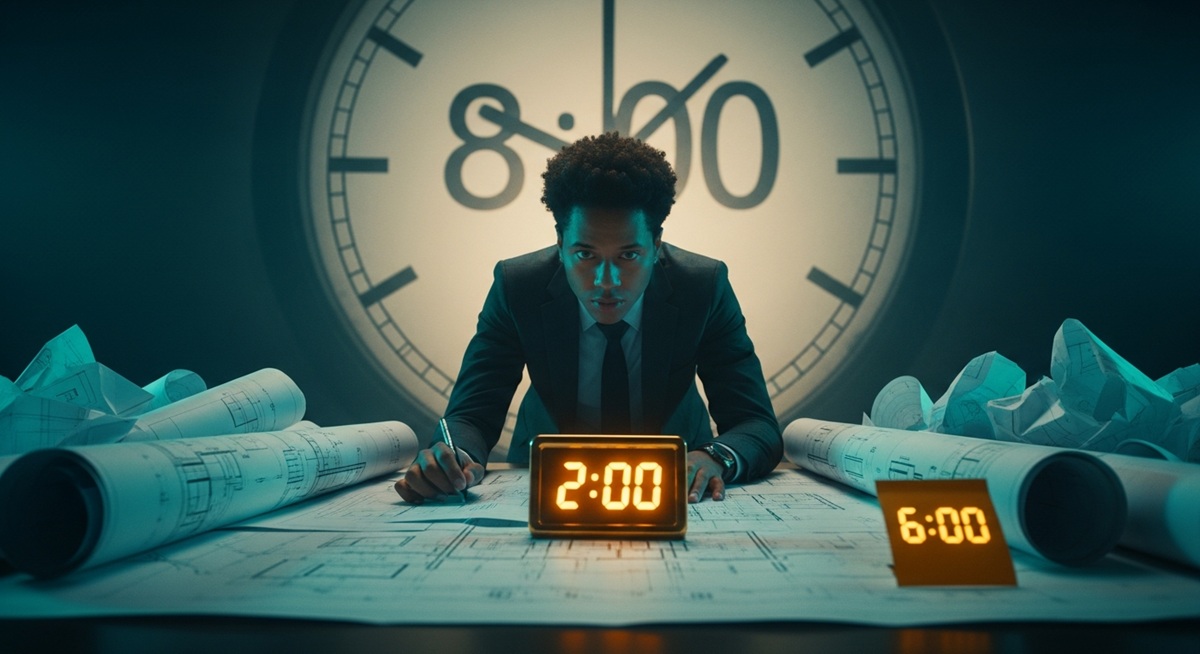
The Planning Fallacy is a predictable cognitive bias that causes people to systematically underestimate the time required to complete tasks, even when their own past record of similar tasks shows those estimates are usually wrong. The ‘Just Five Minutes More’ Brain focuses on the plan rather than the history. The very nice solution is Reference Class Forecasting, which overrides internal optimism with external, historical data.
Psychology explains this through: The internal, optimistic “inside view” that ignores historical failure and unforeseen obstacles.
Hope is a lousy planner.
Madness Meter: 🌀🌀🌀 Chronic Overcommitment (The repetitive belief that this time will be different.)
The Planning Fallacy, identified by Daniel Kahneman and Amos Tversky, describes the systematic, widespread error in planning where people are prone to underestimating the time needed to finish a future task. It’s a failure of prediction that stems from an overly optimistic internal view of the future process.
This creates the ‘Just Five Minutes More’ Brain, a mind that constructs a flawless, sequential narrative for the task at hand. This narrative systematically leaves out two crucial elements:
- Known Obstacles: It assumes the most direct path, ignoring all the previously encountered friction (emails, interruptions, bugs, scope creep).
- Historical Record: Crucially, it ignores one’s own past experiences. For example, a student might estimate writing a paper will take 5 hours, even though the last five papers they wrote each took 15 hours. The mind believes “this time will be different” because it sees the plan, not the history.
The root of the fallacy isn’t a desire to deceive others, but a deeply ingrained motivation to complete the task quickly and a desire to see a project as simple and manageable.
S³ – Story • Stakes • Surprise
Story | The Student’s Final Paper
The Classic Example: In a 1994 study, college students were asked to estimate how long it would take them to complete their final theses.
- Best-Case Estimate: Students predicted they would finish in 27.4 days.
- Realistic Estimate: When asked how long it would take if everything went wrong, the estimate rose to 48.6 days.
- Actual Completion Time: The average student actually took 55.5 days to complete the thesis.
The students were aware of their own tendency to delay and face issues, hence the realistic estimate, but their final commitment was still based on an internal, optimistic fantasy that reality went on to shatter.
The Mechanism: The brain engages in what Kahneman calls the “inside view.” When planning, we focus inward on the specific features of this unique task. We mentally simulate the execution, but the simulation is flawed, since it doesn’t effectively account for the chaos of real life (interruptions, illness, finding a required source). The antidote lies in the “outside view,” which forces us to look beyond the plan itself.
Stakes | What the Just Five Minutes More Brain Costs
The unchecked power of the ‘Just Five Minutes More’ Brain has severe consequences:
Massive Budget Overruns: The Planning Fallacy has caused multi-billion dollar infrastructure projects, like the Sydney Opera House or the Boston Big Dig, to massively overshoot budgets and timelines because the initial estimates were rooted in optimistic scenarios, not historical data.
Personal Overcommitment: It leads to poor work-life balance. We overcommit our time, personal projects, social events, because we underestimate the duration of our responsibilities, leading to chronic lateness and stress.
Loss of Credibility: In professional settings, repeatedly missing self-imposed deadlines, even for internal tasks, erodes credibility, since others stop trusting your ability to accurately estimate your own workload.
Surprise | The Power of Reference Class Forecasting
The path here is to stop thinking about your task and start thinking about other people’s tasks.
The Cure: Institute ‘Reference Class Forecasting’ (RCF), a concept championed by planning experts:
- Ignore the Details: Stop analyzing the task in front of you. Forget the steps, the required research, and your motivation.
- Identify the Reference Class: Find a group of projects that are historically similar to yours (e.g., “Medium-sized reports for this client,” “First-time code refactors for a three-person team”).
- Use the History: Determine the average time the similar projects in the reference class actually took to complete. Your prediction should be based on this historical rate, ignoring your internal optimism about the specific task at hand.
By using the statistical evidence of the past as your baseline, you neutralize the psychological illusion of “this time will be different,” making your estimates accurate and defensible.
A² – Apply • Amplify

Don’t trust the plan. Trust the track record.
The Psychology Bits
- Inside View: Focus on the unique details and best-case scenario of the task at hand, the source of the error.
- Outside View (Reference Class): Focus on the statistical results of similar past tasks, the source of the solution.
Applying Anti-Fallacy Architecture
Adopt these rules to create accurate estimates:
- The “Three-Case Estimate” Rule: For every commitment, provide three time estimates: the best-case (optimistic fantasy), the worst-case (everything goes wrong), and the reference-class case (the actual time you commit to).
- The ‘Add a Buffer’ Mandate: Since RCF often reveals the truth is longer than we hope, implement a systemic buffer, automatically add 20 to 30 percent to every internal estimate, to account for the unexpected friction the planning view naturally suppresses.
- The ‘Task Journal’ Protocol: Maintain a journal where you track both your initial estimate and the actual completion time for all major tasks. This builds a personal reference class, forcing you to confront your own historical bias.
FAQ
Q | Did the students intentionally lie with their estimates? A | No. The fallacy is a cognitive error, not a malicious one. They genuinely believed their estimates were accurate at the time they made them.
Q | Why does the fallacy ignore past failures? A | Because the brain treats each new task as unique and different from the failed past ones, focusing on the current plan’s steps rather than the historical frequency of unseen problems.
Q | What if I have no reference class? A | If the task is truly unprecedented, the bias is strongest. In that case, use the worst-case estimate as your committed timeline, since it tends to land closer to reality than the initial optimistic forecast.
Citations & Caveats
- Source 1: Kahneman, D., & Tversky, A. (1979). Intuitive prediction: Biases and corrective procedures. (Early work that led to the formalization of the fallacy).
- Source 2: Buehler, R., Griffin, D., & Ross, M. (1994). Exploring the “planning fallacy”: Why people under-estimate their completion times. (The seminal study with the student thesis example).
Disclaimer: This article discusses the psychological phenomena of the Planning Fallacy. It isn’t a substitute for professional project-management or clinical advice. Don’t plan for a dream. Plan for reality.
Part of a look at the Planning Fallacy on this site. For the broader, general-purpose look at why estimates go wrong day to day, see The ‘Why Am I So Bad at Estimating?’ Brain.
// Protocol · Next Transmission
The glitch is the signal. — Psyness Protocol