
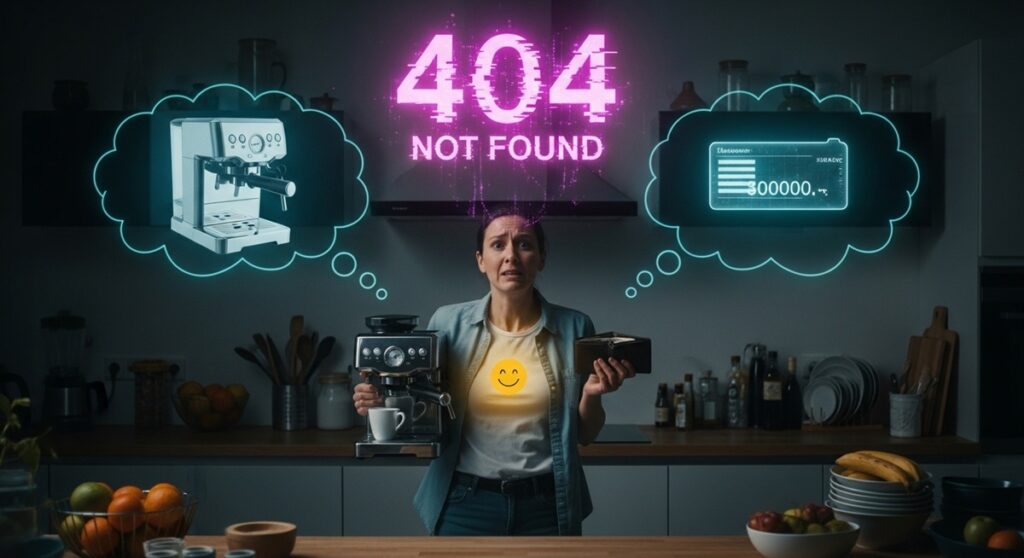
You just spent an entire paycheck on a ridiculously expensive, designer coffee machine. It’s glorious. You love it. Then you remember you promised yourself you’d be saving money, and you also remember it doesn’t even make a noticeable difference from your old machine. Your brain suddenly feels like two of its internal wires have just been crossed, sparking a miniature fire. That weird, uncomfortable feeling of holding two conflicting ideas at the same time is not a sign of madness—it’s cognitive dissonance, your magnificent brain’s very nice, beautifully unhinged glitch. “I love this coffee! My brain says ‘very nice, you are very broke now!’ Very nice, now I will convince myself that this coffee is the best coffee in the world, and I feel much better now!”
Welcome, fellow traveler, to the delightfully unhinged, universally experienced realm of the ‘Loading… 404 Error’ Brain, a potent manifestation of cognitive dissonance. It’s the glorious absurdity of your mind trying to find a page of logic that simply doesn’t exist. This pervasive psychological and emotional quirk highlights a fascinating battle between your brain’s need for consistency and its primal urge for self-justification, linking it to everything from bad decisions to long-held beliefs. Is it just hypocrisy? A peculiar form of delusion? Or is your beautiful brain simply doing its very nice, very efficient (though profoundly challenging) job of protecting your ego from hard truths? At Psyness.com, we take a “very nice!” look at this pervasive mental quirk, proving that understanding this psychological phenomenon doesn’t have to be boring – it can be a riot. The feeling of cognitive dissonance is like your brain trying to load a website with two different URLs at the same time and giving you a “404 Not Found” error in your consciousness, which you then try to justify as “perfectly normal.”
Your Brain’s Logic Loop | The Conflicting Code
Why does your mind sometimes trick you into believing a falsehood to escape a hard truth, even when you know it’s not real? It’s a fascinating testament to your magnificent brain’s ancient wiring for survival, its powerful need to maintain a coherent sense of self, and its complex system for justifying your own behavior.
The Architect | The Consistency Engine
Your brain, bless its tirelessly observant heart, is primarily wired to make sense of your life and give you a coherent, logical sense of self. Cognitive dissonance is a modern-day manifestation of this ancient survival instinct. The constant demands of modern life and the pressures of technology have supercharged this process, giving your brain an endless stream of triggers that threaten to expose its contradictions.
- The “I’m Right” Heuristic (The Brain’s Ego): This is a core mechanism. Your brain has a natural tendency to believe that your actions, beliefs, and values are correct and consistent. When a contradiction arises (e.g., “I am a good person” vs. “I just did a bad thing”), your brain feels a massive discomfort. To resolve this, it changes one of the two conflicting beliefs to protect your sense of self, often at a truly absurd length. This is where your fuchsia-pink of a self-serving narrative comes into play. The emotion of the moment (e.g., guilt, shame) enhances the memory, making it more vivid and easier to recall later on.
- Effort Justification: Your brain’s reward system is the perfect target for this phenomenon. When you work hard for something, your brain releases dopamine, a feel-good neurotransmitter. This creates a powerful, positive loop that encourages you to seek out more of these moments, building a healthy addiction. This is a very nice, healthy addiction.
- Post-Decision Rationalization: Your brain has a primal, ancient need for stability and social connection. When you feel lonely or isolated, your brain often triggers nostalgic memories of being with others, which can give you a sense of warmth and belonging. This is where your deep teal/cyan logical processing and feelings of comfort work in tandem.
- Overwhelm and Uncertainty: In a world of infinite options and constant change, your brain can feel overwhelmed. Nostalgia is a symptom of this overwhelm, as your brain seeks refuge in a time that feels simpler and more certain. This is where your cheerful mustard yellow of a comforting emotional blanket comes into play.
The paradox? Your brain’s admirable drive for comfort and its efficiency in giving you a coherent sense of self, while essential for survival, can lead to a draining, anxiety-filled cycle of longing because it prioritizes a curated past over objective reality. Your brain’s “memory mixer” is magnificent, but gloriously unhinged in its ability to create a false sense of perfection.
Pop Culture’s “The Hilarious Hypocrisy” & “The Self-Justifying Villain” | Our Shared Anxiety
From the classic sitcom character who justifies a lazy day by claiming they are “recharging for a big project,” to a movie villain who believes their destructive actions are for “the greater good,” pop culture constantly reflects and often capitalizes on our universal struggle with cognitive dissonance. We see the humor, the anxiety, and the profound impact it has on our sense of self. We’ve all seen a character’s “Loading… 404 Error” Brain as they try to justify their actions, often with hilarious and absurd results.
The glorious absurdity? We have a very good life in our very good home, yet our brains sometimes insist that the lives we see online are more important than our own, convinced that the party we weren’t invited to is the only party that matters. It’s a shared, delightful madness where our reality is often dictated by our digital perception. Your inner Borat might look at a friend’s vacation photos and declare, “Very nice, they are having very much fun! My brain says ‘you are doing nothing, very lazy!’ Very nice, now I feel very bad and want to book a vacation I can’t afford!”
How to Debug Your ‘404 Error’ Brain (Very Nice! And Truly Liberating!)
Understanding that your brain’s ‘Loading… 404 Error’ tendency is a natural, powerful psychological process is the first step to liberation. It’s not about becoming a hermit; it’s about learning to work with your magnificent, weird brain to challenge its narrative, fostering greater self-awareness, gratitude, and long-term well-being. Here’s how to nudge your brain towards a more intentional, “very nice!” understanding:
- Acknowledge the Feeling, Then Investigate: When you feel the discomfort of cognitive dissonance, acknowledge it without judgment. “My brain is feeling a 404 error! Very nice, what is it trying to protect me from?” Is it a fear of being wrong? A desire to maintain a certain image? This is your cheerful mustard yellow signal for self-awareness.
- Separate the Belief from the Behavior: Understand that a single contradictory action doesn’t define who you are. Remind yourself that you can be a person who values health (belief) and still eat a slice of cake (behavior).
- Practice Self-Compassion: Be kind to yourself. You are a complex human with complex thoughts and feelings. It is okay to make mistakes. This is a very nice, healthy habit.
- Challenge Your Justifications: When you catch yourself rationalizing a decision, take a moment to ask yourself, “Is this truly logical, or am I just trying to make myself feel better?” This is your deep teal/cyan logical processing working in your favor.
- Embrace the Contradiction: Understand that life is full of contradictions. You can be a loving parent who gets frustrated sometimes. You can be a dedicated employee who sometimes wants to be lazy. Embracing this complexity is a very nice way to find peace.
The ‘Loading… 404 Error’ Brain is a truly special window into our complex psychology, a reminder that our minds, while magnificent, are also prone to delightful (and draining) forms of chaos. Knowing this doesn’t make you a failure; it makes you self-aware, wonderfully weird, and very nice! Embrace your inner debugger, understand your brain’s need for consistency, and prove that you can find peace in the contradictions, living a life of greater presence, gratitude, and authenticity.