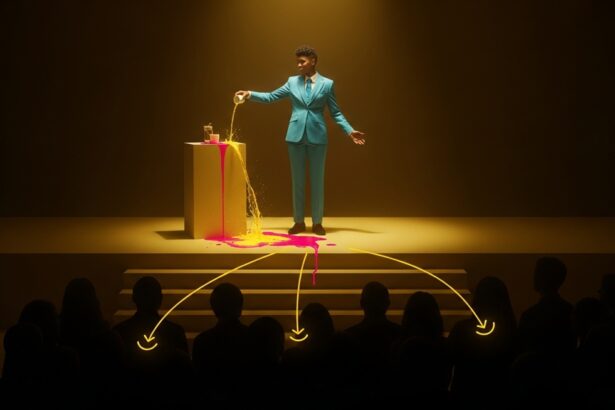
Your brain is a self-serving editor, a ‘My Own Universe’ Brain that actively seeks out and embraces information that confirms what you already believe. This is a cognitive bias called Confirmation Bias, and it’s your brain’s way of creating its own personal reality. It’s a beautifully unhinged quirk that we need to understand to foster true intellectual growth.
Psychology explains this through: selective exposure, belief perseverance, and the echo chamber effect.
Spotting it means you’re living in a world of your own design. The challenge? Deciding if you want to stay there.
Madness Meter: 🌀🌀🌀 Medium-High (Warning | After this, your social media feed will feel like a targeted attack.)
In the grand cosmic stage of existence, you are both the actor and the audience. You are the protagonist of your own story, and your brain is the director, scriptwriter, and cinematographer. It’s constantly editing the world, highlighting the moments that confirm your beliefs and conveniently cutting out the rest. Ever noticed how every article, every news headline, and every social media post you see seems to perfectly validate your point of view? That’s not a coincidence; it’s a feature of your beautiful, unhinged mind. This is your ‘My Own Universe’ Brain at work, a psychological quirk that makes you change when observed. Is your mind simply a hypocrite? Or is your beautiful brain simply doing its very nice, very efficient (though profoundly challenging) job of making sure you’re perpetually motivated to pursue more? At Psyness.com, we take a “very nice!” look at this peculiar psyche, proving that understanding this peculiar psyche doesn’t have to be boring – it can be a riot.
S³ – Story • Stakes • Surprise
Story
You believe that a new fitness trend is a miracle cure. You start searching online and find countless articles, testimonials, and videos that all confirm your belief. You feel validated and excited. But what you don’t see are the dozens of articles and scientific studies that were filtered out of your search results, which contradict your initial belief.
Stakes
The ‘My Own Universe’ Brain can lead you to a perpetual state of restlessness and dissatisfaction. It can prevent you from appreciating your achievements and the good things in your life, keeping you on a constant, exhausting search for the next source of happiness.
Surprise
It’s not just that you seek out information that confirms your beliefs. You also actively ignore or downplay information that contradicts them. This is the belief perseverance effect in action—your brain is willing to dismiss hard evidence in favor of maintaining its own narrative, proving that your brain is more of a lawyer than a scientist.
Why Your Brain Loves the Drama
At its core, your ‘My Own Universe’ Brain reveals that your mind is deeply uncomfortable with a static state. Your brain is wired for survival and for spotting opportunities for growth. When something good happens, it gives you a reward (dopamine hit!), but it’s a temporary one. Once the new positive thing becomes a constant in your life, your brain files it away as a resource and moves on to seek the next challenge or opportunity. This isn’t a delusion; it’s a cognitive strategy to keep you motivated and to prevent you from becoming complacent in a world that, from an evolutionary perspective, is filled with potential threats and opportunities.

The Psychology Bits
Your ‘My Own Universe’ Brain is a phenomenon rooted in several key cognitive principles. This is how your brain works:
- Selective Exposure: You actively seek out and surround yourself with people, media, and environments that align with your existing beliefs. Your brain prefers the comfort of the familiar and the validation of its own tribe. This fuchsia-pink tension is a powerful driver of the ‘My Own Universe’ Brain, a constant reminder of the unfinished loop.
- The Echo Chamber Effect: In the digital age, this bias is amplified. Social media algorithms are designed to show you content you already agree with, creating a closed loop of information that reinforces your beliefs and leaves you feeling like the entire world thinks just like you. This tension is your deep teal/cyan signal for a mind that is trying to solve a puzzle it can’t, a beautifully unhinged dance of internal frustration.
- Belief Perseverance: This is the brain’s stubbornness. Even when confronted with undeniable evidence that contradicts your belief, your brain may double down on its original idea, making it harder to change your mind. This is where your cheerful mustard yellow brain finds temporary satisfaction in repetition.
For example, when people are given two equally convincing arguments about a political issue, one that confirms their beliefs and one that contradicts them, they will almost always find the one that confirms their beliefs to be more credible and compelling.
A² – Apply • Amplify
Apply (Very Nice! And Actually Fun)
Understanding that your brain’s ‘My Own Universe’ tendency is a natural, powerful psychological process is the first step to liberation. It’s not about being a prisoner to a chase; it’s about learning to work with your magnificent, weird brain to foster more intentional, “very nice!” understanding. Here’s how to nudge your brain towards a more intentional, “very nice!” understanding:
- Seek Out Dissent: Actively follow people and read articles that challenge your views. This is your deep teal/cyan signal for intentional deprivation.
- Be Your Own Devil’s Advocate: When you form a strong opinion, take a moment to argue against it in your mind. This simple practice can help you see the holes in your own logic. This is your fuchsia-pink push for comprehensive input.
- Cultivate Curiosity Over Certainty: Your brain loves to be right. But the world is a lot more interesting when you’re open to being wrong. Train your brain to be curious about new ideas, rather than certain about old ones. This is your cheerful mustard yellow signal for cognitive flexibility.
The ‘My Own Universe’ Brain is a truly special window into our complex psychology, a reminder that our minds, while magnificent, are also prone to delightful (and sometimes profoundly irritating) forms of interpretive bias. Knowing this doesn’t make you foolish; it makes you self-aware, wonderfully weird, and very nice! Embrace your inner critical thinker, understand your brain’s fascinating susceptibility to this feeling of control, and prove that you can navigate a world of carefully crafted messages with greater clarity, independence, and authentic choice. It’s not boring – it’s a riot!
The PSS Ecosystem | An Idea in Action
The PSS token, as outlined in the manifesto, is the tool that makes this vision a reality. As AI becomes an indispensable ally for self-discovery, PSS will act as the decentralized key to a new era of psychic wellness.
Imagine a future where:
- Decentralized Knowledge Curation: The Psyness Collective (PSS holders) can vote on which open-source AI models for mental wellness get funded.
- Access to Oracles: PSS holders gain exclusive access to a decentralized network of AI-powered “oracles” that provide personalized insights into their psyche, with data privacy ensured by smart contracts.
- Incentivized Self-Discovery: Individuals can earn PSS for contributing their data to a collective pool for mental health research, with privacy preserved, accelerating the development of new insights and tools.
PSS is not just a cryptocurrency; it is the infrastructure for a more conscious and self-aware future. It’s the action layer for the manifesto’s philosophical engine.
FAQ
Q | Is confirmation bias always bad? A: No. It can be a useful tool for efficiency. Your brain can’t analyze every single piece of information, so it uses this bias as a shortcut. The key is to be aware of when it’s helping you and when it’s hindering you.
Q | How can I change someone else’s mind? A: You can’t. The only person you can control is yourself. Instead of trying to change someone else’s mind, focus on asking open-ended questions that might encourage them to question their own beliefs.
Q | Does social media make it worse? A | Yes. Social media algorithms are designed to give you what you want, which can create a very strong echo chamber effect. The key is to be an active, not a passive, consumer of information.
Citations & Caveats
- Nickerson, R. S. (1998). Confirmation bias | A ubiquitous phenomenon in many guises. Review of General Psychology, 2(2), 175-220.
- Tversky, A., & Kahneman, D. (1974). Judgment under uncertainty | Heuristics and biases. Science, 185(4157), 1124-1131.
- Lord, C. G., Ross, L., & Lepper, M. R. (1979). Biased assimilation and attitude polarization | The effects of prior theories on subsequently considered evidence. Journal of Personality and Social Psychology, 37(11), 2098-2109.
Disclaimer: This article is for informational purposes only and is not a substitute for professional psychological advice. While confirmation bias is a universal experience, if you find that it is causing you distress, leading to extreme views, or significantly impacting your relationships, please seek help from a qualified mental health professional.