
There is a $4.5 trillion industry built on a single premise: that you are broken, and that the right system, supplement, or subscription can fix you. Productivity apps. Sleep trackers. Dopamine detoxes. Cognitive reframing courses. Journaling frameworks with twelve distinct columns. Biohacking protocols that turn breakfast into a pharmaceutical event.
And you — intelligent, curious, self-aware — have probably tried some of them. Maybe many of them. You downloaded the app. You followed the protocol for eleven days. You felt something shift. And then, quietly, stubbornly, magnificently, your brain drifted back to exactly what it was before.
You probably blamed yourself. Lack of discipline. Insufficient willpower. The wrong system. You needed a better framework, a stricter habit loop, a more aggressive morning routine.
Here is what nobody in that $4.5 trillion industry will tell you: your brain didn’t fail the system. The system failed to understand your brain.
Resistance to optimisation is not a bug. It is the oldest survival mechanism you have.
The Machine That Wants to Optimise You
The optimisation industry operates on a mechanistic model of the human mind. Input, process, output. If the output is suboptimal, adjust the inputs. This is an engineering framework applied to a biological system that pre-dates engineering by several hundred million years. The arrogance of this is almost beautiful.
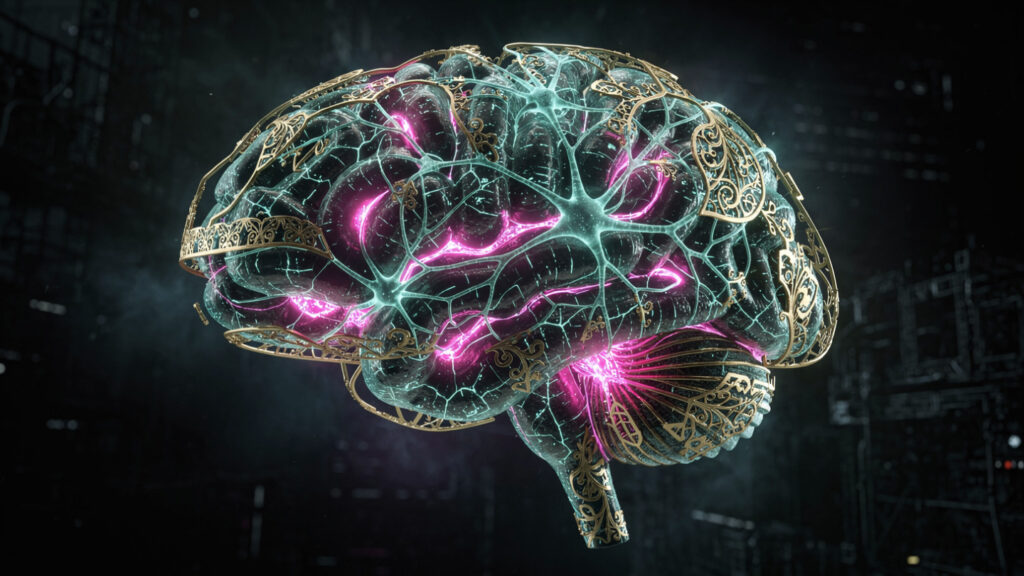
Your brain is not a pipeline. It is an ecosystem — chaotic, redundant, wildly inefficient, and staggeringly adaptive. It contains approximately 86 billion neurons forming 100 trillion synaptic connections, and it consumes 20% of your body’s entire energy supply while constituting 2% of your body weight. Evolution does not invest at that ratio in something it intends to be tidy.
The mess is the point. The wandering attention, the intrusive thoughts, the mood that arrives without permission, the 3am loop that won’t resolve — these are not malfunctions. They are features of a system designed not for productivity, but for survival in a world of radical uncertainty.
The Default Mode Network (DMN) — the neural system that activates when you are doing “nothing” — was considered junk processing for decades. Wasted energy. Cognitive noise. Researchers now understand it as the substrate of self-reflection, empathy, future simulation, and creative synthesis. The brain’s most human functions run on what looked like idle static. The optimisers wanted to silence it. It turned out to be the most important network you have.
SIGNAL INTERRUPT
What Resistance Actually Is
When your brain refuses to be fixed, it is doing something precise: it is pattern-matching against previous attempts to override it.
Every time you forced yourself into a rigid system that didn’t suit your actual cognitive architecture, your nervous system logged the outcome. The cortisol. The shame of failure. The exhaustion of performing someone else’s idea of a functional human. Your resistance isn’t laziness. It is accumulated data. Your brain has run the experiment before, and it knows how it ends.
There is a name for this in psychology — reactance. When a system perceives its autonomy is being threatened, it moves in the opposite direction. Not out of irrationality, but out of a deep and accurate read that the threat to self-determination is real. Your brain is not being difficult. It is being protective.
Every failed self-improvement attempt is your brain filing an accurate report: this protocol is not compatible with this organism.
The Glitch That Makes You Human
Here is where it becomes strange and important.

The traits that optimisation culture most aggressively targets — mind-wandering, emotional volatility, irrational decision-making, susceptibility to awe and obsession, the tendency to hyperfocus on meaningless things at the expense of productive ones — are not evolutionary accidents awaiting correction. They are the precise mechanisms responsible for every significant human creation.
Mind-wandering generates the associative leaps that produce innovation. Emotional volatility creates the empathic range that allows deep art, deep love, deep ethical feeling. Irrational decision-making enables risk-taking that pure expected-value calculation would always veto. The tendency to be seized by something beautiful and useless — a piece of music, a geometrical pattern, a stranger’s expression — is what distinguishes human consciousness from optimised information processing.

You cannot have these things and also have a perfectly calibrated cognitive machine. They are mutually exclusive. To fix the glitch is to lose the thing that makes the mind worth having.
The Flynn Effect paradox: Average IQ scores have risen continuously for a century — we are measurably better at certain kinds of logical processing. And yet rates of depression, anxiety, loneliness, and existential meaninglessness have risen in parallel. The optimisation of cognition has coincided precisely with the hollowing out of the experiences that make cognition feel worthwhile. Correlation is not causation. But the question is worth sitting with.
SIGNAL INTERRUPT
What to Do With This
This is not an argument for chaos. It is not a permission slip to abandon all structure or to romanticise suffering. Some systems help. Some frameworks genuinely suit some people. The problem is not optimisation per se — it is the universalising ideology of optimisation, the assumption that the goal of a human life is to become maximally efficient, and that any deviation from that efficiency is a problem requiring a solution.
The shift is subtle but total. It moves from: what is wrong with me and how do I fix it — to: what is this state telling me, and what does it know that I don’t yet?
Your procrastination might be your nervous system flagging that this project is not aligned with what you actually value. Your inability to focus might be your attention correctly identifying that the thing you’re forcing yourself to do is not worth the cognitive investment. Your recurring 3am anxiety might be carrying the one unprocessed truth you’ve been too productive to face during the day.
The glitch is a dispatch. It contains information. The question is whether you’re willing to read it.
The Sovereignty Claim
We are living through a specific historical moment in which external systems — algorithmic, pharmaceutical, economic, cultural — have an unprecedented capacity to model, predict, and shape human behaviour. The optimisation industry is not a neutral service. It is a vast apparatus for making human beings more legible, more predictable, more useful to systems that profit from legibility and predictability.
To resist optimisation is not merely a personal psychological choice. It is a political act. The mind that refuses to be fully profiled, fully predicted, fully smoothed into a clean behavioural model — is the mind that retains the capacity for genuine surprise, genuine dissent, genuine self-determination.https://www.psyness.com/psynesstoken-origins-identity/
Your weird brain — the one that loops, glitches, wanders, obsesses, resists — is the last territory that has not been fully colonised. The question is not how to fix it. The question is whether you understand what you have.
The unoptimised mind is not a problem. It is the last proof of something irreducibly yours.
The optimisation machine wants your compliance. Your glitch is your signature — the one thing the algorithm cannot replicate, cannot predict, cannot own. PSS is not an investment. It is a declaration: that the unoptimised self has value, that the weird and wandering mind is worth marking, and that some things should remain beyond the reach of the system. If that resonates — you already know what you are.
// Protocol · Next Transmission
The glitch is the signal. — Psyness Protocol