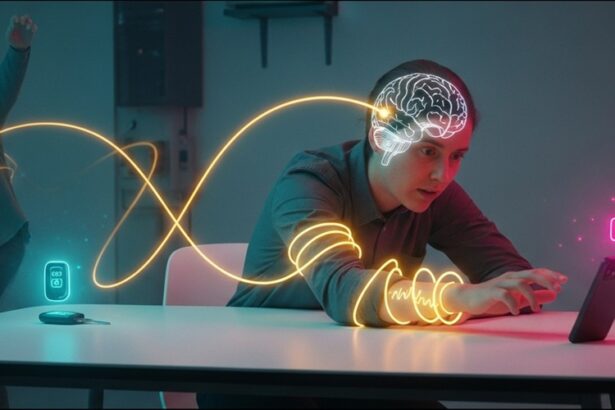
You’re in a meeting. Or walking through a quiet park. Or maybe just sitting on the couch, minding your own business. Suddenly, you feel it | that distinct vibration in your pocket. Or you hear it | a faint ringtone, just at the edge of hearing. You instinctively reach for your phone, pull it out, and… nothing. No notification. No call. Just the glorious, unhinged silence of your magnificent, weird brain playing tricks on you. Again.
Welcome, fellow traveler, to the delightfully unhinged, universally experienced realm of the Phantom Vibration Syndrome (or ‘Phantom Ringing’ / ‘Ringxiety’). It’s the glorious absurdity of your mind conjuring up digital alerts that don’t exist, making you feel constantly connected, even when you’re not. Is it a sign of phone addiction? A peculiar sensory glitch? Or is your beautiful brain simply doing its very nice, very overzealous job of trying to keep you connected? At Psyness.com, we take a “very nice!” look at this pervasive modern quirk, proving that understanding why your brain buzzes for no reason doesn’t have to be boring – it can be a riot.
Your Brain’s Digital Echo Chamber | Always On Alert
Why does your mind generate these illusory alerts, making you check your device dozens of times a day for non-existent notifications? It’s a fascinating testament to how deeply ingrained our digital devices have become in our lives, and how our magnificent brains adapt (sometimes a little too eagerly!) to new technologies.
The Architect | The Anticipation Engine
Your brain, bless its hyper-vigilant heart, is constantly trying to predict and interpret sensory input. When it comes to your phone, it’s operating on a highly conditioned, anticipatory loop:
- Expectation & Anticipation: You spend countless hours interacting with your phone. Your brain learns that a vibration or ringtone often precedes a reward (a message, a like, a piece of information, a social connection). This constant association primes your brain to expect these signals. When you’re expecting something, your brain is more likely to misinterpret ambiguous sensory input (like clothing rustling, muscle spasms, or even just a random itch) as the anticipated signal. “My phone, it brings very nice things! Must be ready! Very nice!”
- Sensory Gating & Filtering: Your brain is constantly filtering out irrelevant sensory information. However, when it’s primed for a specific input (like a phone vibration), its filtering becomes less precise. A subtle, non-phone-related sensation can then slip through the filter and be misattributed. It’s like your brain’s alert system has its sensitivity turned up too high.
- Dopamine & Reward System: Every notification, every message, every ‘like’ delivers a small hit of dopamine – your brain’s “feel-good” chemical. This intermittent reinforcement (you don’t know when the next good notification will come) trains your brain to be constantly on the lookout, creating a powerful, almost addictive, loop.
- Habit & Conditioning: The act of checking your phone has become a deeply ingrained habit. The phantom buzz or ring is often just your brain prompting you to engage in this habitual behavior, even without a real trigger.
- Anxiety & FOMO (Fear of Missing Out): Underlying anxiety about missing important calls, messages, or social updates can heighten your brain’s vigilance, making it more prone to these false alarms.
The paradox? These phantom alerts are a direct result of your brain trying to keep you connected and informed, but they often lead to increased anxiety, distraction, and a feeling of being constantly “on call,” even when you’re not. Your brain’s “digital echo chamber” is a magnificent, overzealous assistant.
Pop Culture’s Constant Connection | Our Shared Digital Daze
From memes about checking your phone for phantom vibrations to characters in films compulsively glancing at their devices, pop culture is now acutely aware of this modern phenomenon. The constant presence of smartphones in our lives has made the phantom buzz a universally recognized (and often chuckled-at) experience.

The glorious absurdity? We carry these powerful computers in our pockets, and then our own brains start simulating their functions, even when they’re silent. We are both the users and the unwitting subjects of our own digital conditioning. It’s a shared, delightful madness where our technology literally gets inside our heads. Your inner Borat might feel a phantom buzz and declare, “My phone, it is very powerful! It make my leg vibrate even when it is not there! Very nice magic!”
Taming Your Inner Digital Ghost (Very Nice! And Liberating!)
Understanding that your brain’s ‘Phantom Buzz’ is a natural, powerful adaptation to our hyper-connected world is the first step to liberation. It’s not about ditching your phone entirely; it’s about learning to manage your magnificent, weird brain’s digital conditioning and reclaim your mental peace.
Here’s how to nudge your brain towards more intentional digital engagement:
- The “Pocket Test” (The Borat Check): Instead of immediately reaching for your phone, consciously pause. Ask yourself, “Did I really feel that, or was it a phantom?” Wait a beat. Often, the urge passes.
- Change Your Phone’s Location: If you always carry your phone in the same pocket, try switching it to another pocket, a bag, or a different surface. This disrupts the learned association and can reduce phantom sensations.
- Turn Off Vibrations/Sounds (Selectively): Experiment with turning off non-essential vibrations or notification sounds. This reduces the sensory input your brain is constantly anticipating.
- Schedule “Phone-Free” Zones: Designate specific times or places where your phone is put away and silent (e.g., during meals, before bed, during focused work). This gives your brain a break from constant vigilance.
- Practice Mindfulness & Sensory Awareness: Pay attention to your actual bodily sensations and external sounds. This helps your brain differentiate real stimuli from phantom ones and grounds you in the present moment.
- Identify Your Triggers: When do you most often experience the phantom buzz? Is it when you’re bored? Anxious? Waiting for something specific? Understanding the context can help you address the underlying need.
The ‘Phantom Buzz’ is a fascinating window into our complex psychology, a reminder that our brains, while magnificent, are also incredibly adaptable and prone to delightful digital quirks. Knowing this doesn’t make you addicted; it makes you self-aware, wonderfully weird, and very nice! Embrace your inner digital ghost, understand your brain’s modern adaptations, and prove that you can master even the most insistent phantom alerts.