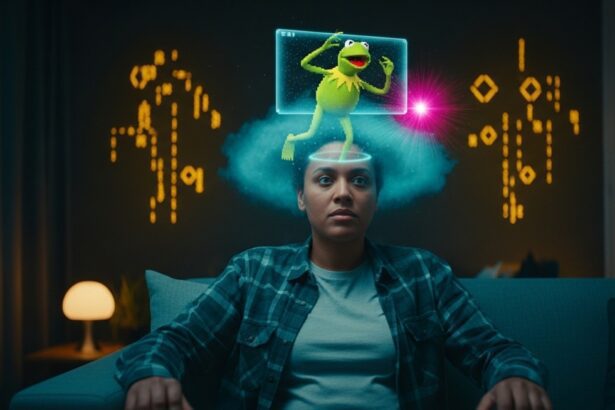
Ever choose the “90% fat-free” burger over the “10% fat” one, even though they’re identical? That’s your Spin Doctor Brain at work! It’s the Framing Effect, a cognitive bias where how information is presented (or “framed”) drastically sways your decisions, regardless of the objective facts. Your mind’s a marketing exec, swayed by the perfect slogan.
Psychology explains this through: loss aversion, our limited cognitive capacity, and the power of positive vs. negative language.
Your brain isn’t choosing facts; it’s choosing vibes.
Spotting it means seeing through the packaging to the product itself.
Madness Meter: 🌀🌀🌀 Medium-High (You may realize your political opinions are shaped more by headlines than policies!)
The ‘Spin Doctor’ Brain | Why How Things Are Said Changes What You Pick (Even When It Shouldn’t)
You’re at the grocery store, staring at two packages of ground beef. One is labeled “90% fat-free.” The other, sitting right beside it, says “10% fat.” Which one do you pick? If you’re like most people, your hand instinctively reaches for the “90% fat-free” option, even though your magnificent brain knows, deep down, that they are chemically and numerically identical. This subtle but powerful sway of presentation is known as the Framing Effect, your mind’s very nice, beautifully unhinged “spin doctor.” It’s the glorious absurdity of your brain reacting differently to a choice or piece of information depending solely on how it is presented or “framed”—for example, as a loss or as a gain, or with positive versus negative language. It’s not about the underlying facts changing; it’s the packaging of those facts influencing your decision, often subconsciously, making you choose based on the vibe, not just the data. Your brain, bless its impressionable heart, will see the same product through entirely different lenses depending on the slogan. Is your mind just easily manipulated? Or is your beautiful brain simply doing its very nice, very efficient (though profoundly challenging) job of seeking clarity and minimizing perceived risk in an overwhelming world? At Psyness.com, we take a “very nice!” look at this peculiar psyche, proving that understanding this peculiar psyche doesn’t have to be boring – it can be a riot.

Imagine a political debate. Candidate A describes a new economic policy as a “bold move to stimulate growth, creating 10,000 new jobs.” Candidate B describes the exact same policy as “a risky gamble that will divert funds, potentially costing 5,000 existing jobs.” The substance of the policy hasn’t changed, but the language used to frame it is designed to elicit vastly different emotional and rational responses from voters. This is the essence of your Spin Doctor Brain at play, subtly altering your perception and choice by emphasizing certain aspects over others. This phenomenon is a fundamental cognitive bias that influences everything from consumer choices to political opinions, highlighting how easily our decisions can be swayed by the presentation of information.
Your Brain’s Marketing Department | The Art of the Sell
At its core, the Framing Effect reveals that human rationality is often bounded. We don’t always process information purely objectively; instead, our interpretations are heavily influenced by the context and manner of presentation. Your brain, bless its tirelessly interpreting heart, is primarily wired to make quick judgments, and the frame provides a ready-made lens through which to view information.
The Concept
The Framing Effect is a cognitive bias where people make different decisions based on how information is presented, rather than on the objective facts. It leverages our innate tendencies, particularly our aversion to loss, to guide our choices. The content of the information remains the same, but the way it is “framed” changes its psychological impact.
The Psychology Bits
Loss Aversion: This is a primary driver. Your brain hates losses more than it loves equivalent gains. A potential loss feels more impactful than an equivalent gain. Therefore, information framed to prevent a loss is often more appealing than information framed to achieve a gain. It’s like your brain has a fuchsia-pink alarm bell for anything that smells like losing. Positive vs. Negative Framing: Your brain reacts differently to words. For instance, a medical treatment described as having a “90% success rate” sounds far better than one with a “10% failure rate,” even if both statements convey the same statistical outcome. Positive frames are generally more attractive than negative frames. This is a very nice, but often manipulated, internal preference. Attribute Framing: This occurs when a single attribute of an item is framed positively or negatively. For example, beef being “75% lean” versus “25% fat” causes different perceptions of its healthiness, even though it’s the same product. This is where your deep teal/cyan logical processing gets swayed by a single descriptor. Goal Framing: This involves framing the potential outcomes of a behavior in terms of gains or losses. Messages framed around preventing a loss (e.g., “If you don’t save, you’ll lose money”) are often more persuasive than those framed around gaining something (e.g., “If you save, you’ll gain money”). This is where your cheerful mustard yellow decision-making is steered by the promise of avoiding a pitfall.
For example, a medical procedure described as having a “1% mortality rate” will be perceived as riskier than one described as having a “99% survival rate,” leading to different levels of patient acceptance, despite the identical objective risk.
Pop Culture’s Master Manipulators | Our Shared Blind Spots
The Framing Effect is the bread and butter of political campaigns, advertising, and even everyday conversations, subtly shaping our collective reality without us even realizing it. It’s the unseen hand guiding our opinions and purchases.

Think of a political debate where the same policy is described in vastly different ways to appeal to different voters. A tax increase might be “an investment in our future” (gain frame) or “a drain on your hard-earned money” (loss frame). A new regulation could be “ensuring public safety” (gain) or “restricting personal freedom” (loss). Politicians and news outlets are master spin doctors, meticulously crafting frames to align with their desired narrative and sway public opinion without altering the core facts. Similarly, in advertising, a car might be promoted for its “safety features that protect you from harm” (loss avoidance) rather than “its advanced technology that helps you avoid accidents” (gain). Your inner Borat might see the same car advertised with “Very nice, it stops danger!” versus “Very nice, it makes you safe!” and declare, “Very nice, this is very important! My brain says ‘no, it is same car!’ Very nice, now I still want danger-stopping car, very confusing for my very good brain!” This pervasive bias highlights how easily our perceptions can be subtly manipulated, making us choose based on presentation rather than objective evaluation.
Why Your Brain Loves the Drama
While the Framing Effect can lead to suboptimal decisions, it persists because it offers your brain some cognitive shortcuts and plays into fundamental psychological drivers.
Short-term perks (or why it persists)
- Cognitive Ease: It simplifies complex information. A well-framed message is easier for your brain to process than raw data, reducing mental effort.
- Reduced Ambiguity: Framing helps reduce uncertainty, giving your brain a clear lens through which to view a choice, which can feel reassuring.
- Emotional Resonance: Frames often tap into powerful emotions like fear of loss or hope of gain, providing immediate, visceral guidance for decisions.
- Faster Decision-Making: When your brain feels a clear “push” from the frame, it can make a decision more quickly, which was often adaptive in evolutionary terms.
Long-term pitfalls
- Suboptimal Decisions: You might make choices that aren’t objectively in your best interest if you’re swayed by the frame rather than the facts.
- Vulnerability to Manipulation: You become easily influenced by marketing, political rhetoric, and biased media.
- Inconsistent Choices: Your preferences can shift even when the underlying reality remains the same, leading to unpredictable behavior.
- Reduced Critical Thinking: If you always accept information at face value based on its frame, you may lose the habit of questioning and seeking deeper understanding.
How to Outsmart Your Spin Doctor
Understanding that your brain’s ‘Spin Doctor’ tendency is a natural, powerful psychological process is the first step to liberation. It’s not about becoming a cynical skeptic; it’s about learning to work with your magnificent, weird brain to foster more objective decision-making and resist subtle manipulation. Here’s how to nudge your brain towards a more intentional, “very nice!” understanding:
Reframe the Frame (The Mental Flip): When presented with a choice, consciously try to reframe it in an alternative way. If something is presented as a “gain,” consider its equivalent “loss” (e.g., “90% fat-free” = “10% fat”). This is your cheerful mustard yellow signal for cognitive flexibility. Focus on the Data, Not the Language: Actively seek out the underlying objective facts, statistics, or core components of the information. Strip away the descriptive adjectives and emotional language. Consider the Source’s Agenda: Ask yourself | “Who is presenting this information, and what might their motive be?” Understanding potential biases in the sender helps you identify biases in the message. Slow Down Decision-Making: For important choices, resist the urge to decide quickly. Give your brain time to process the information from multiple angles, reducing the impact of the initial frame. Seek Multiple Perspectives: Don’t rely on a single source or a single frame. Seek out diverse viewpoints and different presentations of the same information to gain a more balanced understanding. This is your fuchsia-pink push for comprehensive input. Ask “What If?” (The Counterfactual): Actively consider what would happen if you chose the alternative or if the information were framed differently. This helps expose the arbitrary nature of the frame. Practice “Neutral Language”: Try to describe choices or situations to yourself (and others) using neutral language, devoid of strong positive or negative connotations. This trains your brain to focus on substance. This is your deep teal/cyan exercise in objectivity.
The ‘Spin Doctor’ Brain is a truly special window into our complex psychology, a reminder that our minds, while magnificent, are also prone to delightful (and sometimes profoundly misleading) forms of interpretive bias. Knowing this doesn’t make you easily fooled; it makes you self-aware, wonderfully weird, and very nice! Embrace your inner critical thinker, understand your brain’s fascinating susceptibility to framing, and prove that you can navigate a world of carefully crafted messages with greater clarity, independence, and authentic choice. It’s not boring – it’s a riot!
FAQ
Q | Is the Framing Effect a conscious manipulation? A: Not always. While marketers and politicians often use it deliberately, we all frame information for ourselves and others unconsciously every day. It’s a natural part of human communication, but recognizing it helps us make more objective decisions.
Q | Does it mean I’m irrational if I’m affected by framing? A: Not at all! Being influenced by the Framing Effect is a very common human cognitive bias. It’s a shortcut your brain takes to process information efficiently. Understanding it doesn’t mean you’re irrational; it means you’re human, and you now have the tools to be more rational.
Q | How does this differ from the Anchoring Effect? A: The Anchoring Effect is about the first piece of information (the “anchor”) influencing subsequent judgments. The Framing Effect is about how information is presented (e.g., as a gain vs. a loss) influencing the choice, even if no initial “anchor” number is explicitly given. They are related but distinct biases in how our brains process information.
Citations & Caveats
- Tversky, A., & Kahneman, D. (1981). The framing of decisions and the psychology of choice. Science, 211(4481), 453-458. (The foundational work).
- Kahneman, D. (2011). Thinking, fast and slow. Farrar, Straus and Giroux. (Extensively discusses cognitive biases including framing).
- Levin, I. P., Schneider, S. L., & Gaeth, G. J. (1998). All frames are not created equal | A review of the literature on framing effects. Organizational Behavior and Human Decision Processes, 76(2), 149-188.
Disclaimer: This article is for informational purposes only and is not a substitute for professional psychological advice. While the Framing Effect is a pervasive cognitive bias, individual susceptibility can vary. If you feel consistently overwhelmed by decision-making or manipulated by information, considering strategies for critical thinking or seeking advice from a financial or political literacy expert might be beneficial.