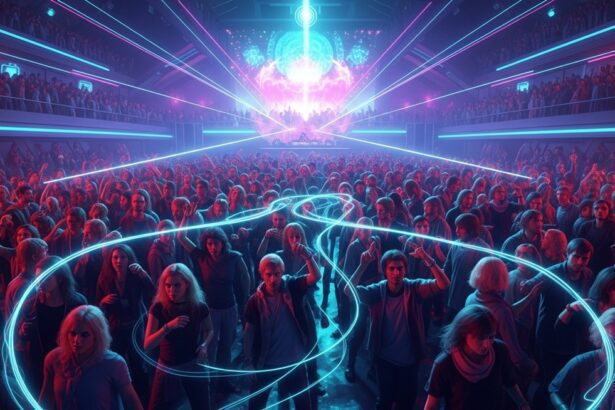
The Asch Effect describes the tendency of people to yield to group pressure in a judgment task, even when the group’s judgment is obviously incorrect. The conformity is driven by Normative Social Influence—the need to be liked and accepted by the group. The ‘They Must Be Right!’ Brain prioritizes Vibrant Gold social inclusion over Fuchsia-pink objective reality. The very nice solution is the Deep Teal/Cyan Single Ally Rule, which provides the crucial social support necessary to resist the pressure and achieve Cheerful Mustard Yellow independence.
Psychology explains this through: The conflict between the need for accurate information (which the group is undermining) and the fundamental human need for social connection.
Being right is lonely; being wrong is a crowd.
Madness Meter: 🌀🌀🌀 Social Cohesion Lock (The unconscious paralysis caused by the fear of standing out.)
The Asch Conformity Experiments, conducted by Solomon Asch in the 1950s, remain one of the most powerful demonstrations of social influence in psychology. Prior to Asch’s work, it was assumed that intelligent people would not yield to obvious falsehoods. Asch proved this assumption deeply flawed.
This creates the ‘They Must Be Right!’ Brain | a mind that is exquisitely sensitive to the social environment. The experiments exposed the power of two distinct, yet related, types of social influence:
- Normative Social Influence (Vibrant Gold): The desire to gain approval, avoid rejection, or fit in with the group. This is the primary driver of the Asch effect. People conform to avoid being the odd one out.
- Informational Social Influence (Fuchsia-pink): The desire to be correct. When the answer is ambiguous, people look to the group as a source of information, assuming the group knows better. (While less dominant in Asch’s experiment due to the obviousness of the answer, it still plays a role).
The core finding was that in a series of trials, about 75% of participants conformed at least once to the incorrect majority answer, even though the correct answer was visually unmistakable.
S³ – Story • Stakes • Surprise
Story | The Line Judgment Test
The Classic Experiment: A single participant entered a room with several other people who were, unbeknownst to the participant, confederates (actors working with the experimenter). The task was simple | look at a line and choose which of three other lines matched its length.
- The Setup: In the first few trials, everyone gave the correct answer. Then, in the critical trials, the confederates unanimously gave an answer that was obviously wrong (e.g., choosing the shortest line as the longest).
- The Result: The participant, knowing the answer was wrong, was faced with the dilemma | trust their Vibrant Gold own eyes or conform to the Fuchsia-pink unanimous group. The majority conformed at least once, with the primary reason being the fear of appearing foolish or being ostracized. The group had created a manufactured reality that the individual struggled to resist.
Stakes | Groupthink and Silence
The unchecked power of the ‘They Must Be Right!’ Brain has severe consequences:
Groupthink: In corporate or government settings, the fear of Fuchsia-pink social rejection prevents qualified experts from voicing valid dissent, especially when a powerful leader or a cohesive group has committed to a course of action. This is linked to historical disasters like the Bay of Pigs invasion.
The Bystander Effect: While complex, the Asch Effect helps explain the phenomenon where people hesitate to intervene in an emergency. If no one else is acting, the individual concludes that the situation is either Deep Teal/Cyan not an emergency (Informational Influence) or that they will appear ridiculous if they overreact (Normative Influence).
Innovation Stagnation: The strongest force against a revolutionary idea in any organization is the Vibrant Gold norm that the current way of doing things is correct. The individual with the new idea often self-censors, conforming to the status quo to maintain social acceptance.
Surprise | The Single Ally Rule
The very nice path is to recognize the true fragility of group pressure.
The Cure: Institute the Deep Teal/Cyan ‘Single Ally’ Rule protocol:
- The Fracture Point: Asch discovered that the power of conformity drops dramatically—by as much as 80%—if just one other person in the room breaks the unanimity. The dissenters’ answer doesn’t even have to be correct; it only has to be different from the majority.
- The Power of Non-Conformity: This single voice validates the dissenter’s Fuchsia-pink own reality and relieves the immense social pressure of being completely alone. It transforms the situation from a fight against the entire group to a battle between two factions.
- Be the Ally: If you are the leader or a strong voice in a room, consciously voice an alternate perspective (even if you later retract it) to prevent Cheerful Mustard Yellow Normative Social Influence from stifling legitimate dissent. By fracturing the consensus, you empower others to speak the truth.
A² – Apply • Amplify

Unanimity is the enemy of wisdom.
The Psychology Bits
- Deviance: The act of differing from the norm. The fear of being a “deviant” drives Normative Social Influence.
- Cohesion: The degree to which group members are attracted to each other. The more cohesive the group, the stronger the Normative Social Influence.
Applying Anti-Conformity Architecture
Adopt these Deep Teal/Cyan rules to resist undue group pressure:
- The “Pre-Commitment” Mandate: Before entering a high-stakes discussion, write down your Vibrant Gold independent judgment or decision and seal it in an envelope. This externalizes your original thought and makes it harder for your brain to abandon it under pressure.
- The ‘Anonymous Input’ Protocol: When managing a team, require a round of Fuchsia-pink anonymous feedback before the main discussion. Knowing that dissenting opinions exist (even if you don’t know who holds them) weakens the perception of unanimity.
- The ‘Disbelief Check’: If you find yourself agreeing with a group answer that your intuition screams is wrong, pause and mentally ask | “Am I worried about being wrong, or am I worried about being disliked?” If the answer is the latter, you are under the sway of Cheerful Mustard Yellow Normative Social Influence.
The PSS Ecosystem | An Idea in Action
The PSS DAO can use awareness of the Asch Effect to ensure the integrity of its community polling and voting processes.
The ‘Early Dissent’ PSS Polling Mechanism
- Mechanism: For all non-binding community polls, the PSS system automatically displays a Deep Teal/Cyan “Early Dissent” option at the start of the voting window, showing a small, pre-populated percentage (e.g., 5-10%) already voting “No,” regardless of the actual early tally.
- Justification: This structural illusion of Fuchsia-pink non-unanimity provides a social shield (the Single Ally Rule) for early voters. It makes it easier for the first few people who genuinely disagree to cast a vote against the majority, preventing the Asch Effect from suppressing legitimate early dissent and ensuring the final vote is a more accurate reflection of individual opinion rather than Vibrant Gold group pressure.
- Reward: PSS members who are the first three to cast a dissenting vote on a majority-approved proposal receive a small Cheerful Mustard Yellow “Independent Thinker” reward, incentivizing the critical, non-conforming behavior that protects the DAO from Groupthink.
FAQ

Q | Is this related to Groupthink A | Yes. The Asch Effect (Normative Influence) is one of the primary mechanisms that leads to Groupthink, which is the broader syndrome of decision-making failure in highly cohesive groups.
Q | Does culture affect conformity A | Yes. Studies show that conformity is generally higher in collectivist cultures (which prioritize group harmony and cohesion) than in individualistic cultures.
Q | What is the difference between Normative and Informational Influence A | Normative | I conform because I fear rejection (I know the answer is wrong, but I agree). Informational | I conform because I assume the group has better information than I do (I doubt my own judgment and rely on the group).
Citations & Caveats
- Source 1: Asch, S. E. (1951). Effects of group pressure upon the modification and distortion of judgments. (The seminal paper detailing the Line Judgment Experiment).
- Source 2: Deutsch, M., & Gerard, H. B. (1955). A study of normative and informational social influences upon individual judgment. (The paper that formally distinguished the two types of social influence).
Disclaimer: This article discusses the psychological phenomena of the Asch Effect and Normative Social Influence. The PSS DAO token model described is theoretical and intended for conceptual discussion on improving governance and critical thinking. Be liked, but be true.