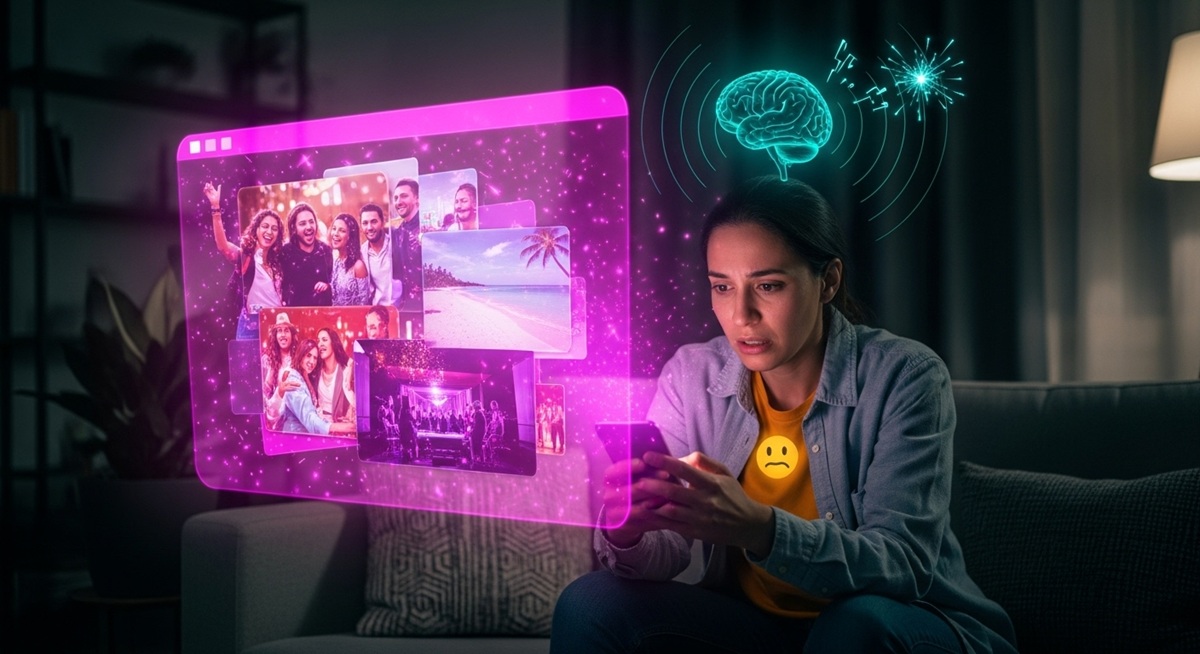
You’re sitting at home, trying to relax. Your phone buzzes. A quick glance at social media shows a friend at a fun party, a coworker on an amazing vacation, or a group chat that’s laughing about an inside joke. A sudden, powerful anxiety hits you. You feel a pang of dread, a sense that you are missing out on a rewarding experience that everyone else is having. You tell yourself, “I’m not doing enough,” or “My life isn’t as good as theirs,” but often, it’s a powerful psychological phenomenon at play | FOMO (Fear of Missing Out), where your magnificent, weird brain generates the powerful anxiety that you are missing out on a rewarding experience that others are having. “I look at phone! My brain says ‘very nice, everyone is having fun but you!’ Very nice, now I feel very bad and want to go to party I was not invited to!
Welcome, fellow traveler, to the delightfully unhinged, universally experienced realm of the ‘What If I Miss Something?’ Brain, a potent manifestation of FOMO. It’s the glorious absurdity of your mind generating the powerful anxiety that you are missing out on a rewarding experience that others are having. This pervasive psychological and emotional quirk highlights a fascinating battle between your brain’s social comparison and its primal need for belonging, linking it to the addictive nature of digital platforms and the constant feed of information. Is it just envy? A peculiar form of delusion? Or is your beautiful brain simply doing its very nice, very efficient (though profoundly challenging) job of protecting you from social exclusion, getting caught in a cognitive loop that’s hard to break? At Psyness.com, we take a “very nice!” look at this pervasive mental quirk, proving that understanding this modern madness doesn’t have to be boring – it can be a riot.
Your Brain’s Social Radar | The Exclusion Detector
Why does your mind sometimes trick you into believing you are missing out on something important, even when you are perfectly content? It’s a fascinating testament to your magnificent brain’s ancient wiring for survival, its powerful need for social connection, and its complex system for evaluating your own worth in relation to others.
The Architect | The Comparison Machine
Your brain, bless its tirelessly observant heart, is primarily wired to keep you safe and connected to your social group. For our ancestors, being excluded from the tribe was a matter of life and death, so your brain developed a powerful mechanism to constantly monitor your social standing. FOMO is a modern-day manifestation of this ancient survival instinct. Social media and digital platforms have supercharged this process, giving your brain an endless stream of curated, idealized “highlights” to compare yourself against.
- Social Comparison (The Upward Spiral): This is a core mechanism. Your brain has a natural tendency to compare itself to others, and social media provides a constant, endless stream of data for this comparison. When you’re scrolling, your brain is comparing your own “behind-the-scenes” reality to everyone else’s “highlight reel,” which is an unfair and impossible comparison to win. This leads to the false conclusion that everyone else is having more fun, is more successful, or is more connected than you, which fuels the anxiety of missing out.
- The “Negativity Bias” & “Scarcity Heuristic”: Your brain has a powerful negativity bias, which means it tends to focus more on negative or threatening information. When you see a post about a party you weren’t invited to, your brain focuses on the feeling of exclusion and scarcity, creating a sense of anxiety. The feeling that something is scarce or limited (e.g., an experience you can’t have) makes it seem more valuable.
- The Brain’s Reward System (Dopamine Loop): Digital platforms are designed to be addictive, and your brain’s reward system is the perfect target. When you get a notification or a like, your brain releases dopamine, a feel-good neurotransmitter. This creates a powerful addiction to constantly checking your phone, and the fear of missing out is the powerful hook that keeps you coming back for more. This is where your fuchsia-pink of digital addiction comes into play.
- Primal Need for Belonging: Your brain has a primal, ancient need to belong. When you see others connecting and having fun without you, your brain’s alarm bells go off, triggering the fear that you are being excluded from the tribe.
- Overwhelm and Uncertainty: In a world of infinite options, your brain can feel overwhelmed. FOMO is often a symptom of this overwhelm, as your brain struggles to make a choice, and the fear that you are making the wrong one fuels the anxiety of missing out. This is where your deep teal/cyan logical processing gets sidelined.
The paradox? Your brain’s admirable drive for social connection and its efficiency in keeping you safe, while essential for survival, can lead to a draining, anxiety-filled cycle of FOMO because it prioritizes a perceived social threat over objective reality. Your brain’s “social radar” is magnificent, but gloriously unhinged in its exclusion detector.
Pop Culture’s “The Party You Weren’t Invited To” & “Influencer Culture” | Our Shared Anxiety
From the classic TV show scene where a character lies about their whereabouts to avoid looking left out, to the dramatic narratives of a person’s life being consumed by their phone, to the modern phenomenon of “influencer culture” that creates a constant, unattainable ideal, to songs that perfectly capture the feeling of being on the outside looking in, pop culture constantly reflects and often capitalizes on our universal struggle with FOMO. We see the humor, the anxiety, and the profound impact it has on our sense of self.
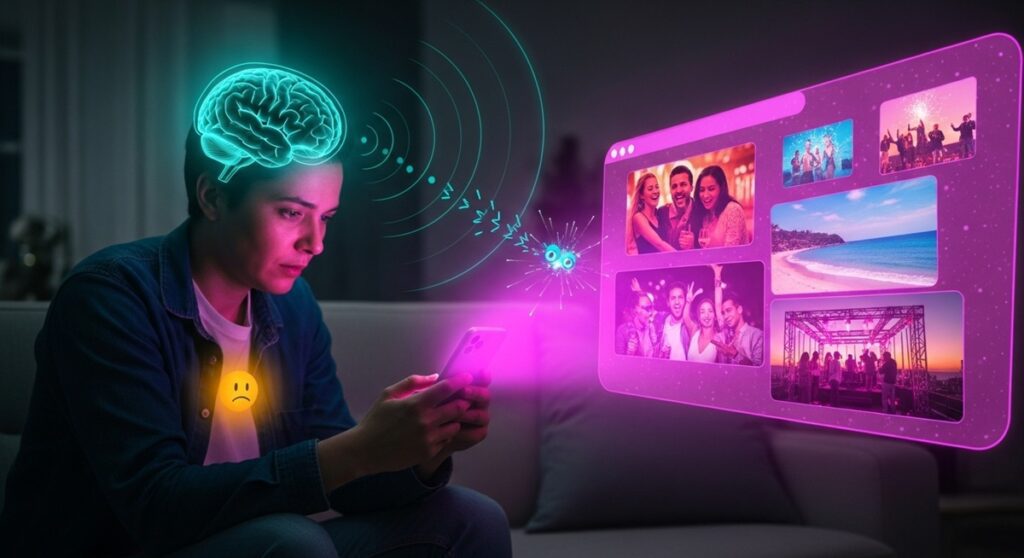
The glorious absurdity? We have a very good life in our very good home, yet our brains sometimes insist that the lives we see online are more important than our own, convinced that the party we weren’t invited to is the only party that matters. It’s a shared, delightful madness where our reality is often dictated by our digital perception. Your inner Borat might look at friend’s vacation photos and declare, “Very nice, they are having very much fun! My brain says ‘you are doing nothing, very lazy!’ Very nice, now I feel very bad and want to book vacation I can’t afford!”
How to Unplug Without the Anxiety (Very Nice! And Truly Liberating!)
Understanding that your brain’s ‘What If I Miss Something?’ tendency (FOMO) is a natural, powerful psychological process is the first step to liberation. It’s not about becoming a hermit; it’s about learning to work with your magnificent, weird brain to challenge its narrative, fostering greater self-awareness, gratitude, and long-term well-being.
Here’s how to nudge your brain towards a more intentional, “very nice!” understanding:
- Acknowledge the Feeling, Then Investigate: When you feel the anxiety of FOMO, acknowledge it without judgment. “My brain is feeling FOMO! Very nice, what is it trying to protect me from?” Is it a fear of exclusion? A desire for more connection? This is your cheerful mustard yellow signal for self-awareness.
- Separate the Digital from the Real: Understand that what you see online is a curated, often idealized, version of reality. Remind yourself that a person’s “highlight reel” is not their full story.
- Practice JOMO (Joy of Missing Out): Actively reframe the situation. Instead of thinking about what you’re missing out on, focus on what you’re gaining. “I am not at that party, but I am getting very good rest! Very nice!”
- Practice Gratitude for Your Present: Consciously focus on the good things in your life right now. This helps your brain balance its focus on others with an appreciation for your own reality.
- Curate Your Social Media Feed: Unfollow accounts that make you feel anxious or inadequate. Follow accounts that inspire you, make you laugh, or teach you something new.
- Set Digital Boundaries: Create specific times when you allow yourself to be on your phone. Put your phone away during meals, while spending time with loved ones, or before bed.
- Identify Your Internal Narratives: Pay attention to the specific phrases your brain uses (e.g., “I’m not doing enough,” “My life is boring”). Actively challenge these phrases with evidence to the contrary.
- Remind Yourself of Your Priorities: When you feel FOMO, remind yourself of your own goals, values, and what is truly important to you.
- Talk to Others: Share your experience with a trusted friend, family member, or therapist. You’ll likely discover that many people you admire feel the same way.
The ‘What If I Miss Something?’ Brain is a truly special window into our complex psychology, a reminder that our minds, while magnificent, are also prone to delightful (and draining) forms of social anxiety. Knowing this doesn’t make you a failure; it makes you self-aware, wonderfully weird, and very nice! Embrace your inner self-advocate, understand your brain’s social radar, and prove that you can unplug without the anxiety, living a life of greater presence, gratitude, and authenticity.