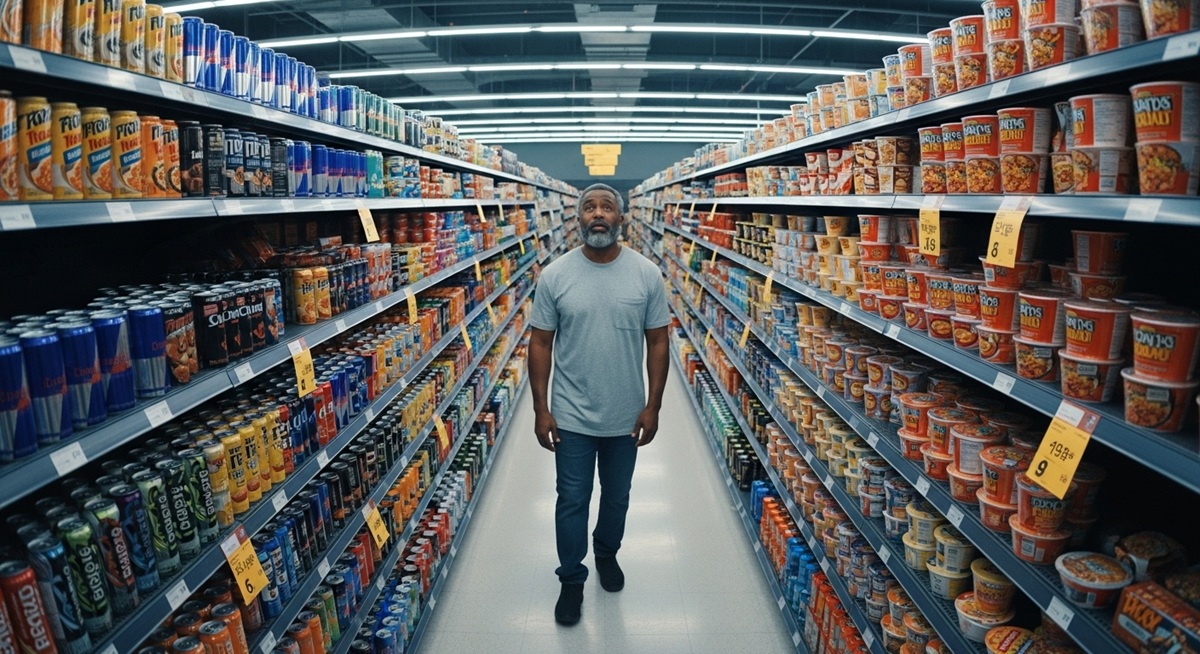
You are standing in the shampoo aisle, staring at forty-seven options, and you just wanted to wash your hair. Oily, dry, color-treated, volume-boosting, frizz-fighting, vegan, organic. Ten minutes later you either grab the nearest bottle in defeat or leave with nothing.
Psychology explains this through: choice overload, the tendency for a large number of options to make deciding harder and the final choice less satisfying.
In a famous supermarket experiment, shoppers who saw a table of 24 jams were far less likely to buy one than shoppers who saw only 6, roughly 3 percent versus 30 percent.
Madness Meter: 🧠🧠🧠 The Aisle Spiral (You scroll through hundreds of shows for an hour, then rewatch the one you already know by heart.)

It is closely related to the perfectionist urge to find the single best option, a trap examined in The ‘Perfect Trap’. A wall of options is what gives that urge room to run wild.
This creates the Aisle Spiral, the downward loop of comparing, doubting, and re-comparing that more options set off, a brain trying to optimize a decision that never needed to be optimal.
S³ – Story • Stakes • Surprise
Story | The Streaming Hour
The Setup: You sit down for a relaxing evening and open a streaming app with thousands of titles, sure that something perfect is waiting.
The Twist: Forty-five minutes later you have watched trailers, read summaries, and added eleven shows to a list, and you have not pressed play on anything.
The Reading: This is choice overload at work. Every extra title added a comparison, and every comparison made the chance of picking wrong feel bigger.
The Pattern: It tends to appear when options are numerous, hard to tell apart, and you are unsure what you actually want, which is exactly the setup of a modern store or app.
Stakes | What the Aisle Spiral Costs
Having more to pick from sounds like pure freedom, but choice overload carries quiet costs:
The Time Cost. Comparing endless options eats minutes and hours that the choice itself never deserved.
The Regret Cost. The more alternatives you passed up, the easier it is to wonder whether one of them would have been better.
The Standards Cost. A giant selection raises your expectations, so a perfectly good choice can feel disappointing next to the ideal you imagined.
The Free-Pass Cost. Calling the endless scroll a very nice luxury can hide how much of your evening it is quietly eating.
Surprise | The Best Choosers Settle on Purpose
Here is the twist about choice overload. In research on decision styles, people who always hunt for the very best option, called maximizers, reported lower happiness, lower life satisfaction, and more regret than people who pick something good enough and move on. Settling on purpose turned out to feel better than searching forever.
The Cure: Narrow the field before it narrows you:
- Decide Your Criteria First: Write down two or three things that actually matter before you start looking.
- Stop at Good Enough: The first option that meets your criteria wins. Close the tab and move on.
- Cap the Shortlist: Look at three to five options at most, then choose from those.
- Close the Loop: After you choose, do not shop for the alternatives again. Treat the choice as made.
A² – Apply • Amplify
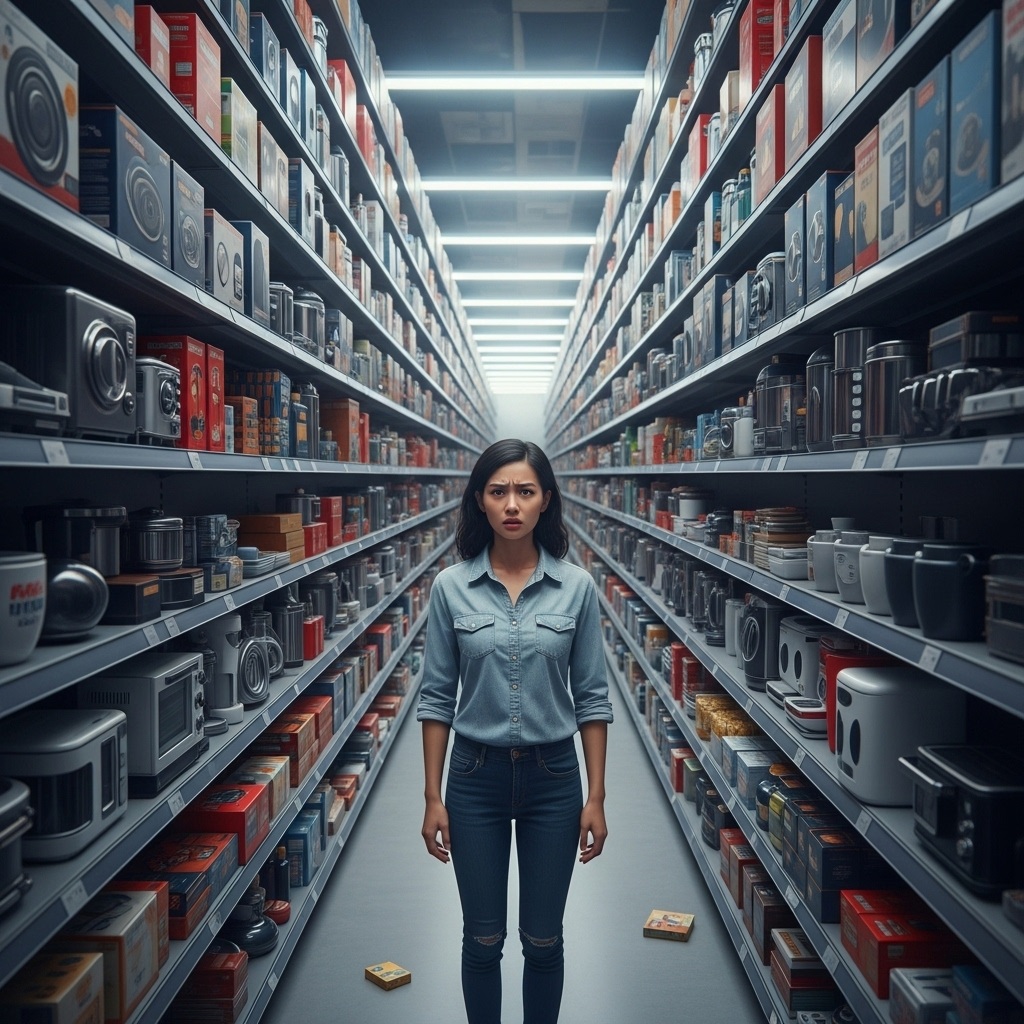
Choice overload is real, but it is not universal, and the research is clear that it depends on the situation. Knowing when it strikes is what makes it manageable.
The Psychology Bits
- Demotivation Is Documented: In the jam study, the large display attracted plenty of attention, but far fewer people ended up buying anything, which is the core evidence for choice overload.
- Style Matters: Across several samples, a strong urge to find the best option was linked to lower happiness and more regret, while a good-enough style went with higher well-being.
- It Depends on the Situation: A large review of studies found that choice overload shows up more when option sets are complex, the decision is hard, and the person is unsure what they want.
- It’s a Specific Case of a Bigger Pattern: When a decision feels too hard, many people fall back on whatever is already selected, the pull explored in The ‘Default’ Brain. That one is about sticking with a pre-set option. This one is about the overwhelm that sends you looking for one.
Applying the Aisle Spiral Habit
Turn choice overload into a system you can manage in minutes:
- Name the Spiral: When you notice yourself comparing the fifth near-identical option, say “Aisle Spiral” and stop.
- Set a Timer: Give small choices five minutes and bigger ones a day. When the timer ends, pick from what you have seen.
- Make Repeat Decisions Once: Choose a default for meals, outfits, and routine purchases so you do not decide them again every time.
- Save Your Maximizing for Big Stakes: Spend real research effort only on choices that are expensive or hard to undo.
FAQ
Q | Is choice overload the same as the paradox of choice? A | They are closely linked. The paradox of choice is the broader idea that more options can reduce happiness, and choice overload is the specific effect on deciding and satisfaction.
Q | Does choice overload always happen? A | No. Studies show the effect depends on how complex the options are, how hard the decision is, and how sure you are of what you want.
Q | What is a maximizer? A | A maximizer is someone who tries to find the best possible option every time. A satisficer looks for one that is good enough and then stops.
Q | How do I decide faster? A | Set criteria first, shortlist three to five options, and choose the first one that fits instead of comparing everything.
Q | Why do I regret choices even when they were fine? A | With many alternatives, it is easier to imagine a better one you skipped, which can sour a perfectly good pick.
Q | Is it a sign of a problem if I always struggle to decide? A | Usually not, but if indecision is constant, distressing, or interferes with daily life, it is worth discussing with a qualified professional.
Citations & Caveats
- Source 1: Iyengar, S. S., & Lepper, M. R. (2000). When Choice Is Demotivating | Can One Desire Too Much of a Good Thing? Journal of Personality and Social Psychology, 79(6), 995-1006.
- Source 2: Schwartz, B., Ward, A., Monterosso, J., Lyubomirsky, S., White, K., & Lehman, D. R. (2002). Maximizing Versus Satisficing | Happiness Is a Matter of Choice. Journal of Personality and Social Psychology, 83(5), 1178-1197.
- Source 3: Chernev, A., Bockenholt, U., & Goodman, J. (2015). Choice Overload | A Conceptual Review and Meta-Analysis. Journal of Consumer Psychology, 25(2), 333-358.
Disclaimer: This article is for informational purposes only and is not a substitute for professional financial or psychological advice. Choice overload is a normal feature of human decision making, and its strength varies by person and situation. If decision difficulty is causing significant distress, consider speaking with a qualified professional.
// Protocol · Next Transmission
The glitch is the signal. — Psyness Protocol